How to Calculate LTV CAC Ratio Ad Profit Efficiency
Learn how to calculate Shopify CAC, LTV, and LTV CAC ratio. Understand what is a good ratio and how to improve ecommerce profitability.
Scaling a Shopify store without advertising is possible. But if you want to grow beyond organic, you're spending on ads.
Every sale that comes from that spend has to add real value to your business. Not just revenue but actual profit that compounds over time.
But how often do you have clear visibility into the value you're actually getting from each customer you acquire?
That's the question the LTV CAC ratio answers. And it's what this article is about.
TL;DR
CAC is the total you spend to acquire a new customer
LTV is the revenue that customer generates over a set period
Dividing LTV by CAC tells you whether your ad spend is generating real value
A ratio above 3:1 is a healthy starting point for most ecommerce stores
Payback period and purchase frequency determine how fast you break even
Revenue-based LTV is a starting point, profit-based LTV is the honest version
How to Calculate CAC for Your Shopify Store
Customer Acquisition Cost (CAC) is the total amount you spend on advertising divided by the number of new customers acquired in the same period.
Formula: CAC = Total Marketing Spend / New Customers Acquired
If you spent $1,000 on ads and acquired 100 new customers, your CAC is $10. You paid $10 to win each new customer.
CAC tells you the cost side of the equation. On its own, it doesn't tell you whether that cost was worth it.
How to Calculate LTV for Your Shopify Store
Lifetime Value (LTV), or Customer Lifetime Value, is the total revenue a customer generates over their relationship with your store. In practice, most Shopify merchants calculate this over a fixed window of 30, 60, or 90 days, rather than trying to project an entire lifetime. A window-based approach gives you actionable data faster.
Formula: LTV = Total Revenue in a Period / New Customers Acquired in That Period
If 100 customers acquired in January generated $6,000 in revenue by day 60, your 60-day LTV is $60 per customer.
How to Calculate LTV CAC Ratio for Your Shopify Store
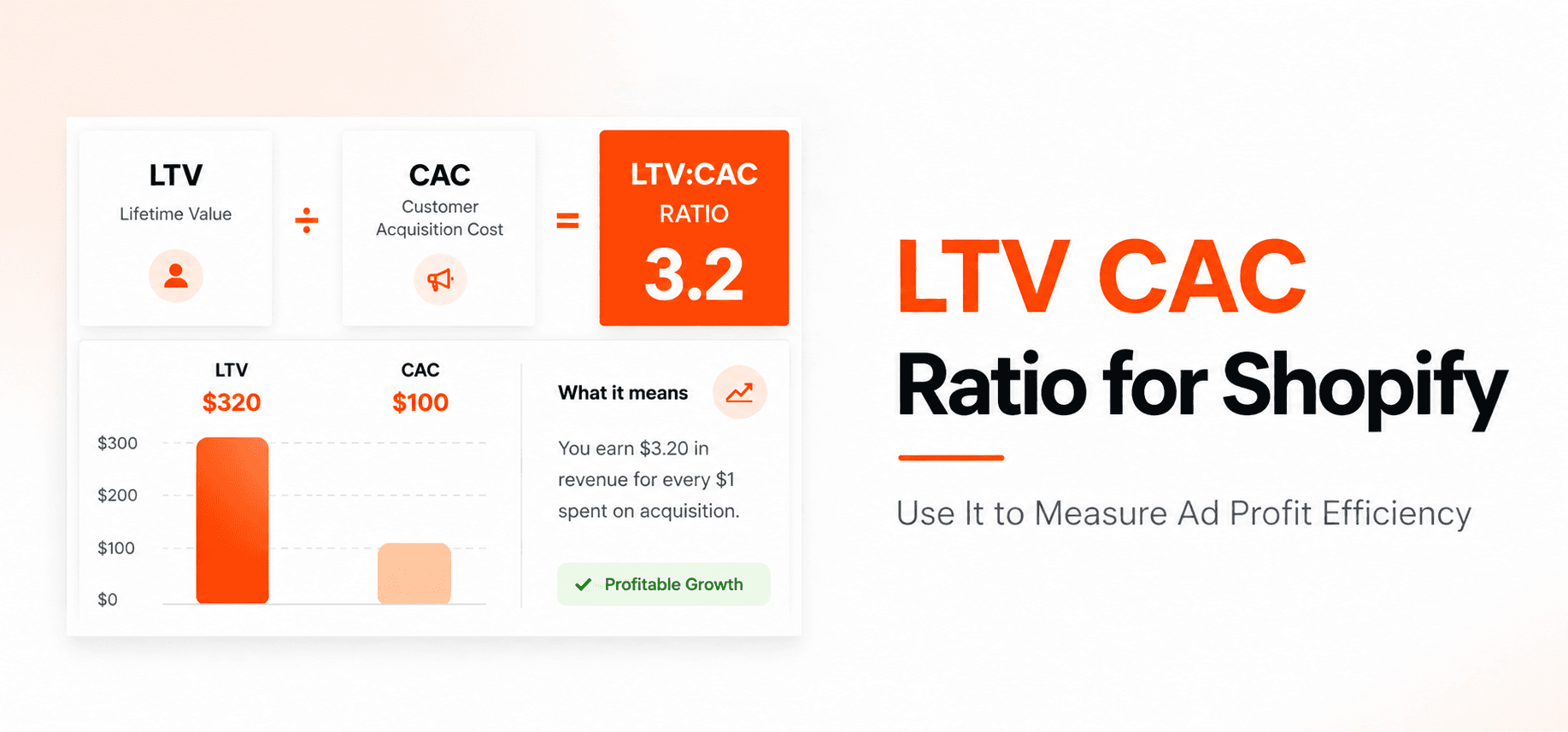
The LTV CAC ratio puts both numbers together. It tells you how much revenue you're generating for every dollar you spend to acquire a customer.
Formula: LTV CAC Ratio = LTV / CAC
Using a real example: if your 60-day sales from acquired customers total $450 and your ad spend to acquire them was $155:
LTV / CAC = 450 / 155 = 2.9
This means for every dollar you spent on acquisition, you generated $2.90 in revenue. You've recovered your cost and then some revenue which is a positive sign.
A ratio of 2.9 is close to 3:1. The question that naturally follows is: what does a good ratio actually look like?
What Is a Good LTV CAC Ratio for Ecommerce?
A good LTV CAC ratio for ecommerce is generally 3:1 or above. At this level, the revenue generated from acquired customers is sufficient to cover acquisition cost and leave room for the other costs that come with running a store.
Here's how to read the benchmarks:
Ratio | What It Means |
Below 1:1 | You're losing money on every customer acquired |
Around 1:1 to 2:1 | Close to breakeven. Paid ads are not yet sustainable at scale |
LTV CAC of 3:1 | On track. You're covering acquisition cost with room to operate |
4:1 and above | Strong ad efficiency. You have room to increase spend confidently |
The 3:1 benchmark exists because most Shopify stores carry costs beyond the ad spend itself, fulfillment, platform fees, returns, operating expenses. A 3:1 ratio on revenue gives you enough buffer to remain profitable after those costs come out.
How to Improve LTV CAC Ratio for Ecommerce
You can't change the ratio directly. What you can do is improve the factors that drive it.
Spend more effectively on acquisition. Your ad spend is the largest controllable input in the CAC calculation. Focus on the real revenue your campaigns generate, not platform-reported ROAS, which overstates performance by ignoring your actual costs. When you allocate a budget based on what campaigns genuinely return, CAC improves naturally.
Build a product lineup with strong revenue and healthy margins. A strong product with good margins means you don't have to rely on discount campaigns to move inventory. Discounts inflate your CAC, compress your LTV, and attract customers who won't return at full price. Working on product quality reduces your dependence on promotions and improves the LTV side of the ratio.
Pay attention to payback period and purchase frequency. Payback period is how long it takes to recover the cost you spent acquiring a customer and start generating profit. It's one of the most practical ways to read your LTV CAC ratio in context.
If your product margin covers the acquisition cost on the first purchase, you break even immediately. If not, you're relying on repeat purchases to get there and the timing of those repeat purchases is what determines your actual payback window.
A 60-day payback period is a healthy benchmark for most ecommerce businesses. Beyond that, you're carrying acquisition cost for longer, which creates cash flow pressure and limits how aggressively you can scale.
Purchase frequency is the engine that drives payback speed. One additional purchase within the first 60 days changes your LTV curve significantly and with it, your ratio.
The More Honest Way to Look at LTV CAC
Using revenue to calculate LTV is the standard approach. But revenue isn't what stays in your business.
A customer who generates $120 in LTV against a $30 CAC looks like a 4:1 ratio. Add up the product cost, shipping, and any returns on those orders, and the actual profit that customer contributed might be $40 or $50.
That changes the picture.
The more useful calculation is profit-based LTV substituting revenue with the actual profit per order in your cohort. The ratio it produces is smaller. It's also accurate. Most merchants who run this calculation for the first time find their acquisition efficiency is tighter than the revenue LTV suggested.
Bloom calculates LTV using real profit after COGS, fulfillment, and fees not revenue. So the LTV CAC ratio you see in Bloom reflects what your business actually keeps, not just what it generates. That's the number worth making scaling decisions from.
Bloom has a free trial for Shopify merchants. Install it in a couple of minutes and see your profit-based LTV data today.
FAQ
What is a good LTV CAC ratio for ecommerce? A ratio of 3:1 or above is a healthy benchmark for most Shopify stores. It means the revenue generated from each acquired customer is sufficient to cover acquisition cost and leave room for fulfillment, fees, and operating expenses. If your margins are thin, you may need a 4:1 or higher ratio to genuinely profit on each customer acquired.
How do you calculate LTV CAC ratio? Divide your customer lifetime value by your customer acquisition cost. LTV CAC = LTV / CAC. For the most accurate reading, using the same time window for both 60 days is a practical starting point for ecommerce. If you can use profit-based LTV rather than revenue-based, your ratio will reflect reality more accurately.
Why is my LTV CAC ratio low? The most common causes are high acquisition costs from inefficient campaigns, low repeat purchase rates, thin product margins, or high returns. Purchase frequency is usually the fastest lever even a single additional order within 60 days of acquisition meaningfully shifts the ratio.
What is the payback period and why does it matter for LTV CAC? Payback period is the number of days it takes to recover your CAC from a customer's purchases. A 60-day payback period is generally healthy for ecommerce. A strong LTV CAC ratio with a long payback period can still create cash flow strain. Both numbers matter when you're deciding whether to scale spend.
Should I use revenue or profit to calculate LTV? Revenue-based LTV is the industry default and useful for benchmarking. Profit-based LTV is more accurate for business decisions. Revenue flatters it as it doesn't account for what you spent to fulfill those orders. If you're using LTV CAC to decide whether to increase ad spend, use the profit version.
How often should I review my LTV CAC ratio? Monthly is a practical cadence for most stores. For stores running heavy acquisition campaigns, a 60-day review cycle aligns naturally with the payback window and gives you a complete cohort to analyze rather than partial data.
Know Your Real Profit And
The Ads That Actually Sell.
No need to spend. Just try it on your store.