

A product with a 70% gross margin can still lose you money on every single sale.
That's the part most "best products to sell on Shopify" articles skip. They hand you a list of trending items, quote a juicy markup figure, and send you off to run Meta ads. Then you wonder why your dashboard says $400K last month and your bank account disagrees.
Below, you'll get the list merchants usually come here for. Ten product categories with real margin potential on Shopify in 2026. But you'll also get the five-minute check that tells you whether any of it will actually work for your store, because the same product that prints money for one brand is a slow bleed for another.
What makes a product profitable on Shopify?
A profitable Shopify product is one where the selling price, after subtracting cost of goods, shipping, transaction fees, and a return allowance, still leaves enough contribution margin to acquire a customer profitably. Gross margin on a supplier spec sheet isn't the same as profit in your Shopify account.
Three things to check before a product earns a spot in your catalog:
Gross margin of at least 60%. For DTC brands running paid traffic, anything lower makes the math on ads almost impossible. According to TrueProfit's analysis of 5,000+ ecommerce stores, 60-70% gross and 10-20% net is the range where products tend to survive at scale.
Shipping and return cost that doesn't eat the margin. A $40 product with 70% gross looks great until you factor in a $9 shipping cost and a 12% return rate.
Repeat-purchase or upsell potential. Single-purchase products force you to acquire a new customer every time you want another sale. Consumables, subscriptions, and bundles stretch your CAC over months instead of a single order.
If a product fails on all three, skip it. If it passes two, test it. If it passes all three, it deserves a place in your lineup.
The 10 most profitable product categories on Shopify in 2026
These are categories with structurally good margin potential. They're a shortlist, not a recipe. Every margin range below is a typical benchmark from public industry data, not a promise.
1. Beauty and skincare
The most resilient high-margin category on Shopify, year after year. Low-cost formulations, strong branding leverage, and buyers who come back every 30-60 days. Serums, eye creams, and barrier-repair products all fit a simple pricing model: $4-$8 in COGS, $30-$50 retail.

Typical gross margin: 60-80%.
Watch out for: saturated search terms, high return rates on shade and formula mismatches, influencer CPMs creeping up every quarter.
2. Health supplements and wellness
Subscriptions are what make this category work. A $35 monthly supplement that retains for 4 months turns a breakeven first order into a $140 LTV. Greens powders, sleep stacks, collagen, and gut health are all in demand.

Typical gross margin: 60-75%.
Watch out for: platform ad restrictions (Meta is picky about health claims), compliance and testing costs, customer acquisition cost that climbs fast in Q4.
3. Jewelry and accessories
Small, light, easy to ship, and priced on perceived value rather than material cost. A $4 piece of plated brass can sell for $40 with the right photography and story. Gift-driven demand makes Q4 a cash engine.

Typical gross margin: 50-75%.
Watch out for: trust barriers at price points above $100, which usually require heavy creative investment, reviews, and return policies generous enough to offset risk.
4. Digital products (templates, presets, courses, printables)
The highest-margin category on this list. No inventory, no shipping, no returns in the traditional sense. Shopify's own data suggests digital creators can hit 70-90% margins once a product is built. Notion templates, Lightroom presets, ebooks, design assets, and printable planners all qualify.

Typical gross margin: 80-95%.
Watch out for: piracy, refund abuse, and the fact that acquisition cost is the only thing that matters. Creative and positioning do all the work.
5. Phone accessories and tech add-ons
Cases, MagSafe mounts, cable organizers, wireless chargers. Shopify's own analysis notes that while a phone store makes roughly 5% on the handset, it can hit 100-200% markups on the case that goes with it. That math is why phone accessories keep showing up in every "profitable products" list ever written.

Typical gross margin: 50-70%.
Watch out for: compatibility churn every time a new phone model launches, and commoditization on Amazon.
6. Pet products
Pet owners are some of the stickiest buyers in ecommerce. Treats, supplements, grooming tools, and enrichment toys all have strong repeat rates. Pet shampoo sales on Shopify grew 37% year over year recently, according to Shopify's trending products report.

Typical gross margin: 40-60%.
Watch out for: heavy items (litter, large food bags) that quietly destroy shipping margins. Stick to light, high-value SKUs if you're paying for fulfillment.
7. Home and kitchen
Problem-solving products. Space-savers for small apartments, compact organizers, specialty cookware, portable appliances. These convert well because the value proposition is immediately obvious in a TikTok video.

Typical gross margin: 40-60%.
Watch out for: size and weight. A $45 product that costs $14 to ship and has a 10% return rate is a structurally bad product, no matter how well it converts.
8. Fitness and recovery gear
Resistance bands, foam rollers, mobility tools, massage guns, yoga props. Light, durable, and priced on perceived health value rather than material cost. The home fitness shift that started in 2020 never fully reversed, and the recovery sub-category is still growing.

Typical gross margin: 50-70%. Watch out for: Amazon-driven commoditization. If your product is visually identical to three cheaper listings on Amazon, you need a brand reason to win, not a product reason.
9. Print-on-Demand Apparel (Niche Designs)
Print-on-demand apparel offers a low-risk way to start an online business since products are only made after a sale. Platforms like Printify and Printful simplify the process by handling production and fulfillment, allowing entrepreneurs to focus on design and marketing.

Typical gross margin: 30–45%
The challenge is that margins are thinner than traditional eCommerce. Success comes from targeting specific communities with designs that reflect their interests, humor, or identity. In 2026, niche-focused POD brands consistently outperform generic stores.
10. Candles, soaps, and home fragrance
Gift-purchase economics. High perceived value, low material cost, strong branding potential, and a natural fit for seasonal marketing. A $6 candle can retail for $32 if the jar, label, and scent story are right.

Typical gross margin: 50-70%.
Watch out for: fragile + heavy is the worst combination for shipping. Packaging costs and breakage rates can quietly erode what looked like a 60% product into a 40% product.
A Note on the List Above
Every category here can be profitable. None of them is automatically profitable. The same skincare serum that's a “Star Performer” for one brand is a “Margin Trap” for another, because margins depend on your sourcing, your ad costs, your fulfillment setup, and your return rate. The next section is how you tell the difference.
How do You Calculate the Profit Margin of a Shopify Product?
To calculate a product's true profit on Shopify, start with the revenue the product actually brings in after discounts and refunds, subtract what it cost you to source and deliver it, and then subtract the ad spend that drove the sale. The first subtraction gives you gross profit. The second gives you net profit. Both matter, and most Shopify merchants only track the first one.
Three formulas worth memorizing:
Gross Profit of a product = Net Revenue − Cost of Goods Sold
Gross Profit Margin = (Gross Profit ÷ Net Revenue) × 100
Net Profit of a product = Gross Profit − Ad Spend
Here's what that looks like on a real product. This example is illustrative, not a specific merchant.
Take a $40 skincare serum.
Net Revenue (after 3.5% payment fees and a small return allowance): ~$36.60 COGS (product $8 + shipping $6): $14 Gross Profit: $22.60 Gross Profit Margin: 61.7%
So far the product looks healthy. Now add ad spend.
Say your blended customer acquisition cost on this product is $14 per order.
Net Profit: $22.60 − $14 = $8.60 per order
Net Profit Margin: 23.5%
That's the number that actually tells you whether the product is making money. Gross Profit Margin said 61.7%, which is what most "profitable products" articles would stop at. Net Profit Margin says 23.5%, which is what lands in your bank account.
The gap between those two numbers is where the product either survives or quietly becomes a Margin Trap. If ad costs rise $3 per order next month, this product drops to 15% net margin. If they rise $6, it's a breakeven SKU you're scaling for free.
For the full walkthrough, including how to track COGS and ad spend at the product level in Shopify, see our guide on [how to calculate product profit margin].
Use Bloom to Find Your Real Profitable Products
Instead of revenue reports that flatter the wrong products, you get profit reports that show which SKUs are actually funding your business and which ones are quietly draining it.
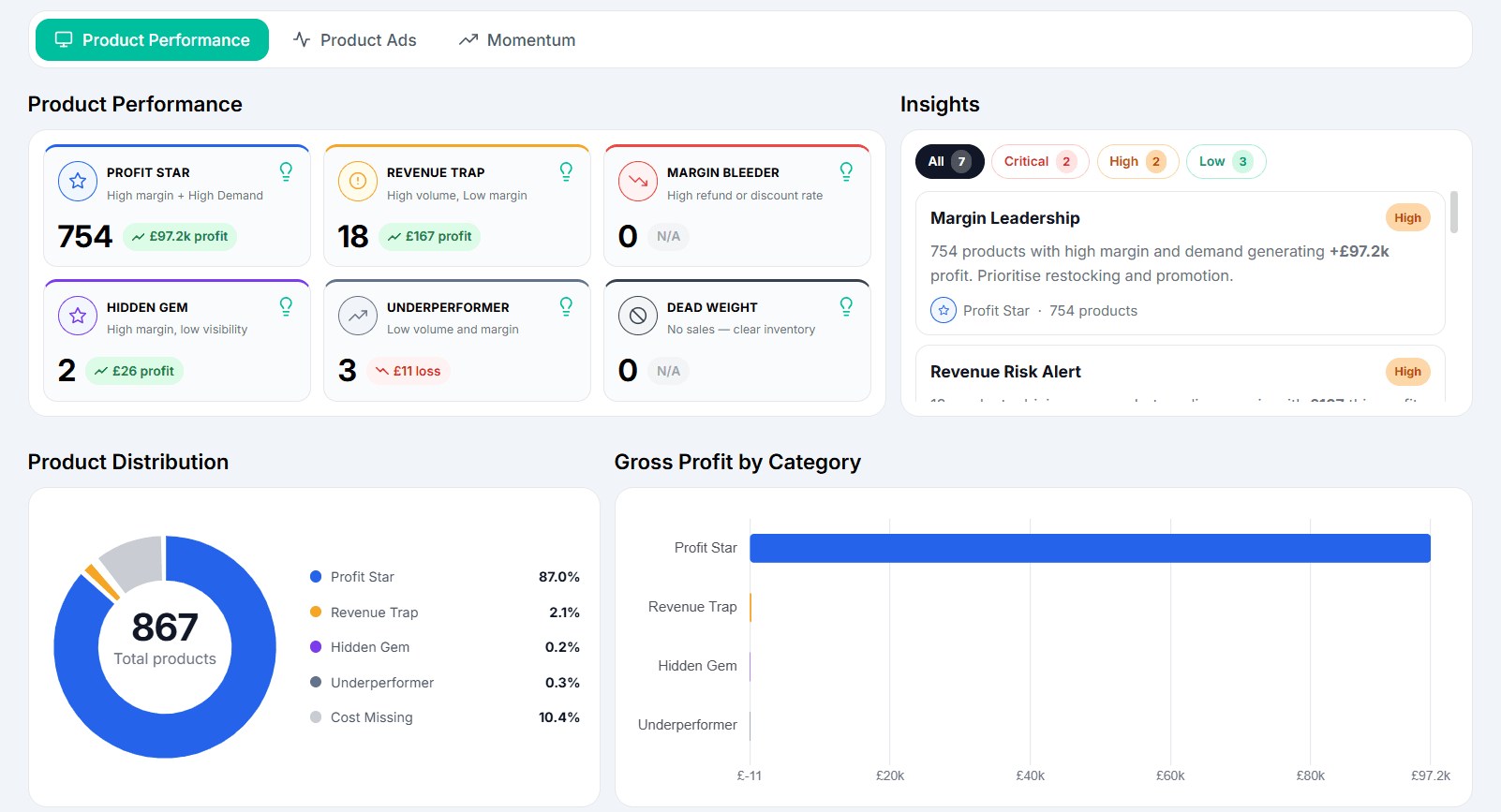
The core feature for this problem is Product profit intel. Bloom pulls your COGS, shipping costs, payment fees, and return data together at the SKU level, then applies labels so you don't have to stare at spreadsheets to find the pattern. Ex: “Star Performers” are the products scaling profitably. “Margin Traps” are the ones selling well but losing margins once real costs are subtracted and other labels that help you understand product performance.
The most common pattern merchants find in their first week: the #3 bestseller by revenue is somewhere around #40 by profit.
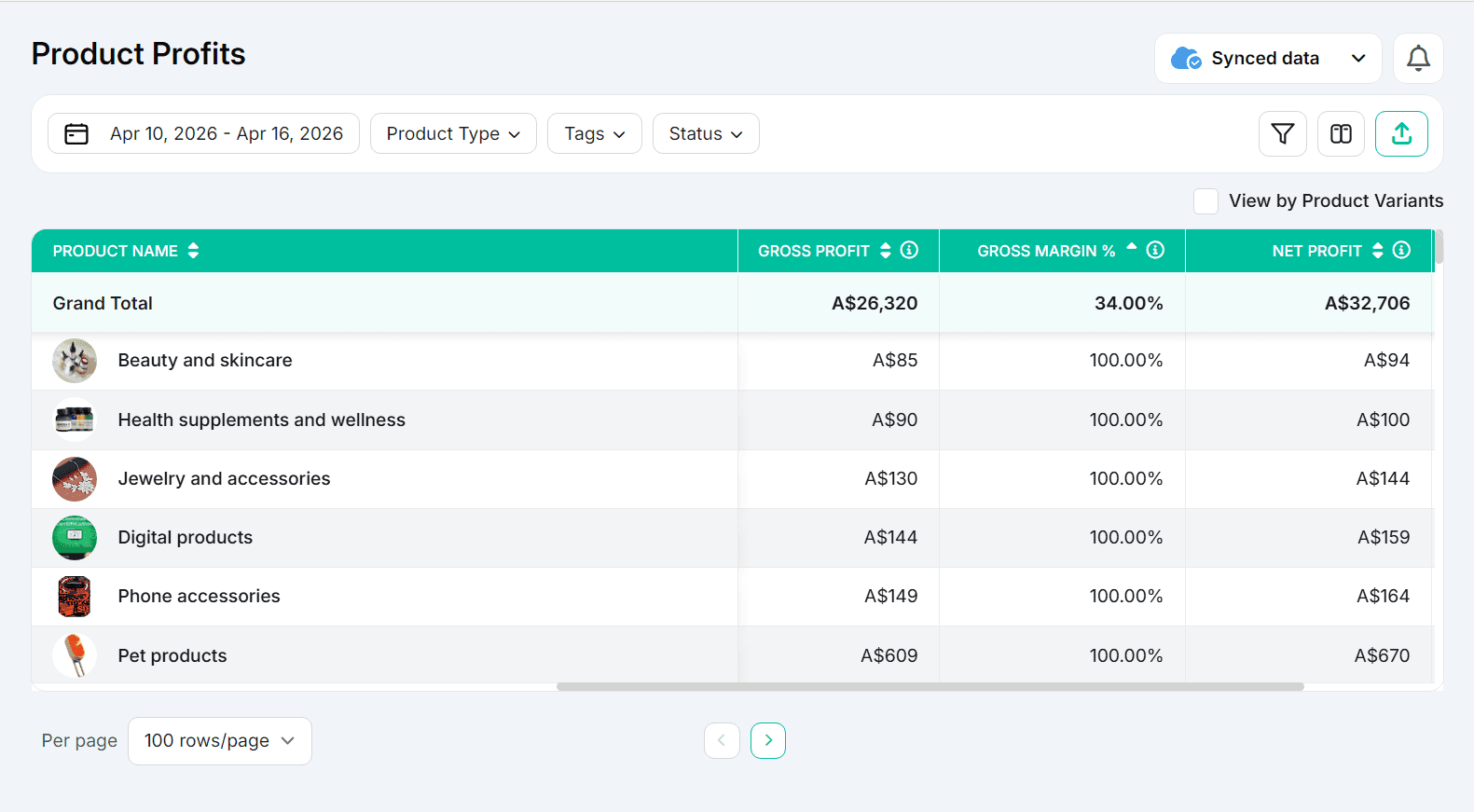
What this changes in practice: you stop running ads to your highest-revenue SKUs by default and start running them to your highest-profit SKUs. You bundle your Star Performers with your lower-margin products to lift blended contribution margin. You cut the Margin Traps that were eating budget disguised as bestsellers. None of this requires new products, new ad creative, or a bigger budget. It requires knowing which products in your existing catalog are actually profitable.
The list at the top of this post is a starting point. Beauty, supplements, jewelry, digital, phone accessories, pet, home, fitness, POD, candles. Those are categories with good margin potential. Bloom tells you which products in those categories are actually profitable in your store, with your ad costs and your fulfillment reality. That's the only version of the question that matters when you're the one running the business.
Bloom has a free trial for Shopify merchants. Install it in two minutes and see which of your products are actually profitable by tomorrow morning.

FAQ
What is the most profitable product to sell on Shopify?
Digital products like templates, presets, and printables have the highest margins, often 70-90%, because there's no inventory or shipping. Among physical products, beauty, supplements, jewelry, and phone accessories consistently show the strongest margin potential. The most profitable product for your store depends on your sourcing and ad costs.
What profit margin should a Shopify product have?
Aim for at least 60% gross margin before marketing costs. Per TrueProfit's analysis of 5,000+ stores, 60-70% gross and 10-20% net is the range where DTC products tend to survive at scale. Anything below 50% gross margin makes the math on paid traffic extremely difficult.
How do I find profitable products to sell on Shopify?
Validate demand first using Google Trends, TikTok Shop rankings, and competitor ad libraries. Then run the margin math: selling price minus COGS, shipping, fees, and ad spend. Test the top candidates with a small ad budget, and scale only the products that show positive net profit at sustainable ROAS.
How is profit actually made selling products on Shopify?
Profit is the gap between selling price and every cost tied to the order: COGS, fulfillment, payment fees, returns, and ad spend. Revenue is what shows on your Shopify dashboard. Profit is what's left after all of that. Most merchants overestimate profit because Shopify's default reports don't deduct fulfillment, COGS, or ads.
Are Dropshipping Products Profitable on Shopify in 2026?
Dropshipping margins typically run 15-30%, thin compared to private label or digital. They can be profitable, but the model needs volume, strong ad creative, and tight shipping cost control. The sweet spot is products in the $50-$200 range, where AOV is high enough to absorb ad spend.
What's the difference between a high-revenue product and a high-profit product?
A high-revenue product generates strong top-line sales. A high-profit product generates strong net profit after COGS, shipping, fees, and ad spend. The two often aren't the same SKU. Your bestseller by revenue can easily be a Margin Trap, which is why product-level profit visibility matters more than sales reports.
Discover More