Why Bloom is the Best Alternative for True Profit Shopify App


Running a Shopify store means your most important numbers live in five different places. The hard part is not finding the data. It is turning scattered numbers into decisions you can act on this week.
TrueProfit and Bloom are both set out to solve this. TrueProfit gives you clean profit reporting with the cost categories most stores need. Bloom, a profit and marketing attribution app for Shopify stores, layers in deeper cost tracking, six attribution models, and plain-English insights that point at the next action.
Both calculate true net profit. They differ in how deep the analysis goes, how flexibly they handle real-world expenses, and what they cost as you scale. Here is a practical, section-by-section breakdown of where each tool lands.
TL;DR
Both apps calculate true net profit by pulling Shopify orders, COGS, ad spend, shipping, fees, and operating costs into one P&L view.
Bloom goes deeper on profit layering (CM1, CM2, CM3), order-level cost allocation, and country and channel level profitability.
TrueProfit's marketing attribution is solid but sits on its $200/month Enterprise plan. Bloom includes six-model attribution at $80/month.
Bloom's pricing starts at $20/month with unlimited orders. TrueProfit starts at $35/month with order caps that scale into overage fees.
TrueProfit is a strong fit if you want straightforward reporting on a smaller catalog. Bloom fits stores that need deeper attribution, complex cost rules, or multi-store reporting.
Profit Tracking
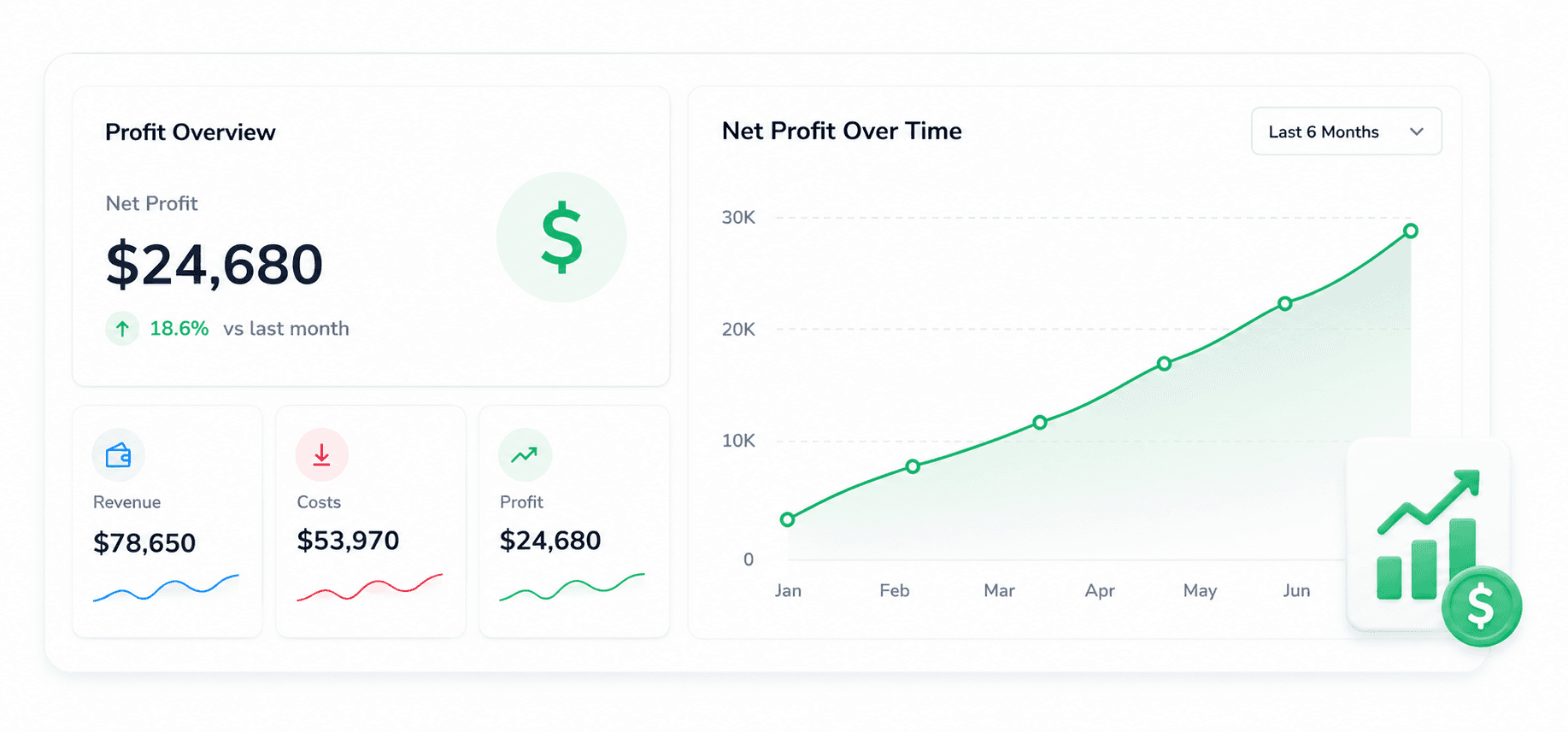
Both tools turn Shopify orders into a P&L that covers revenue, COGS, shipping, handling, transaction fees, taxes, discounts, refunds, operating expenses, and ad spend. Each gives you daily, weekly, and monthly snapshots. They differ in how the profit picture is layered and how granular the order-level view goes.
What's the same:
Full P&L with revenue, COGS, ad spend, fees, refunds, and operating costs
Daily, weekly, monthly profit views
Product-level net profitability
Where they differ:
TrueProfit gives you an end-to-end profit view from gross sales to net profit in a simplified margin structure. Product-level profitability shows which SKUs are pulling weight and which are not. Order-level visibility is partial, covering gross profit and fulfillment costs but stopping short of allocating indirect expenses to individual orders.
Bloom layers profit into CM1, CM2, and CM3, which separates gross profit after product cost, profit after fulfillment, and profit after marketing spend. The point is to see exactly which cost layer is eroding the margin, so you know whether to renegotiate with your 3PL, fix product costs, or cut ad spend.
Order-level analysis is tied to profitability, covering order-specific costs such as variant COGS, discounts, refunds and more so you can see true profit on every order. Profitability also extends to the country level, which matters if you sell internationally and suspect some markets cost more to serve than they earn.
Edge: Bloom on depth, granularity and at-a-glance product signals, especially for stores with complex catalogs, international sales, or detailed unit economics needs.
Custom Expense Tracking
Both apps let you go beyond Shopify's default data by assigning product costs, shipping expenses, transaction fees, and custom operating costs to your P&L. The difference shows up in how flexibly costs can be configured and how many non-standard expense types each tool handles.
What's the same:
Editable COGS at product and variant level
Shipping assigned by country or region, using fixed, weight-based, and quantity-break rules
Transaction fee tracking
Custom operating expense categories
Where they differ:
TrueProfit covers the standard ground well:
Edit and replace COGS at product and variant level, then recalculate profitability when costs change
Track transaction fees and define custom categories such as agency fees, labor, taxes, office expenses, and marketing
For multi-product orders, shipping is calculated using either the highest shipping fee among items or the sum of all item shipping fees
Bloom adds more configuration layers for stores with evolving supplier deals or complex operations:
Retains COGS for deleted variants, preserving historical accuracy even when product data changes
Supports conditional rule logic (such as date-based changes) for shipping and COGS calculations when supplier or fulfillment pricing shifts
Enables shipping costs to be driven by broader order attributes like order value, shipping method, weight, and quantity condition
Supports one-time, recurring, and irregular operating expenses such as rent, salaries, software, and ad hoc costs
Includes dedicated cost types for tariffs, channel fees, and return-specific expenses
Edge: TrueProfit handles standard cost tracking cleanly and reliably. Bloom extends into edge-case modeling, complex supplier pricing, and multi-condition cost logic without relying on manual workarounds.
Marketing Attribution
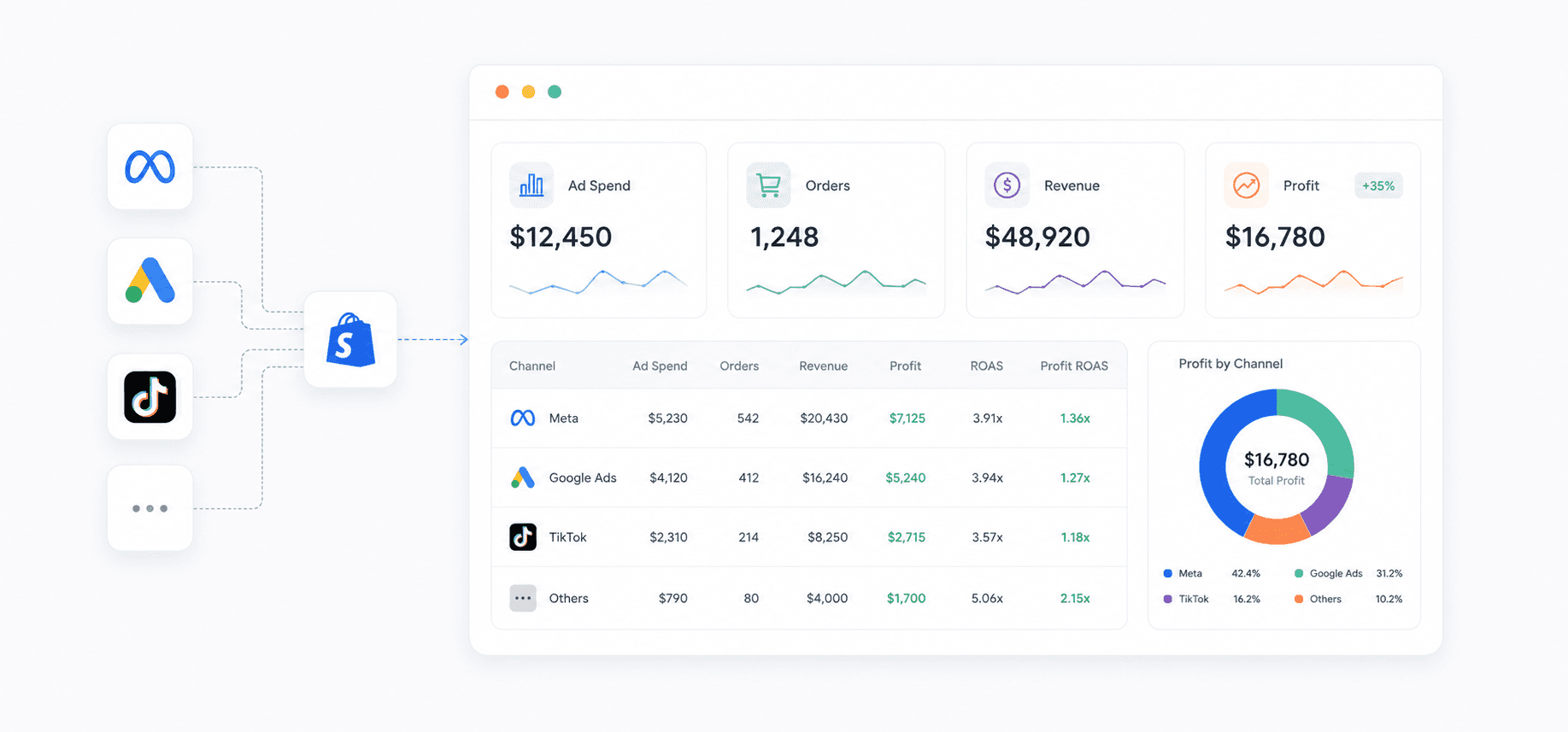
Attribution is where the two tools take noticeably different approaches. Both connect ad platform data to Shopify orders and tie spend back to profit. They differ in how they capture conversions, how many models they support, and what tier they sit on.
What's the same:
Cross-channel attribution across Meta, Google, TikTok
Connection between ad spend and profit metrics
Channel, campaign, ad set, and ad-level drill-down
Where they differ:
TrueProfit uses URL parameters added to your ads to track conversions across connected channels. Its proprietary attribution model separates Last-clicked Purchases from Assisted Purchases, so you can see both the closing ad and the influencing ads earlier in the journey. A 30-day attribution window captures conversions days or weeks after the first click. Attributed orders link back to specific customers and products for traceability.
The catch: marketing attribution is only available on the $200/month Enterprise plan.
Bloom uses its own first-party tracking pixel (Bloom pixel), supported by server-side events and webhooks, to capture customer journeys more accurately. Because it does not rely on cookies or UTMs, it keeps capturing the journey even when iOS restrictions, browser privacy settings, or ad blockers shut down traditional tracking.
You also get six attribution models instead of one:
Last Non-Direct
Last Click
First Click
Any Click
Linear All Channels
Linear Paid Channels
Bloom compares its own attribution data against what Meta, Google, and TikTok report, so you can see where platforms are taking credit they have not earned. Attributed revenue and ad spend flow into contribution margin and net profit, so you can rank channels by what they actually keep, not just what they bring in.
Edge: Bloom on attribution breadth, pixel-based tracking that survives iOS, actionable marketing guidance and price point. TrueProfit's attribution is real and useful but priced for larger stores.
Customer Lifetime Value and Cohort Analysis
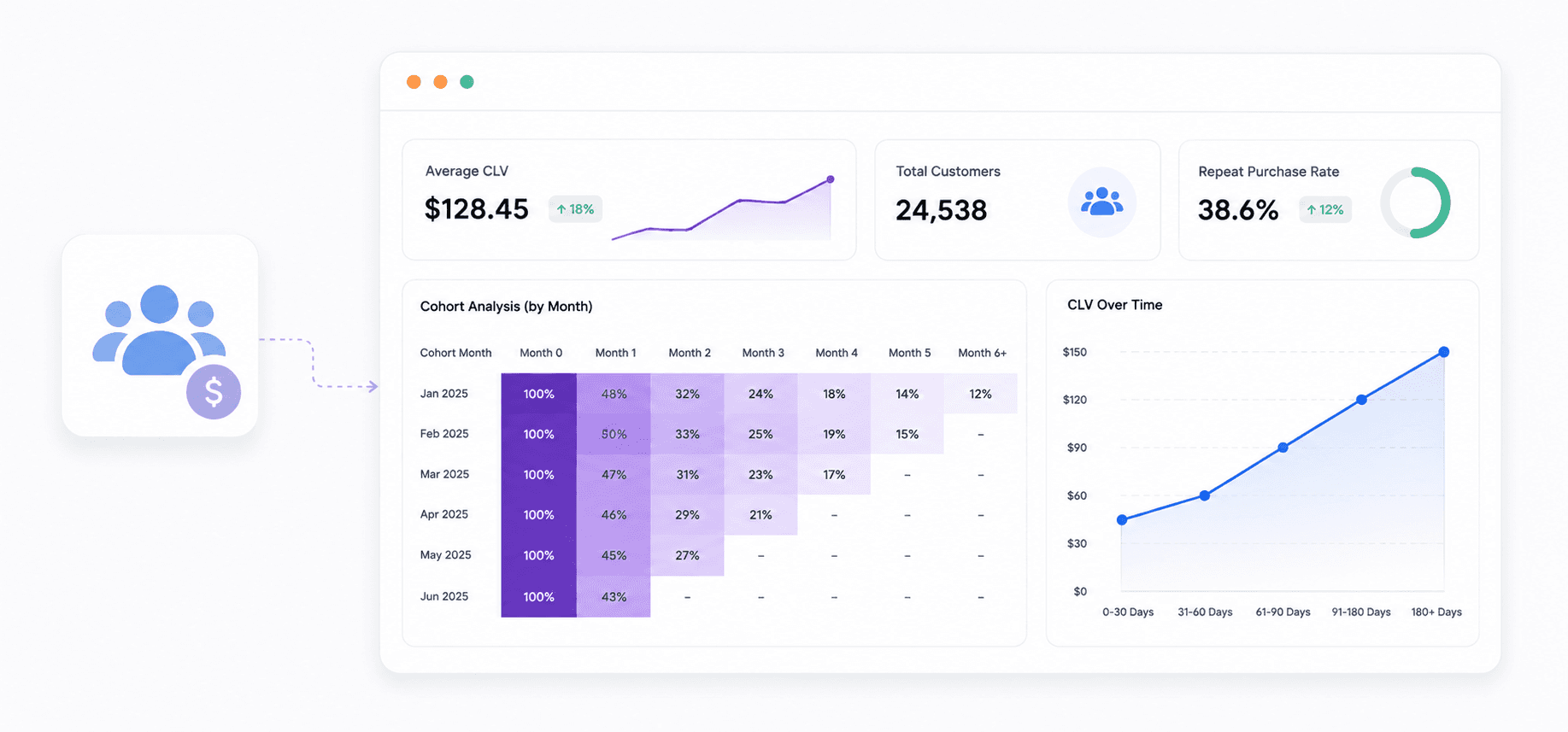
Both tools connect acquisition costs to long-term customer behavior. The difference is what each one emphasizes.
What's the same:
LTV and CAC tracking
Repeat purchase and retention metrics
Connection between acquisition spend and customer value
Where they differ:
TrueProfit treats LTV and CAC as high-level growth metrics. You get a real-time LTV-to-CAC comparison to gauge whether your acquisition is sustainable. Repurchase rate, total customers, and repeat purchase behavior round out the loyalty view. LTV trends feed into revenue forecasting for budgeting.
Bloom ties cohort behavior directly to profitability. You can track customer cohorts over time and see how new and returning customers grow, repeat, or drop off after their first order. Cohort-level revenue, average order value, retention rate, and spend per customer all roll up. The key connection is between cohort performance, CAC, marketing efficiency, and first-order contribution margin, so you can tell whether retention efforts are actually improving profit, not just revenue.
Edge: TrueProfit for clear top-line LTV reporting. Bloom for connecting cohort behavior to margin and acquisition efficiency.
AI Integration and Insights
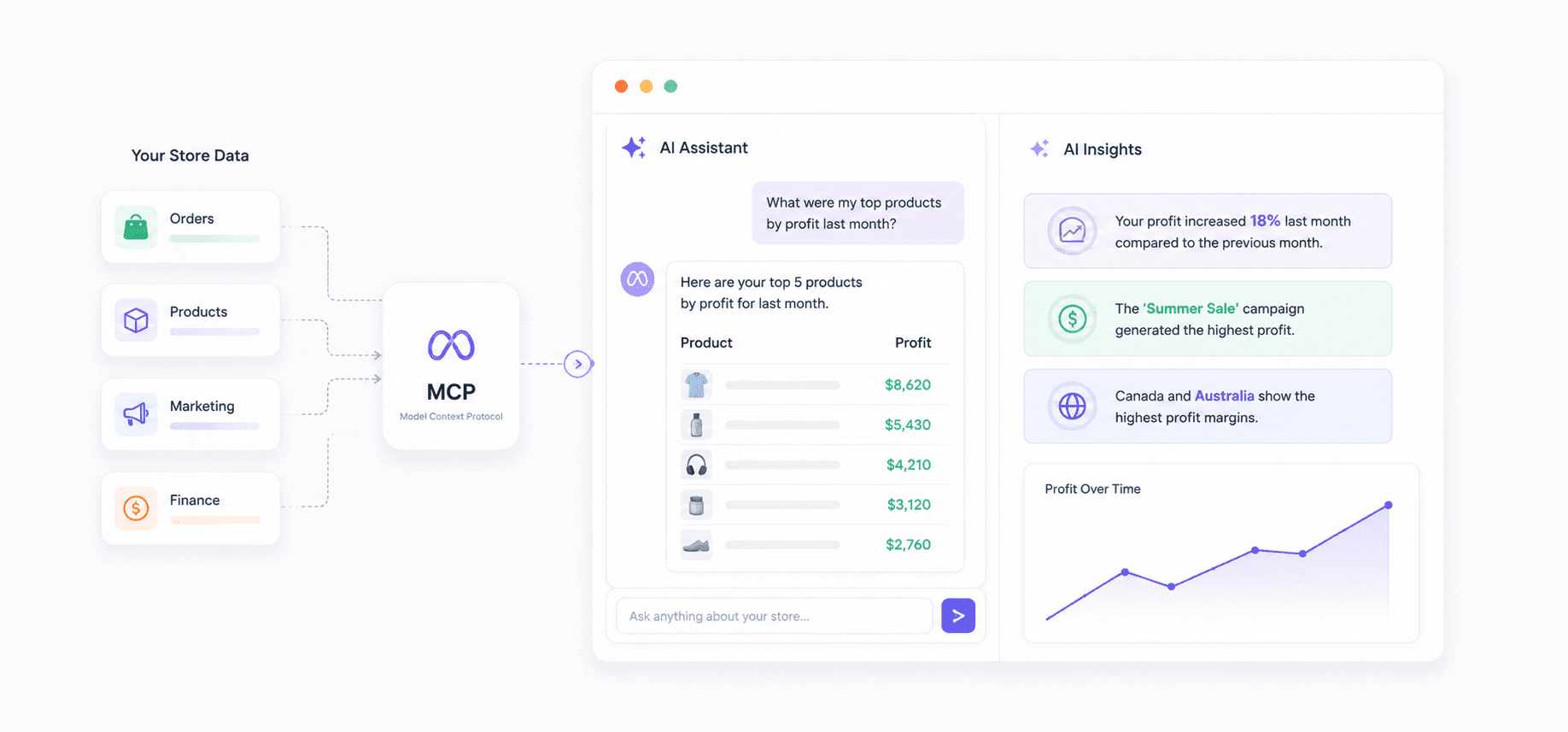
Both platforms let you query your store data conversationally through MCP (Model Context Protocol) integrations, which connect your analytics to AI assistants instead of forcing you to dig through dashboards.
TrueProfit's MCP connects to ChatGPT and Claude, letting you ask questions about profit, orders, products, ad performance, and store metrics in natural language. Currently in beta.
Bloom's MCP also connects to ChatGPT and Claude. You can analyze store data through chat and pipe Bloom data into your own workflows, reports, and internal tools, including building dashboards or automating follow-up actions.
Additionally, Bloom provides product and campaign intelligence based on actual performance data, categorizing them as Star Performer, Margin Leak, Money Pit, and Margin Trap, so you can instantly understand what is driving or hurting profitability and what action to take next without logging into dashboards.
Edge: Both tools let you interact with your store data for insights, recommendations, and basic task execution such as report creation. However, if you need decision-ready insights grounded in real performance data, Bloom has the edge.
Pricing
Both tools use tiered monthly pricing, but what each tier includes and how costs scale are very different.
TrueProfit pricing:
Plan | Price | Order Limit | Key Features |
Basic | $35/month | 300 orders | Core profit tracking, custom costs |
Advanced | $60/month | 600 orders | Product analytics, P&L reporting |
Ultimate | $100/month | 1,500 orders | Ad sync custom rules, unlimited COGS zones |
Enterprise | $200/month | 3,500 orders | Marketing attribution, prioritized support |
P.S:
Pricing climbs with order volume
Overage fees apply when you exceed your tier's limit
Marketing attribution requires the $200/month Enterprise plan
Bloom pricing:
Plan | Price | Order Limit | Store Limit | Key Features |
Sprout | $20/month | Unlimited | Up to 3 shops, $10/ additional store | Full profit and expense tracking |
Grow | $40/month | Unlimited | Up to 3 shops, $10/ additional store | Data intelligence, action-oriented insights |
Flourish | $80/month | Unlimited | Up to 3 shops, $10/ additional store | Advanced marketing attribution |
P.S:
Starts at $20/month, so core profit tracking comes in $15 below TrueProfit's entry tier
Unlimited orders on every plan keeps costs predictable as you scale
Up to three shops under one subscription, useful for operators running multiple brands
Advanced attribution is $80/month, which is $120 below TrueProfit's Enterprise tier
Edge: Bloom on price-per-feature at every tier, plus predictability through unlimited orders.
The quick verdict (if you're in a hurry)
Capability | TrueProfit | Bloom |
Net profit P&L | Yes, end-to-end | Yes, layered into CM1, CM2, CM3 |
Order-level cost allocation | Partial (gross profit + fulfillment) | Full (variant COGS, fees, tariffs, refunds, etc.) |
Country-level profitability | No | yes |
Custom COGS rules | Product and variant level | Variant-level with date ranges |
Retains COGS for deleted variants | No | Yes |
Shipping cost rules | Limited order level logic | Multi-condition order logic |
Tariff and channel fee tracking | Via custom categories | Dedicated cost types |
Attribution models | 2 (Last Click + Assisted) | 6 (Last Non-Direct, Last Click, First Click, Any Click, Linear All, Linear Paid) |
Attribution method | URL parameters | First-party fingerprinting pixel + server events |
Survives iOS/cookie restrictions | Limited | Yes |
LTV / CAC tracking | Yes, top-line metrics | Yes, tied to cohort margin and first-order CM |
Entry price | $35/month (300 orders) | $20/month (unlimited) |
Attribution price | $200/month | $80/month |
Multi-store under one plan | No | Up to 3 shops |
Order overage fees | Yes | No |
Conclusion
TrueProfit and Bloom both do the fundamental job. They sync with Shopify, pull order data, track costs, and calculate profit. On that core layer, they are comparable, and both beat working from spreadsheets by a wide margin.
The differences show up in depth and value. Bloom has an edge on profit layering (CM1, CM2, CM3), order-level allocation, custom cost flexibility, attribution breadth, and price-per-feature. TrueProfit holds its own on clean, straightforward profit reporting and is a good fit for stores that want the basics done well without configuring every cost rule.
Quick verdict for merchants: If you want simple, reliable profit reporting on a focused catalog and you do not need advanced attribution, TrueProfit will serve you well. If you run multiple shops, sell internationally, want deeper attribution without paying enterprise rates, or need cost rules that handle tariffs, supplier price changes, and complex shipping, Bloom is the stronger pick.
If you’d like to compare both tools extensively before committing, try them for free for 14 days. You can also book a demo call with Bloom for a personalized walkthrough of your store’s real profit picture.
FAQs
Is TrueProfit or Bloom better for small Shopify stores?
Bloom is more forgiving for small stores. Its $20/month plan includes unlimited orders, so growth does not trigger overage fees. TrueProfit's $35/month Basic plan caps at 300 orders, which a growing store hits quickly. For under 300 orders and basic needs, TrueProfit works fine.
Does Bloom or TrueProfit include marketing attribution?
Both include attribution, but at different depths and prices. TrueProfit offers a dual model with Last-clicked and Assisted purchase views on its $200/month Enterprise plan. Bloom includes six attribution models on its $80/month plan, plus a first-party pixel that survives iOS and cookie restrictions.
Can I track multiple Shopify stores in one subscription?
Bloom supports up to three shops under one subscription on every plan, which suits operators running multiple brands or country-specific stores. TrueProfit's pricing is per store, so multi-store merchants need a separate subscription for each shop, which adds up fast across two or three stores.
How does Bloom's CM1, CM2, CM3 differ from a standard profit margin?
Standard gross margin is revenue minus COGS, which hides what fulfillment and ads do to profit. Bloom splits that into three layers: CM1 after product cost, CM2 after fulfillment, and CM3 after ad costs, so you can isolate the biggest drivers of margin loss.
Do I need a separate attribution tool if I already use TrueProfit or Bloom?
For most Shopify merchants, no. Both apps cover attribution at the depth typical DTC stores need. If your store invests heavily in paid media, Bloom offers an edge with first-party tracking, multiple attribution models, and direct comparisons against ad platform reporting. Unless your business requires highly specialized enterprise capabilities or additional modeling beyond what these platforms already offer, one of these two tools will handle the job.
Discover More