Klaviyo Attribution: What It Tells You and What It Doesn't
Klaviyo attribution tracks how your email and SMS messages drive sales using a last-touch model and default 5-day window. Learn how it works, what the settings mean, and what attributed revenue doesn't show you.
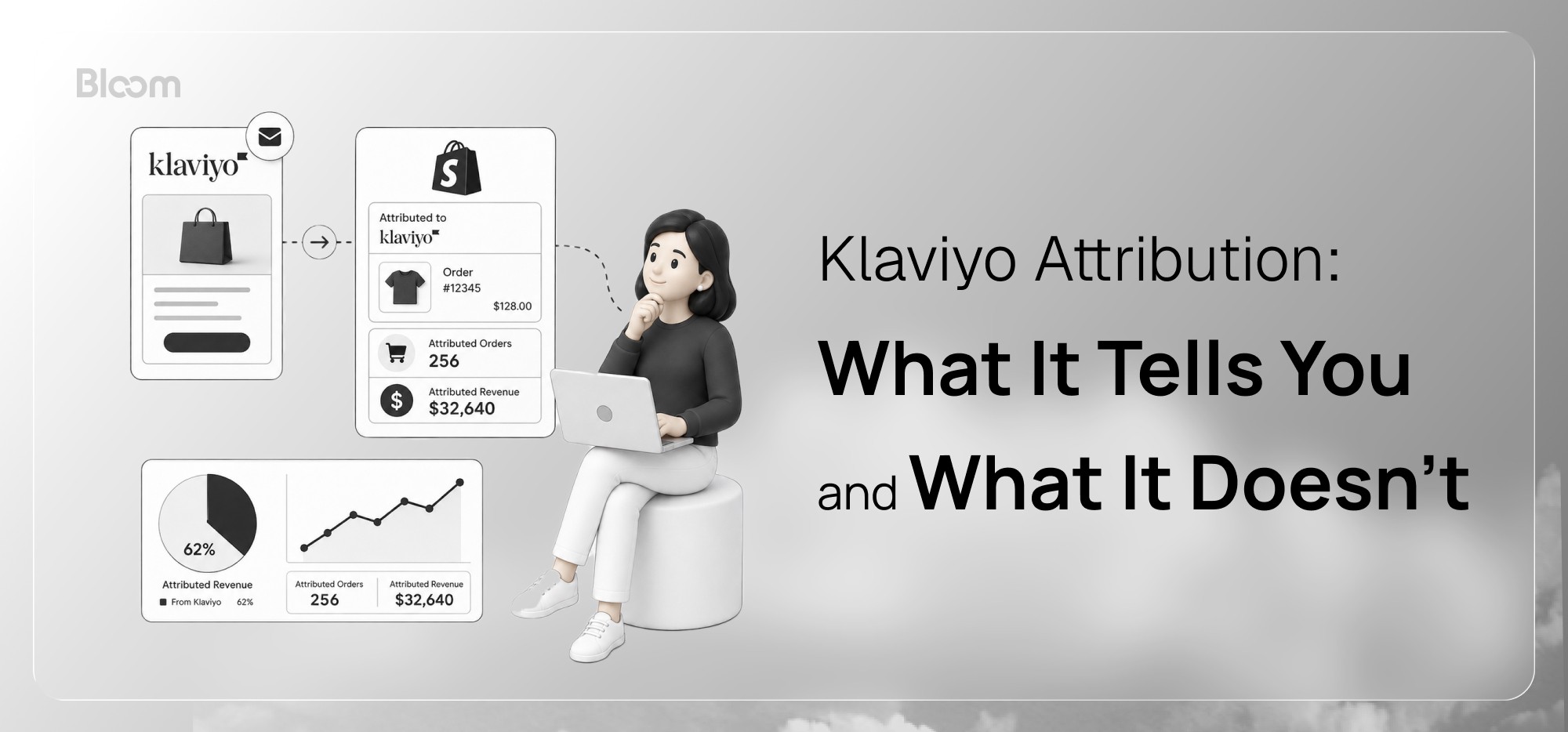
If you run a Shopify store and use Klaviyo for email and SMS, you've probably seen the attributed revenue figure on your dashboard. It's a satisfying number to look at, especially after a strong campaign. But here's a question worth sitting with: does that number actually tell you whether your marketing is profitable?
Attributed revenue shows how much order value Klaviyo connected to your messages. It does not show what you earned after product costs, fulfillment, and discounts. For many merchants, that gap between revenue and actual profit is where decisions go wrong , scaling campaigns that look successful on the surface but are quietly eating into margins.
This article breaks down exactly how Klaviyo attribution works, what the default settings mean, where the model has limitations, and what a more complete view of performance looks like.
What Is Attribution in Marketing?
Most purchases don't happen in a straight line. A customer might discover your brand through an ad, receive a welcome email, ignore it, get a promotional SMS three days later, click through, and then buy. Which of those touchpoints deserves credit for the sale?
That's the question attribution tries to answer. Marketing attribution is the process of connecting a customer's purchase back to the marketing interaction that influenced it.
It removes guesswork from performance analysis and helps you understand which campaigns and channels are actually moving people toward buying.
Without attribution, you're essentially flying blind by spending on email campaigns and messages without knowing what's working.
What Is Klaviyo Attribution and How Does It Work?
Klaviyo attribution tracks what a customer does after receiving an email or SMS and connects that activity to a purchase. Two settings control how this works: the attribution window and the attribution model.
Attribution Window
The attribution window is the time period after a customer interacts with a message during which a purchase can be credited to it.
For email, the default window is 5 days for both opens and clicks. So if a customer opens your email on Monday and makes a purchase on Thursday, that sale is attributed to the email as it falls within the 5-day window.
For SMS, attribution is click based; only opens are not tracked since virtually everyone opens a text message, making it a weak signal of intent.
The default click window depends on when your account was created: accounts set up before October 2024 have a 24-hour SMS click window, while accounts created after October 9, 2024 have a 5-day SMS click window. To confirm which applies to you, go to Settings → Attribution in your Klaviyo dashboard.
Attribution Model
Each platform has different attribution models, Klaviyo uses a last-touch model, meaning the most recent interaction gets full credit for the sale. If a customer opened your email on Day 1 and clicked your SMS on Day 2, and both windows were open at the time of purchase, the SMS gets the credit because it was the last touchpoint.
Klaviyo also offers a linear model as an alternative. Instead of giving all the credit to the final interaction, linear attribution splits it equally across every touchpoint the customer had within the attribution window. So if a customer opened an email, clicked a second email, and then clicked an SMS before purchasing, each of those three interactions would receive an equal share of the revenue credit. This is useful when you want a broader view of how your messages collectively contribute to a sale, rather than only crediting the last one.
This is also a cooperative model, meaning when both email and SMS windows are open, Klaviyo doesn't double count the revenue. One channel gets the credit, based on which message the customer interacted with most recently.
How Useful Is Klaviyo Attribution and Where Does It Fall Short?
Klaviyo's attribution gives you a clear, structured way to track how your email and SMS messages contribute to sales. The dashboard makes it easy to spot when campaigns are gaining traction or when performance drops, and the ability to adjust the attribution window and switch between last-touch and linear models gives you some flexibility to stress-test your numbers.
That said, there are meaningful limitations.
Limited model variety. Klaviyo offers last-touch and linear attribution, but not first-touch or multi-touch models that weight different parts of the customer journey differently. For merchants who want to understand whether their top-of-funnel emails are building purchase intent, last-touch attribution will consistently undervalue them as credit always goes to the final interaction.
Revenue, not profit. The attributed revenue figure is tied to order value, not what you actually keep. A campaign that drives ₹5,00,000 in attributed revenue looks identical in Klaviyo whether your margin on those orders is 40% or 8%. Without knowing costs, it's impossible to judge whether a campaign is genuinely worth running.
No cross-channel visibility. Klaviyo only attributes within its own ecosystem like email, SMS, and push. If a customer saw a Meta ad before clicking your email, Klaviyo won't know that. The result is that email and SMS often receive credit for conversions that were influenced by paid channels upstream.
These aren't reasons to distrust Klaviyo's data, they're reasons to understand what it is and isn't showing you before making decisions based on it.
How Bloom Fills the Gaps
For merchants who want to move beyond surface-level revenue tracking, Bloom builds on top of Klaviyo's attribution with a financial layer that shows actual business performance.
Where Klaviyo shows order value, Bloom breaks the same attributed revenue down into net revenue, product cost, fulfillment cost, and gross profit. This means that instead of seeing that a campaign drove ₹5,00,000 in revenue, you can see what you actually earned from it and compare that across every campaign and flow in your account.
Bloom also supports a wider range of attribution models including First Click, Any Click, Last Click, Last Non-Direct Click, and Linear, along with a lookback window of up to 90 days. This makes it possible to look at the same campaign from multiple angles, validate performance, and make decisions based on a more complete picture rather than a single default view.
The practical result is that you can clearly identify which campaigns are generating real returns, which ones look good on Klaviyo but thin out after costs, and where optimisation would have the most impact on profitability.
To explore this further, read: How to Find Real ROI of Klaviyo Campaigns and Flows in Shopify
Conclusion
Klaviyo attribution is a solid foundation for understanding how your email and SMS contribute to revenue. It's structured, transparent, and more customisable than most email platforms. For tracking engagement and monitoring whether campaigns are active and driving orders, it does the job well.
Where it stops short is in answering the question that actually matters for growing a profitable store: after all costs are accounted for, what did this campaign actually earn me?
Pairing Klaviyo's attribution with Bloom's profit-level breakdown gives merchants a more complete view, one that connects marketing performance to real business outcomes, not just order totals. That combination makes it easier to act on your data rather than just report it
Frequently Asked Questions
What is attributed revenue in Klaviyo?
Attributed revenue is the total order value Klaviyo connects to your email and SMS messages based on customer interactions within a set time window. It shows how much revenue your marketing messages influenced but since it's based on order value, not profit, it doesn't reflect what you actually earned after costs.
What is Klaviyo's default attribution window?
For email, Klaviyo's default is a 5-day window for both opens and clicks. For SMS, the default is 24 hours based on clicks only. Note that accounts created after October 2024 may have a 5-day default for SMS as well you can check Settings → Attribution in your dashboard to confirm your current setup.
What attribution model does Klaviyo use?
Klaviyo uses a last-touch attribution model by default, meaning the most recent message a customer interacted with gets full credit for the sale. You can switch to a linear model in your attribution settings, which shares credit across all touchpoints instead of giving it entirely to the last one.
Does Klaviyo double-count revenue across email and SMS?
No. Klaviyo uses cooperative multi-channel attribution, so a sale is only credited to one channel whichever message the customer interacted with most recently within an open attribution window. This prevents the same order from being counted in both email and SMS revenue.
Why does Klaviyo attributed revenue differ from actual sales in Shopify?
The numbers differ because not every order falls within an open attribution window, and some purchases happen without any prior interaction with a Klaviyo message. Klaviyo only counts orders it can directly link to an email or SMS interaction and anything outside that window appears in your Shopify total but not in Klaviyo's attributed figure.
Is Klaviyo attributed revenue an accurate measure of marketing performance?
It's a useful starting point, but not a complete picture. Attributed revenue reflects order value tied to your messages, It doesn't account for product costs, fulfillment, or whether a customer would have purchased anyway. For a more accurate view of performance, you need to look at metrics like gross profit and net revenue alongside Klaviyo's attribution data
Know Your Real Profit And
The Ads That Actually Sell.
No need to spend. Just try it on your store.