How to Calculate Marginal ROAS
Marginal ROAS is the return on each extra dollar of ad spend. Learn how to calculate marginal ROAS, read it against your breakeven, and know when to stop scaling.

Marginal ROAS is the revenue you earn from each additional dollar of ad spend, and you calculate it by dividing your incremental revenue by your incremental ad spend. It answers the one question blended ROAS, MER, and aMER cannot: whether your next dollar of budget is still making money or quietly losing it.
If you already track MER (marketing efficiency ratio) and acquisition MER (aMER), you know how much your total spend and your new-customer spend return. Marginal ROAS goes one level deeper. Instead of averaging the return across all your spend, it isolates the return on the last increment you added, which is exactly where scaling decisions get made or broken.
What is Marginal ROAS
Marginal ROAS, sometimes called marginal MER or marginal aMER, is the return generated by incremental ad spend rather than total ad spend. It tells you whether the newest chunk of budget is producing a profit, breaking even, or running at a loss.
The distinction matters because averages hide problems. Your blended ROAS can still look healthy while the money you added last week is already underwater. Marginal ROAS separates the two so you can see the true performance of each new dollar.
How to Calculate Marginal ROAS
The formula is simple:
Marginal ROAS = Incremental Revenue / Incremental Ad Spend
Say you spend $500 one week and make $1,500, a 3.0x ROAS. Encouraged by that, you push spend to $600 the next week and pull in $1,700 (2.8x). The week after, you spend $700 and make $1,850 (2.6x). Blended ROAS is sliding, but the real story is in the increments.
Week | Ad Spend | Revenue | Blended ROAS | Extra Spend | Extra Revenue | Marginal ROAS |
1 | $500 | $1,500 | 3.0x | n/a | n/a | n/a |
2 | $600 | $1,700 | 2.8x | $100 | $200 | 2.0x |
3 | $700 | $1,850 | 2.6x | $100 | $150 | 1.5x |
Each extra $100 returned less than the one before it. In week 2 the new spend made $2 for every $1. In week 3 it made only $1.50. Your blended ROAS still reads a comfortable 2.6x, but the marginal dollar tells a different story.
How to Read Your Marginal ROAS
A marginal ROAS of 1.0 looks like breakeven because revenue equals spend, but that is nominal breakeven only. It ignores the cost of the product you just sold. To find your real threshold, you need your breakeven ROAS.
Breakeven ROAS = Net Revenue / Margin After Variable Costs
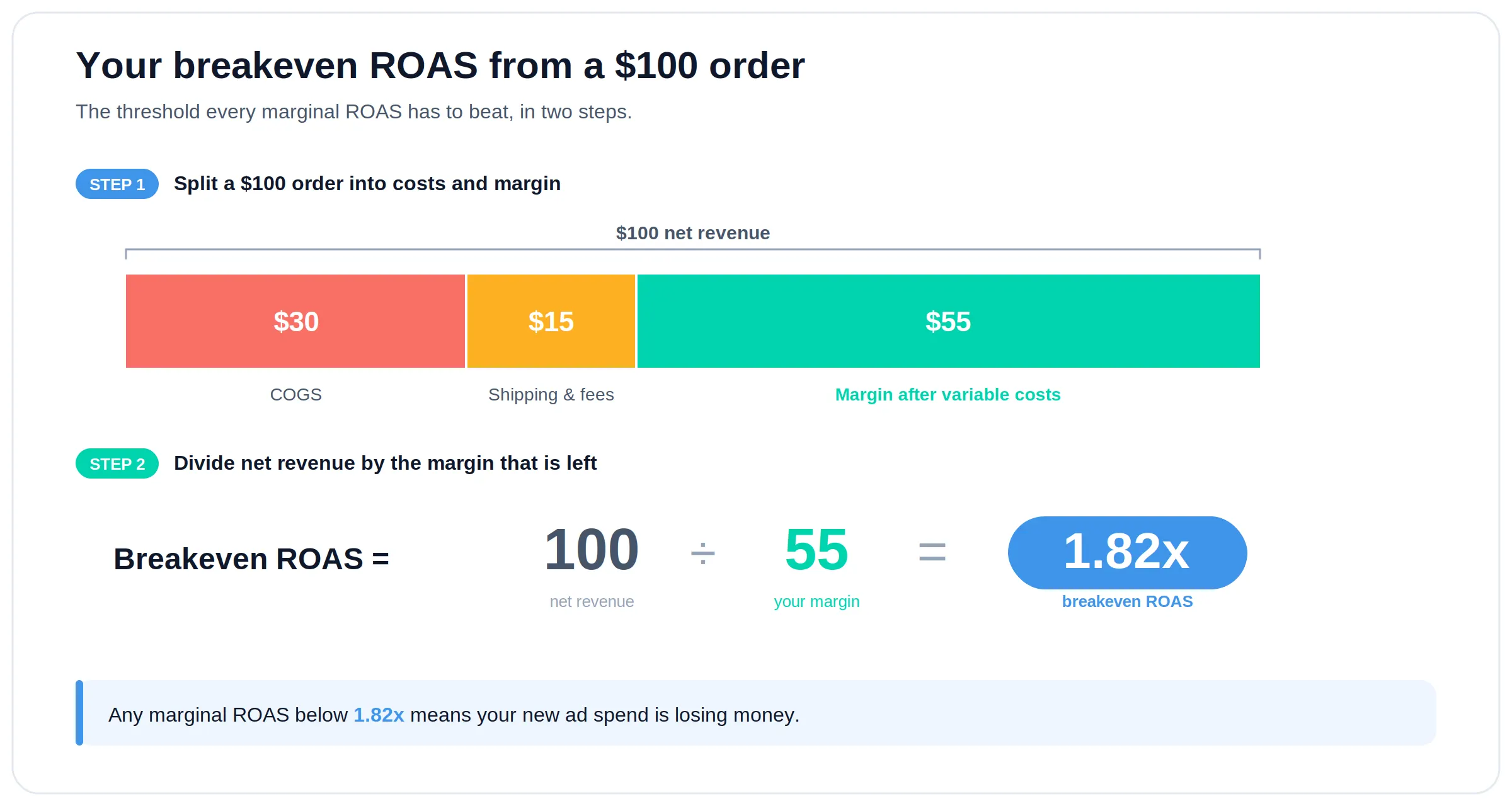
Your margin after variable costs is net revenue minus COGS, shipping, and payment fees. Suppose that for every $100 in net revenue you carry $30 in COGS and $15 in shipping and fees. That leaves $55 in margin after variable costs and a breakeven ROAS of:
100 / 55 = 1.82
Any marginal ROAS above 1.82 means your incremental spend is profitable. Anything below it means the new spend is losing money, even when your blended ROAS still looks fine.
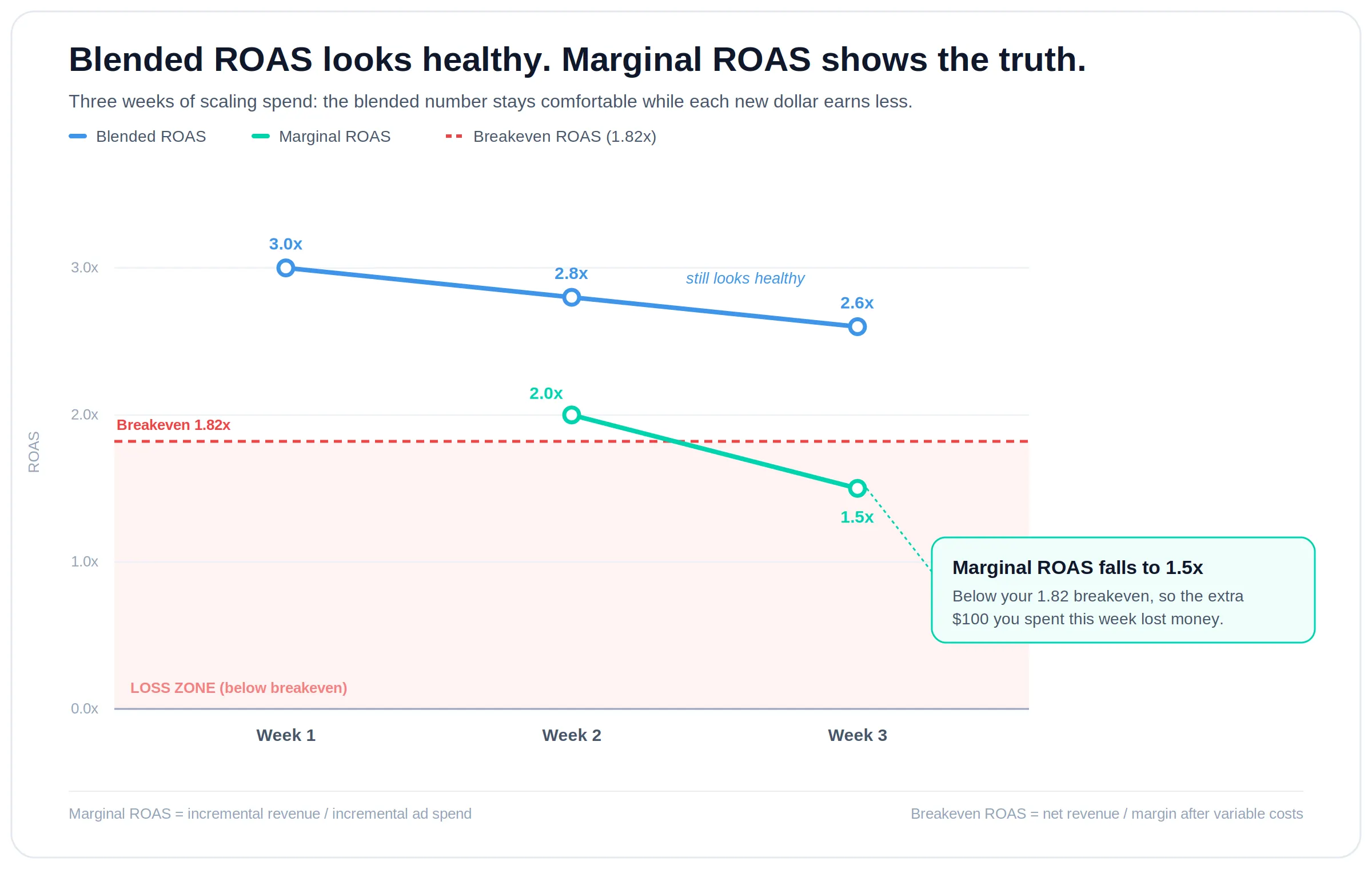
Back to the example. In week 2 your marginal ROAS of 2.0 sits above the 1.82 breakeven, so that $100 was still worth spending. In week 3 your marginal ROAS of 1.5 falls below 1.82, which means the last $100 you added actually lost money. That is your signal to stop scaling, not the blended 2.6x that still looks healthy on the surface.
This is why marginal ROAS belongs next to MER and aMER in your reporting. It is the metric that tells you the exact point where your ad budget stops making money.
Frequently Asked Questions
What is a good marginal ROAS?
A good marginal ROAS is any figure above your breakeven ROAS, which depends on your own margins. If your variable costs leave you a 55% margin after variable costs, your breakeven sits around 1.82, so any marginal ROAS above that is profitable. There is no universal number, because it is set entirely by your product economics.
Is marginal ROAS the same as blended ROAS?
No. Blended ROAS measures the average return across all your ad spend, while marginal ROAS measures the return on only the most recent increment you added. Blended ROAS can stay high while marginal ROAS drops below breakeven, which is why scaling decisions should watch the marginal figure.
Know Your Real Profit And
The Ads That Actually Sell.
No need to spend. Just try it on your store.