7 Shopify Analytics Tools That Deliver Real Value for Growing Stores
Compare 7 Shopify analytics tools on features, pricing and order caps. Find the profit and attribution setup that fits your store instead of overpaying.

If you're looking for a Shopify analytics tool, you have probably hit the limits of the native dashboard by now. You know what's missing and the only thing is you haven't found the right tool yet.
Since you're busy, you install the app that ranks first or gets recommended in a forum. Three months later you regret paying for features you never accessed, and the one number you actually wanted is still missing.
So it's better to spend a few minutes now than to pay for the wrong tool. Work out what you need, then pick a tool that grows with you.
This guide compares the 7 best Shopify analytics tools based on the value and pricing each one provides to a merchant who is looking for a holistic analytics setup.
For each one you get the key features, current pricing, user rating, and the type of store it fits best. Start with the comparison table, then jump to the tool that matches your store.
TL;DR
Most Shopify analytics tools are excellent at one job and thin everywhere else, which is why merchants end up running two apps and reconciling numbers that never quite agree.
Bloom Analytics is the all-round pick: profit, costs, attribution, product and email performance in one view, with unlimited orders on the entry plan.
Profit-first stores: TrueProfit for the deepest cost tracking, Lifetimely for cohort LTV and CAC payback.
Attribution-first stores: ThoughtMetric for multi-touch modelling, Triple Whale for heavy paid media.
Special cases: BeProfit if you sell beyond Shopify, Polar Analytics if someone owns reporting full-time.
Quick Comparison of the 7 Best Shopify Analytics Tools
Tool | Rating | Core functionality | Pricing | Suitable for |
Bloom Analytics | ⭐5.0 | Spend-to-profit analytics with net profit tracking and P&L, cost and expense tracking, marketing intelligence | Sprout plan from $20/mo, unlimited orders | Shopify DTC stores wanting one app for profit and marketing intelligence with insights |
TrueProfit | ⭐4.9 | Profit tracking and P&L clarity | From $35/mo, 300-order limit | Shopify stores wanting net profit analysis as the priority |
Lifetimely | ⭐4.9 | Cohort LTV, P&L, CAC payback, MCP integration | From $49/mo, 500-order limit | Shopify brands where cohort and LTV depth is the buying reason |
BeProfit | ⭐4.5 | Granular financial accounting and P&L health | From $49/mo, 450-order limit | Multi-platform sellers on Shopify, Amazon, WooCommerce and Wix |
ThoughtMetric | ⭐3.8 | Multi-touch ad attribution and customer journey mapping | From $99/mo, 50K pageview limit | Brands whose main gap is attribution, across more than one ecommerce platform |
Triple Whale | ⭐4.0 | Multi-channel ad attribution and profitability | From $219/mo (Foundation plan) | Shopify-first DTC brands spending heavily on paid media |
Polar Analytics | ⭐4.9 | Cross-channel marketing, AI insights, Polar Pixel | Core plan from $750/mo, based on GMV | Multi-channel brands past roughly $5M GMV with someone who owns reporting |
The 7 best Shopify analytics tools
Bloom Analytics
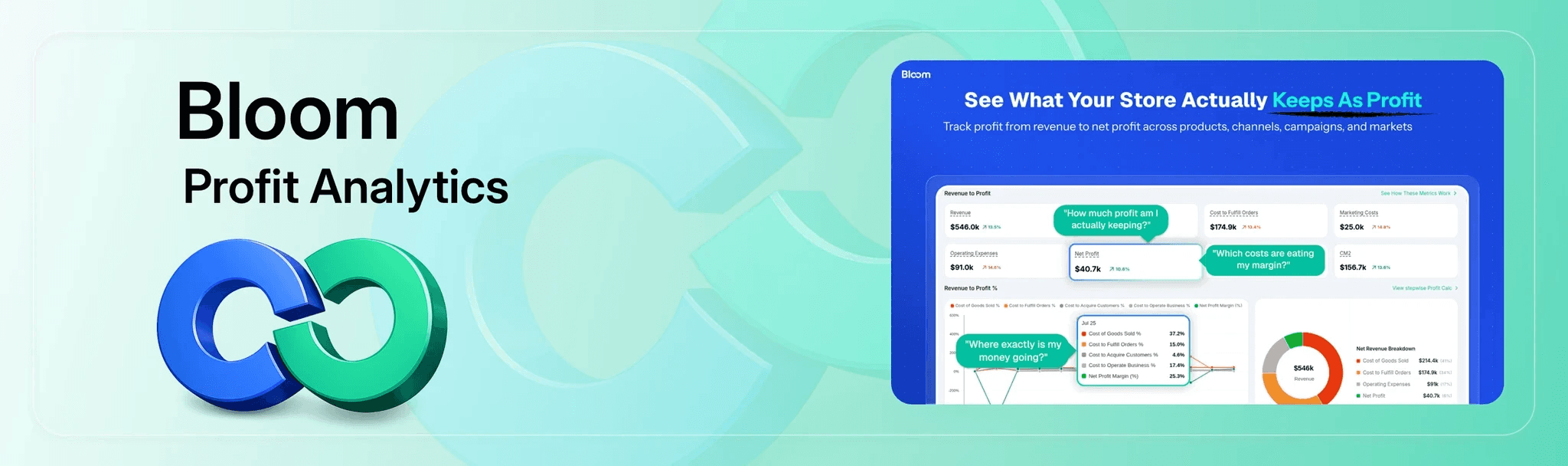
Bloom is a spend-to-profit analytics app for Shopify DTC stores that want profit tracking, marketing attribution and full cost tracking in one place. If you sell on Amazon through Marketplace Connect, it brings that revenue in alongside your Shopify data, so you can toggle between your Amazon and Shopify P&L instead of reconciling two sets of numbers. Marketing intelligence gives you the holistic view of how your store is performing across channels, while separate product, order, email and campaign analysis sit in the same place, each with simple and clear insights.
Key features
Profit analytics across Shopify and Amazon via Marketplace Connect
Custom cost settings, product costs, and untracked expense tracking
Marketing attribution with holistic marketing intelligence
Product performance and profitability at SKU level
Email campaign performance and profitability
Why Choose Bloom : Bloom covers profit and marketing in one view, so your attribution and your P&L always agree. It's also the cheapest entry at $20 a month with unlimited orders no caps, no surcharges.
TrueProfit
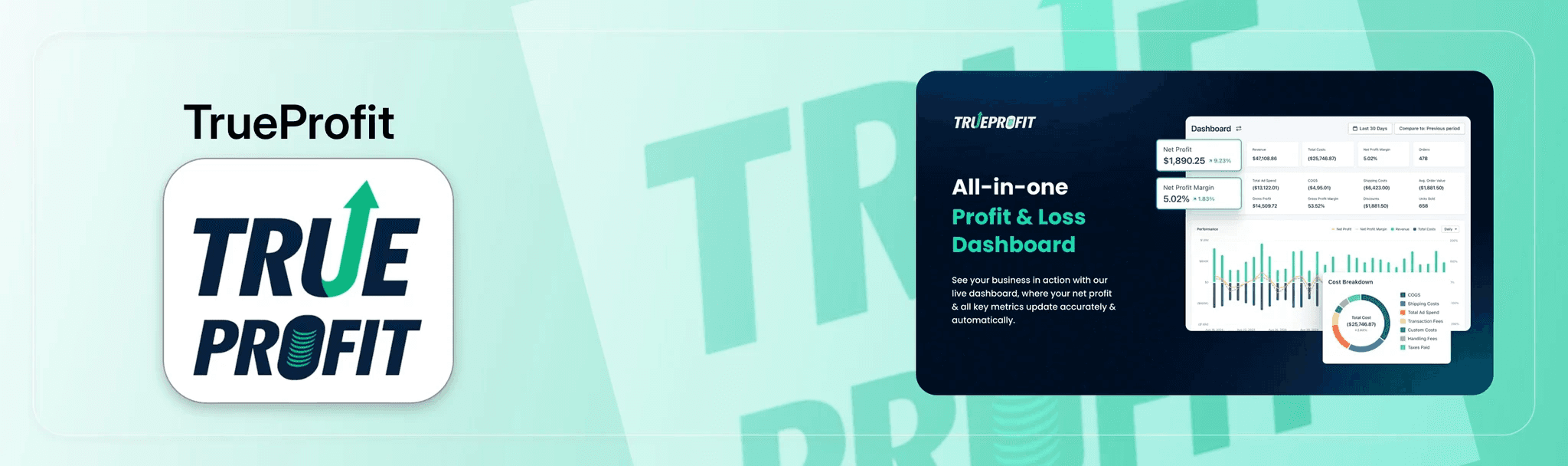
TrueProfit shows your real net profit. It syncs ad spend from the major platforms and handles cost tracking in unusual detail: quantity-based COGS, weight- or location-based shipping, transaction fees and custom costs. Two things to check before committing. Features are tiered, so the P&L report and product analytics start at $60 and marketing attribution only appears on the $200 Enterprise plan. And every plan carries an order cap with per-order surcharges past it, meaning a strong sales month raises your analytics bill.
Key features
Real-time net profit dashboard
Quantity-based COGS and weight-based shipping costs
P&L reporting and product analytics
Customer lifetime value tracking
Mobile app for on-the-go monitoring
Why choose TrueProfit: Pick it if profit is the one number you check. Cost tracking is detailed and the entry price is low. Just know ad tracking sits on the top plan, and extra orders cost extra.
Lifetimely
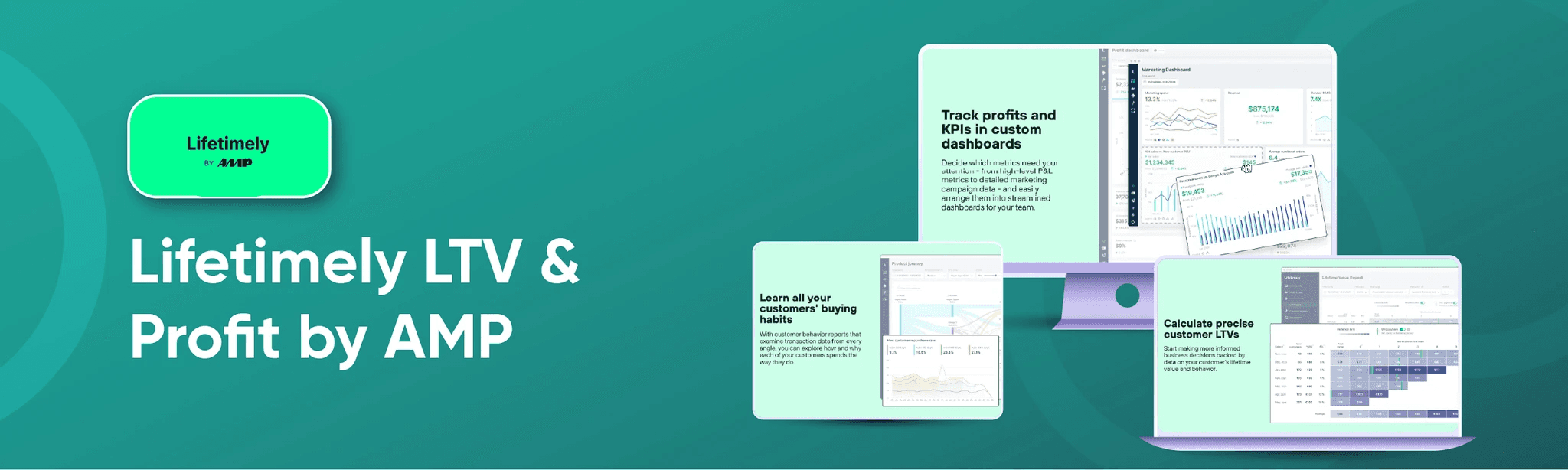
Lifetimely, now part of AMP, is built around customer economics rather than campaigns. It produces a daily P&L, but the reason brands buy it is the cohort work: predictive LTV, CAC payback periods, and repeat purchase curves you can segment by first purchase date, product, channel or geography. Its Profit Agent monitors those numbers and proposes actions for you to approve. Pricing is by order volume with no overage fees.
Key features
Predictive LTV modelling
Daily automated profit and loss
CAC payback analysis by channel and cohort
Cohort and repeat-purchase reporting
Lifetimely MCP and Profit Agent
Why choose Lifetimely: Choose it if customer analytics is your priority. Nothing here goes deeper on repeat purchases, customer value and how long it takes to earn back what you spend. You pay by order volume, and every plan gets every feature.
BeProfit
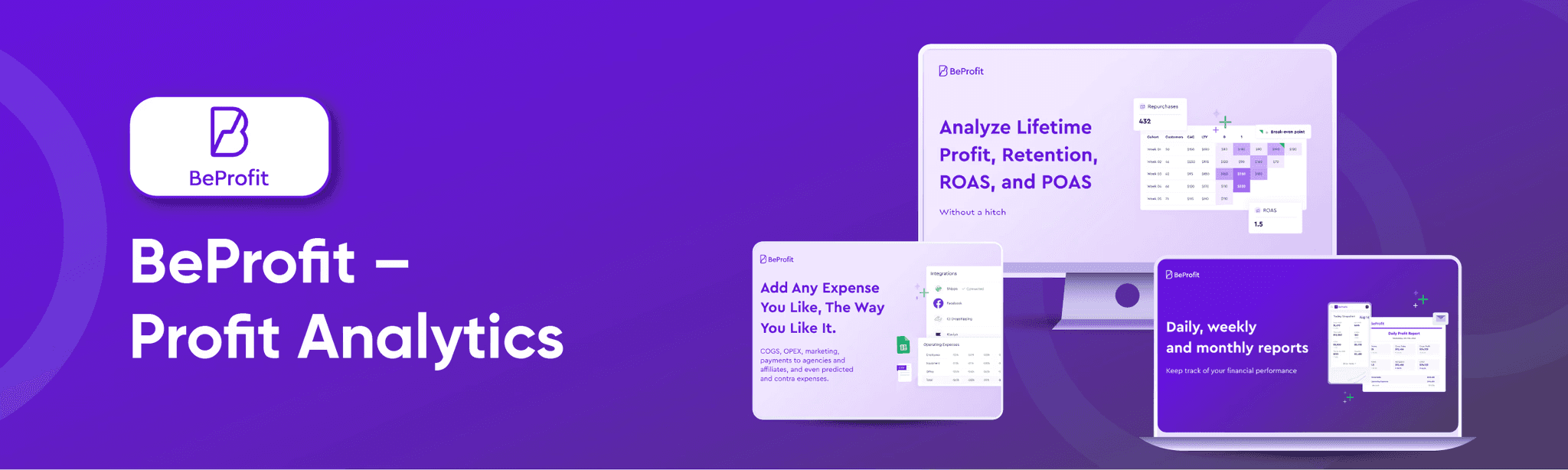
BeProfit is the multi-platform pick. It tracks profit and expenses across Shopify, Amazon, WooCommerce and Wix in one dashboard, which matters if your revenue is genuinely split and you're tired of reconciling separate reports. The profit views are granular, with a live P&L and a cost breakdown showing how shipping, discounts, marketplace fees and marketing each bite into margin. Higher tiers add UTM attribution, LTV cohorts and pricing simulators. The attribution is UTM-based, so its accuracy depends entirely on how disciplined your tagging is.
Key features
Live P&L across multiple platforms and shops
Profit by order, product, country and channel
Custom reports and customisable dashboards
UTM attribution and LTV cohort analysis
Pricing and profit simulators
Why choose BeProfit: Pick it if you sell on more than just Shopify. It puts Shopify, Amazon, WooCommerce and Wix into one profit view, which saves hours of manual work.
ThoughtMetric
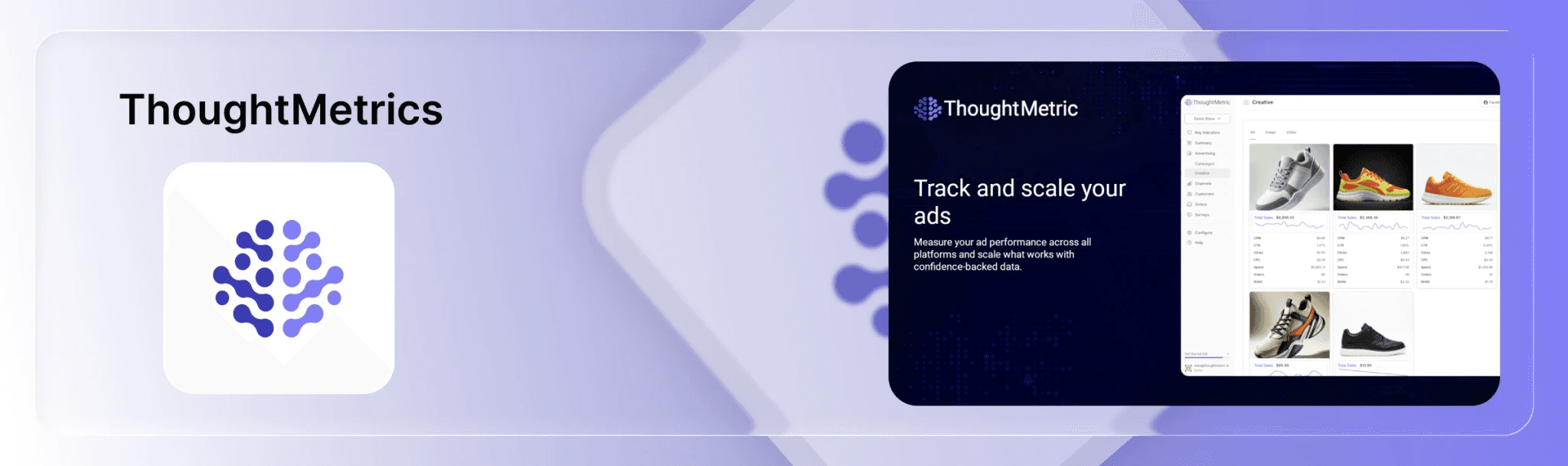
ThoughtMetric is an attribution tool first and a reporting tool second. It offers five models including multi-touch, backed by server-side tracking and Conversions API integrations for Meta and Google. Customer and product analytics show how each segment and SKU performs. Pricing runs on pageviews rather than orders, which means a high-traffic, low-converting store pays the same as a high-converting one.
Key features
Five attribution models including multi-touch
Server-side tracking with Meta and Google CAPI
Post-purchase surveys
Customer journey and segment analytics
Product-level performance reporting
Why choose ThoughtMetric: An attribution-first tool. It tracks the full customer journey, not just the last click. You pay by pageviews, so it suits stores that convert well more than high-traffic ones.
Triple Whale
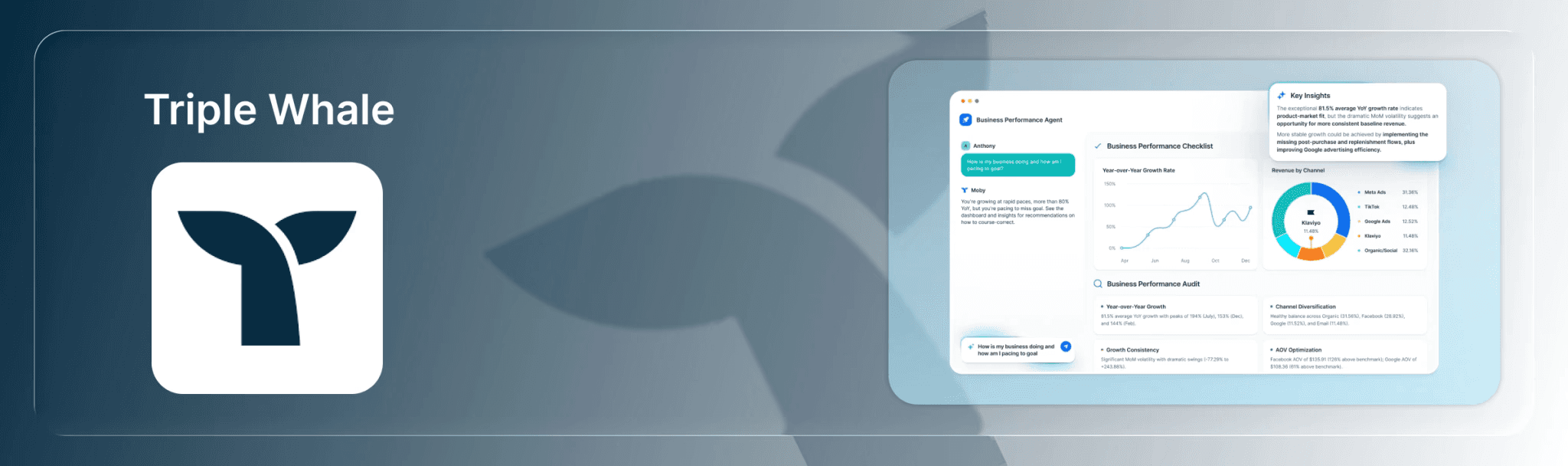
Triple Whale is a marketing and ad spend platform built for performance marketers running Meta, Google and TikTok side by side. Its Triple Pixel is proprietary first-party tracking designed to recover conversions the standard platform pixels lose, and Moby, its AI assistant, answers campaign questions in plain language. Creative analytics and anonymous peer benchmarking help you decide what to scale and when. The scope is the trade-off: it's a marketing tool, so profit visibility beyond revenue is thin. Pricing also runs on your annual GMV under an annual contract, which means the bill climbs as the store grows.
Key features
Consolidated multi-channel ad dashboard
Triple Pixel first-party attribution
Moby AI assistant for marketing queries
Creative performance and fatigue tracking
Peer benchmarking on CAC, AOV and ROAS
Why choose Triple Whale: Pick this if paid ads are your major business mover. It's built to show you which ads are working today so you can move budget the same day. Just know it won't tell you much about profit, and the price goes up as your sales grow.
Polar Analytics
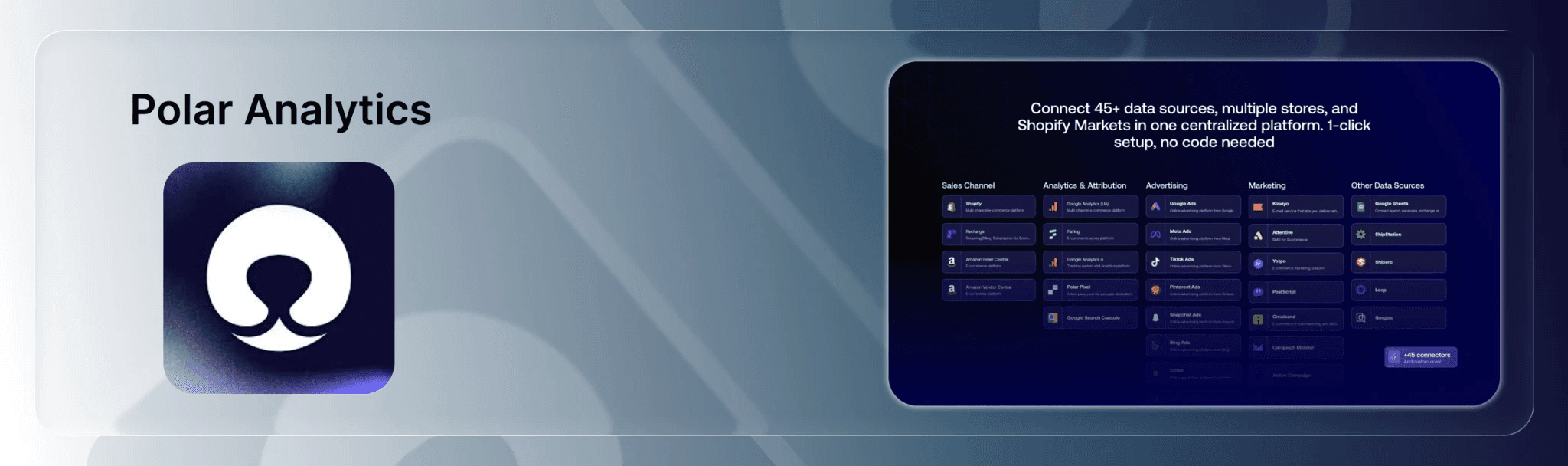
Polar adds multi-touch attribution, cohort analysis and ready-made dashboards on top of your data. When the basic dashboards aren't enough, it goes deeper, giving you the power of a custom data warehouse. That's also why it costs more. Polar charges based on your total sales (GMV) and starts at a higher price than most tools, so it works best for teams that have someone focused on reporting full-time.
Key features
45+ connectors into a dedicated Snowflake warehouse
Multi-touch attribution models
Cohort analysis and LTV tracking
Polar Pixel first-party data collection
Custom reporting, SQL access and Ask Polar AI
Why choose Polar Analytics: Pick Polar when normal dashboards aren't enough and you want to dig deeper. It gives you the power of a full data setup without building one yourself.
The bottom line
The best Shopify analytics tool is the one that helps you make better growth decisions, not the one with the most charts. Most of the tools here are strong at one thing, which is exactly why merchants end up adding a second app for everything else.
And when you need two of them at once, you either pay for both or live with numbers that never quite match. That's the gap Bloom fills: profit, costs, attribution, product and email performance in one place, with unlimited orders. Spend to profit, without stitching tools together.
Frequently Asked Questions
What is the best Shopify analytics tool?
It depends on what you check daily. Bloom Analytics is the strongest all-round pick for DTC stores that want profit and marketing attribution in one view, starting at $20/mo with unlimited orders. If cohort LTV is your buying reason, Lifetimely goes deepest; if paid media is your main lever, Triple Whale is built for that.
Do Shopify analytics apps charge extra as your order volume grows?
Several do. TrueProfit adds per-order surcharges past its cap. Lifetimely prices by order volume but charges no overage fees. Triple Whale and Polar price on annual GMV, so the bill climbs as the store grows. Bloom's entry plan has no order cap at all.
Which tool has the best ad attribution?
ThoughtMetric offers five attribution models including multi-touch, with server-side tracking and Meta and Google CAPI integrations. Triple Whale's Triple Pixel is first-party tracking built to recover conversions the standard platform pixels miss. Polar Analytics offers multi-touch attribution on top of a Snowflake warehouse, at a much higher price point.
Can one app handle both profit tracking and marketing attribution?
Bloom includes profit analytics and marketing intelligence together from the entry tier. Triple Whale is attribution-first, so profit visibility beyond revenue is thin.
Which Shopify analytics tools work beyond Shopify?
BeProfit tracks Shopify, Amazon, WooCommerce and Wix in one dashboard. ThoughtMetric supports more than one ecommerce platform. Bloom pulls Amazon revenue in via Marketplace Connect, so you can toggle between an Amazon and a Shopify P&L.
Know Your Real Profit And
The Ads That Actually Sell.
No need to spend. Just try it on your store.