A Honest Ranking of Shopify Profit Tracking Apps
Compare the 10 best Shopify profit tracking apps for 2026. Real pricing, features that matter, and the right pick for your store stage.

Last updated: June 2026
Most Shopify profit apps fail the same way. They show you forty charts and twenty metrics, and you still cannot tell whether last week was actually profitable. Feature count is not the problem. Accuracy is.
The right app is not the one with the longest feature list. It is the one that calculates your specific store's numbers correctly. A dropshipper with one supplier needs different things from a brand running $80K/month in Meta spend across three product lines. Pay for the accuracy you need, not the toolbox you might one day use.
This guide ranks the ten Shopify profit tracking apps worth considering in 2026, with current pricing, what each one actually does well, and where each one falls short.
Key Takeaways
Best overall: Bloom for net profit and attribution in one app at a usage-based price.
Best for net profit tracking with mobile access: TrueProfit, Bloom Analytics.
Best for cohort and LTV analytics: Lifetimely (now part of AMP).
Best for multi-platform brands (Shopify + Wix + Amazon): BeProfit.
Best free entry point: Triple Whale's Free plan or Profitario for under 100 orders.
Skip if you sell mostly on Shopify: Sellerboard, Profiteer.
How to choose a Shopify profit tracking app
A profit tracking app does one job: tell you what you actually keep after every cost. Anything beyond that is a bonus. Before comparing apps, decide what you need by answering four questions.
Does it pull real COGS, or estimate from margins?
Cost of goods sold has to come from your actual product data, not a flat percentage. Estimates hide the products that are quietly losing money.
Does it allocate shipping per order or per region?
True shipping cost varies by destination, weight, and carrier. Apps that average shipping across all orders miss the regional profit gaps.
Does it track ad spend at the campaign or just the account level?
Account-level ad tracking tells you Meta is at 3x ROAS. Campaign-level tracking tells you which specific campaigns drag the average down.
Does pricing scale with what you actually use?
Usage-based or order-based pricing protects small stores. Flat enterprise pricing punishes you for being early.
If an app cannot answer all four cleanly, it is not built for serious profit tracking.
Quick comparison
App | Starting price | Free trial | Rating | Best for |
$20/month | 14 days | ⭐ 5 | Net Profit + attribution in one tool | |
$35/month | 14 days | ⭐ 4.9 | Net profit focus with mobile access | |
$49/month | Free plan | ⭐ 4.8 | Cohort and LTV analytics | |
$49/month | 14 days | ⭐ 4.2 | Multi-platform brands | |
Free / $129+/month | Free plan | ⭐ 4.2 | High-spend attribution | |
$4.99/month | 14 days | ⭐ 4.7 | Very small stores | |
$5/month | 7 days | ⭐ 3 | Monthly cost allocation | |
Free / $20+/month | Free tier | ⭐ 4.5 | Beginner dropshippers | |
$9/month | 1 month | ⭐ 4 | Amazon-first sellers | |
$15/month | Trial | ⭐ 3.2 | Inventory valuation |
Pricing verified June 2026. Several vendors have restructured plans more than once in the last year, so always confirm on the app's listing before purchase.
1. Bloom: Profit and Analytics
Bloom is a profit intelligence layer on top of Shopify. It combines real COGS, actual shipping costs, ad spend, refunds, and operating expenses into one true profit view, and pairs that with marketing attribution that does not depend on platform reported ROAS.
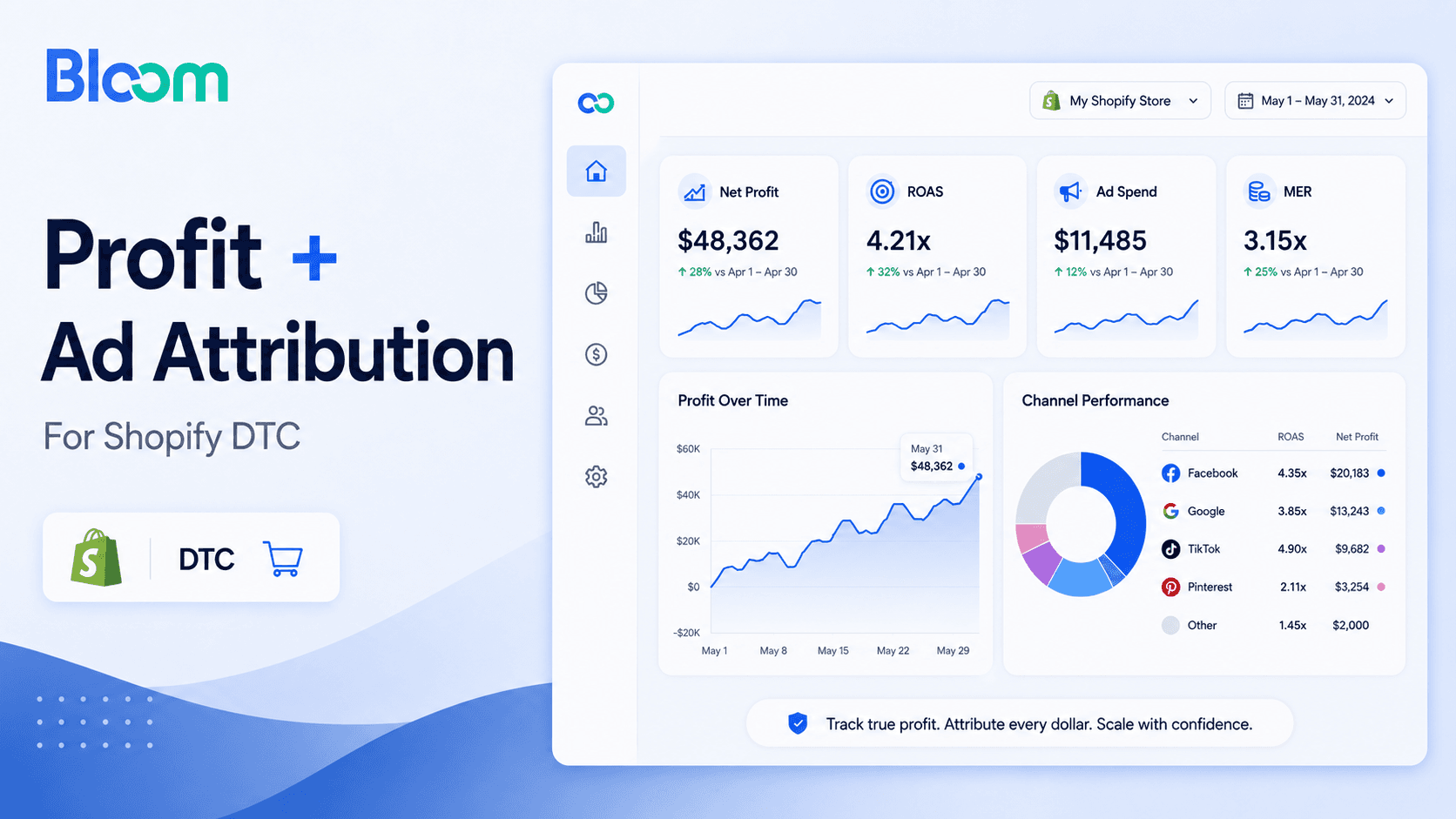
The differentiator is the Margin Trap label. Bloom flags products that look profitable on platform ROAS but lose money after the full cost stack runs through. Most competitors cannot detect this because they only see revenue, not cost adjusted profit per product. Bloom also tracks Email campaign and flow profitability, which most ad-focused tools skip entirely.
Pricing starts at $20/month and goes to $80/month for the attribution tier. Every plan includes unlimited orders, so the price does not climb when sales do. Connects to three Shopify stores by default.
Best for: Shopify DTC merchants who want profit and ad attribution without paying for a third tool.
Watch out for: The free trial is 14 days, so plan setup time before the clock starts.
2. TrueProfit Analytics
TrueProfit is one of the longest-running net profit trackers on Shopify, with a strong mobile app and recent MCP integrations for ChatGPT and Claude. It auto-syncs ad spend from Meta, Google, TikTok, Bing, Snapchat, Pinterest, and Amazon, and pulls COGS, shipping, and transaction fees automatically.
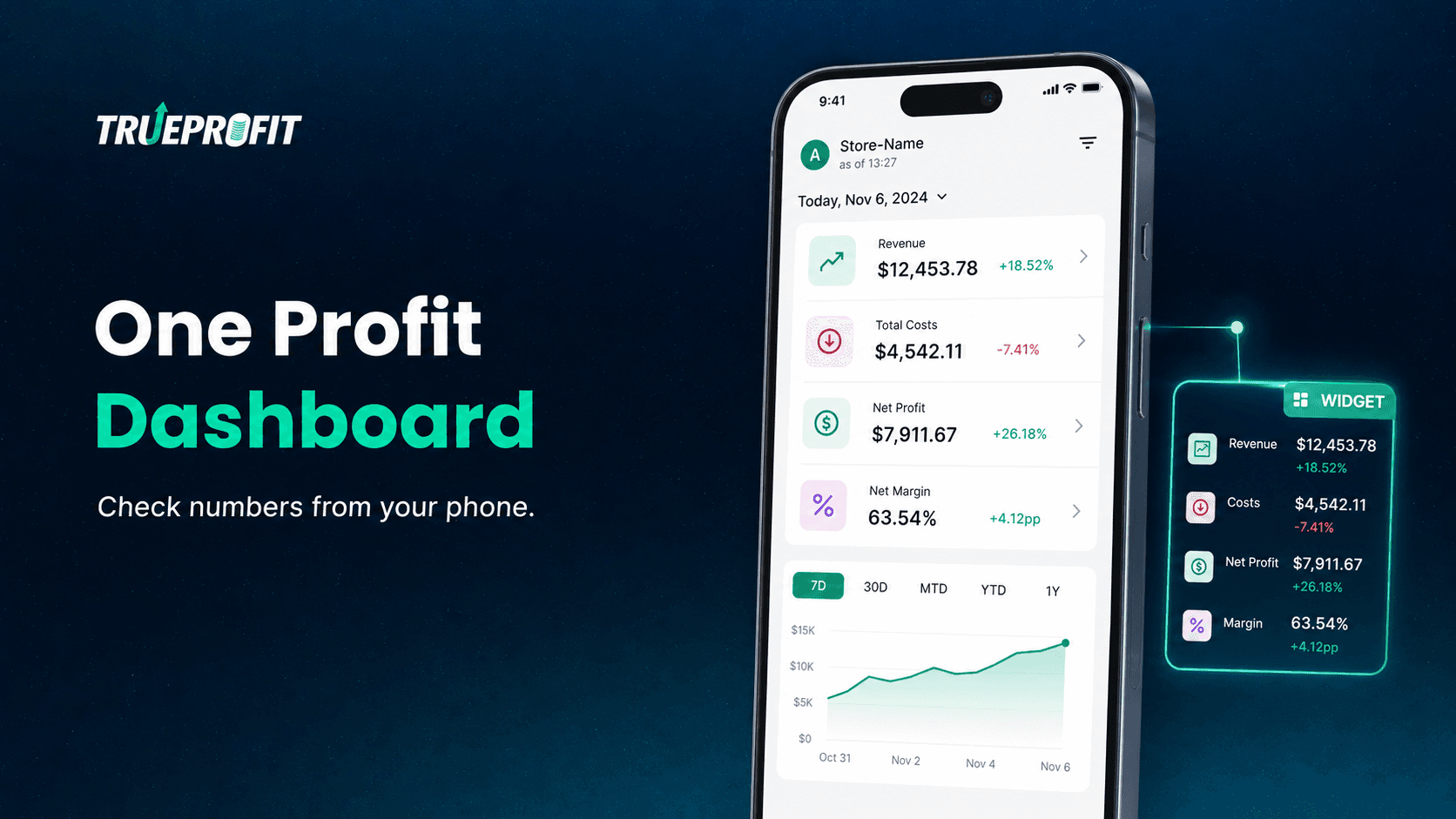
The strength is the focus on a single metric: net profit. The dashboard is clean, the data refreshes every fifteen minutes, and the mobile app means you can check your real margin from anywhere. Product-level analytics let you rank items by profit, not just revenue.
Pricing runs $35 to $200/month based on order volume, with a 14-day free trial. Some recent reviews flag transaction fee calculation bugs on PayPal orders, so verify your numbers against Shopify directly during setup.
Best for: Operators who want a single profit dashboard and check numbers from their phone.
Watch out for: Pricing climbs steeply at higher order volumes.
3. Lifetimely Profit Agent and LTV
Lifetimely, now part of the AMP suite and branded as the AI Profit Agent for Shopify, leads on cohort analysis and lifetime value modeling. If you spend over $20K/month on ads and need to know how long it takes Meta-acquired customers to pay back, this is where the depth lives.
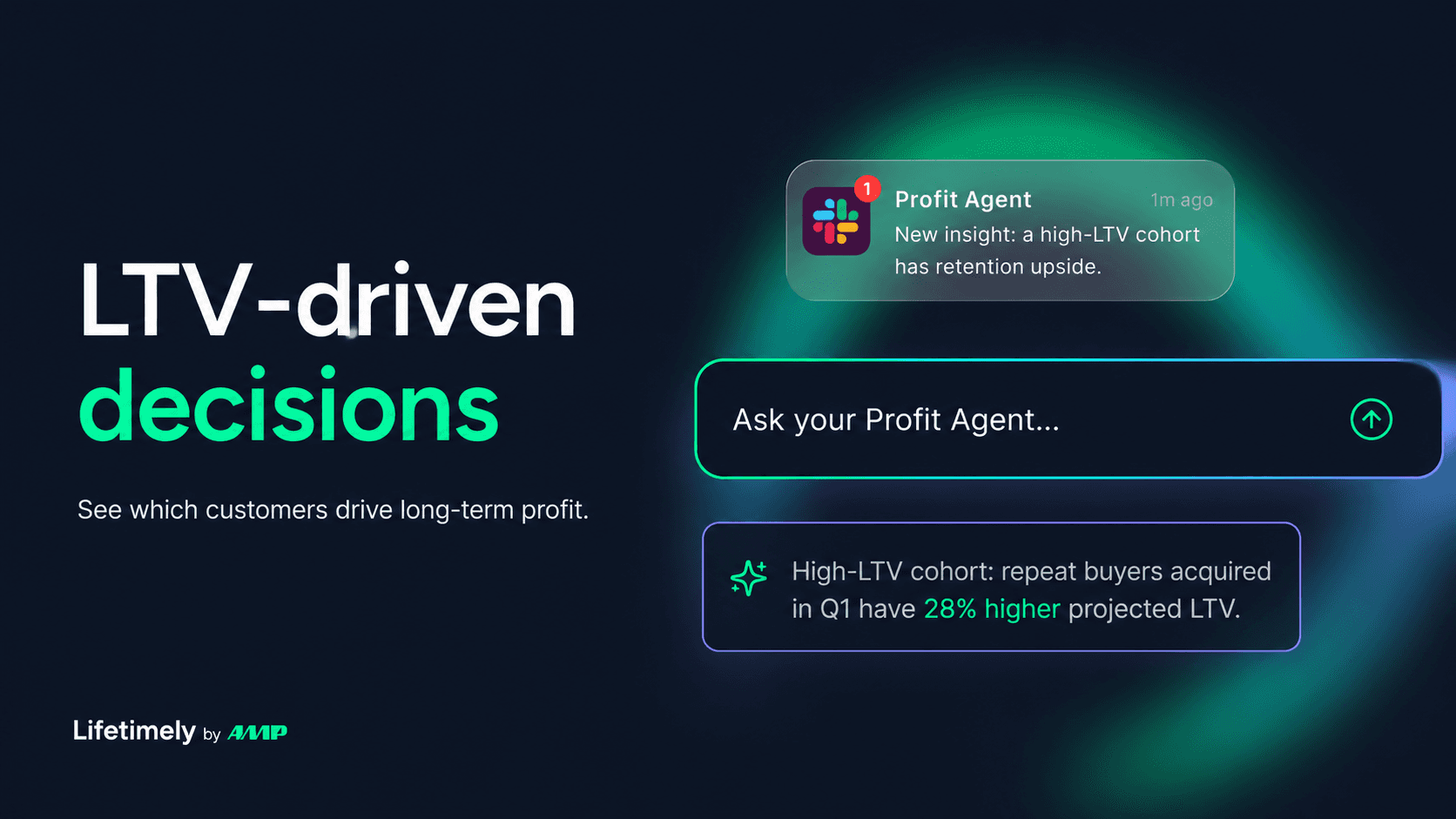
The cohort reporting segments customers by first purchase date, first product purchased, acquisition channel, and geography. Each cohort shows cumulative profit, repeat rate, and CAC payback period over time. The recently added AI agent surfaces anomalies and suggests actions based on the cohort data.
Pricing starts around $49/month for low-volume stores and climbs to $749/month at scale. The first paid tier most operators land on is roughly $149/month. A free plan exists for stores under $5K/month in tracked sales.
Best for: Brands scaling paid acquisition and serious about LTV-driven decisions.
Watch out for: Setup takes effort, and the higher tiers are a real line item.
4. BeProfit Profit Analytics
BeProfit covers Shopify, WooCommerce, Wix, and Amazon, which makes it the natural pick for brands selling across more than one platform. The dashboard breaks down profit by order, product, country, and channel, with custom report templates and automated email summaries.
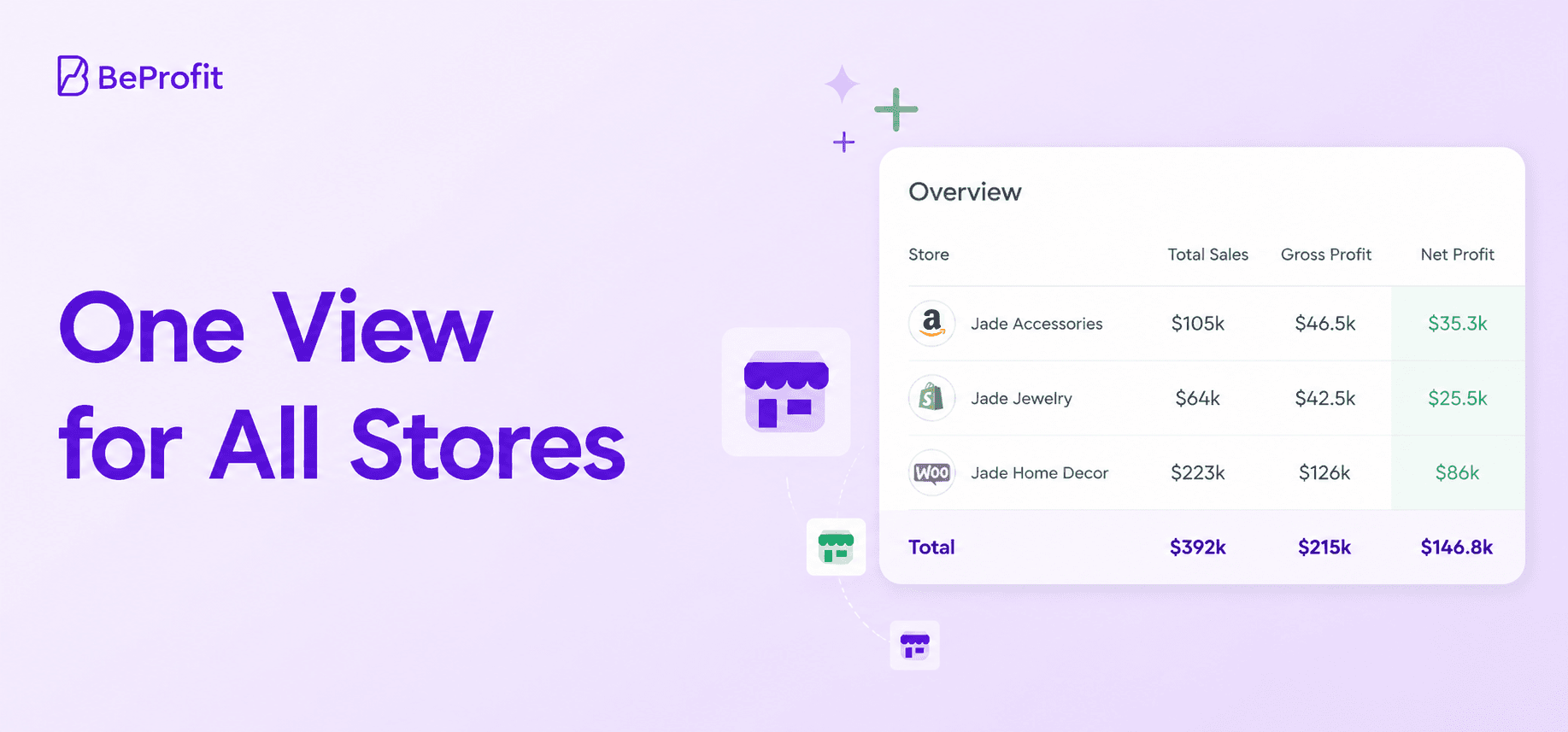
Cost configuration is flexible. COGS can be set as fixed rates, quantity tiers, or variant pricing. Shipping costs can be tracked by quantity, weight, or order value. Transaction fees and operating costs can be layered in with rules across marketing, procurement, and shipping.
Pricing starts at $49/month, with the Ultimate plan at $149/month. A 14-day free trial covers all plans. Note that recent Shopify App Store reviews include billing complaints from merchants who struggled to cancel; if you start the trial, set a calendar reminder before day fourteen.
Best for: Multi-platform merchants who need profit tracking across Shopify, Wix, Amazon, or WooCommerce.
Watch out for: UTM-based attribution loses accuracy in iOS environments.
5. Triple Whale
Triple Whale rebuilt itself in 2025 and 2026 around AI agents and incrementality testing, and it now markets itself as an AI operating system for ecommerce rather than just an analytics tool. The Triple Pixel remains the strongest piece, with multi-touch attribution that works around iOS privacy limits.
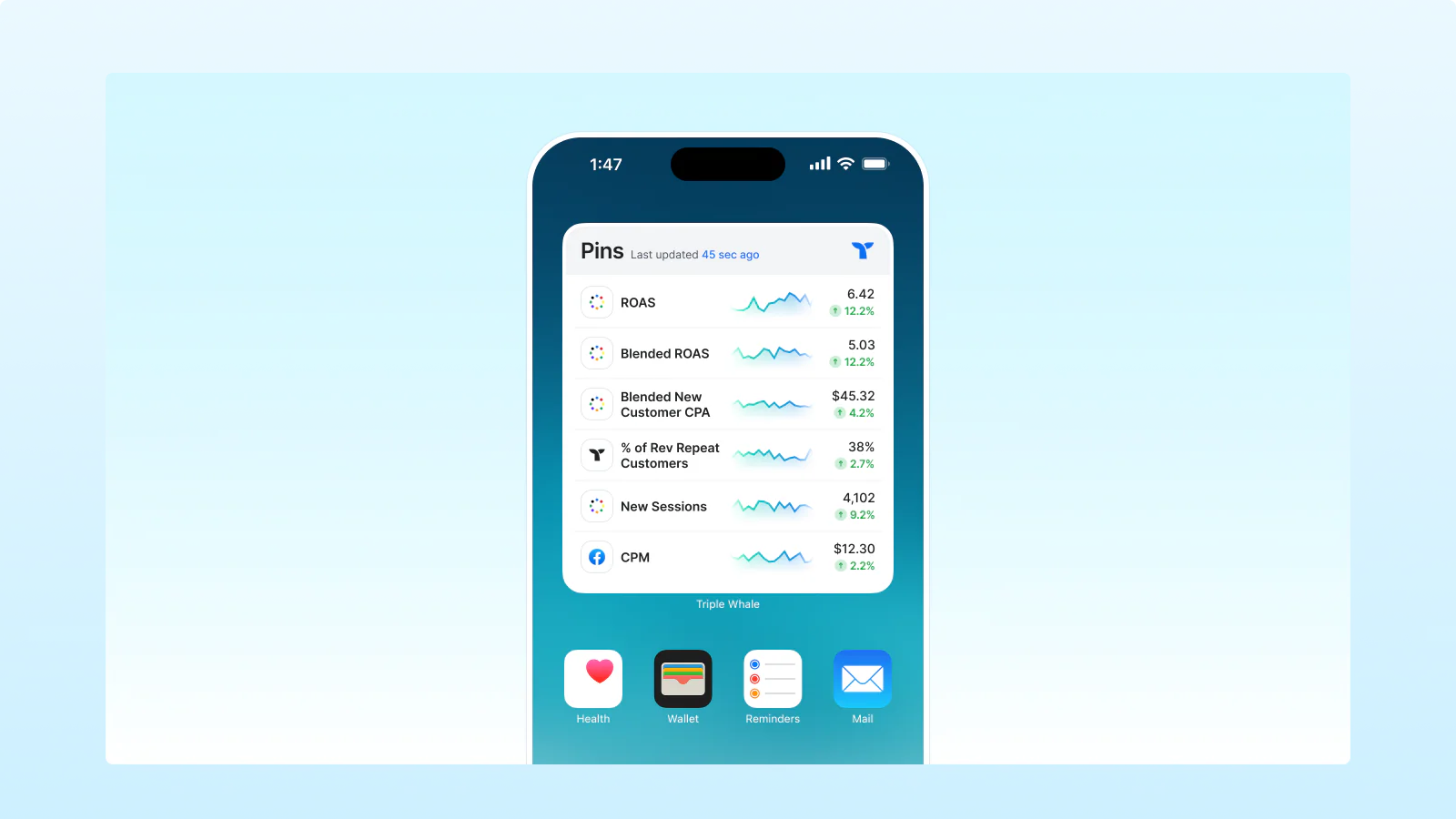
The Free plan now includes the pixel, first and last click attribution, a 12-month lookback, and up to ten users. That is genuinely useful if you want to test Triple Whale without commitment. Paid plans add multi-touch attribution, creative analytics, cohort depth, and AI agents.
Paid pricing is tiered by GMV. Smaller stores can start around $129 to $219/month. Higher GMV brands pay significantly more, with Automate tier referenced at $749/month and Enterprise pricing custom-quoted. Annual commitments lock in tier pricing.
Best for: Brands spending over $30K/month on ads who want creative analytics and AI-assisted attribution.
Watch out for: The pricing scales fast with GMV. What costs $200 today could be $1,000+ next year.
6. SimplyCost
SimplyCost is the cheapest serious option on this list. At $4.99/month with a 14-day free trial, it automates basic expense and profit calculations: COGS, shipping cost, transaction fees, and ad spend get pulled in and totaled into a real-time profit number.
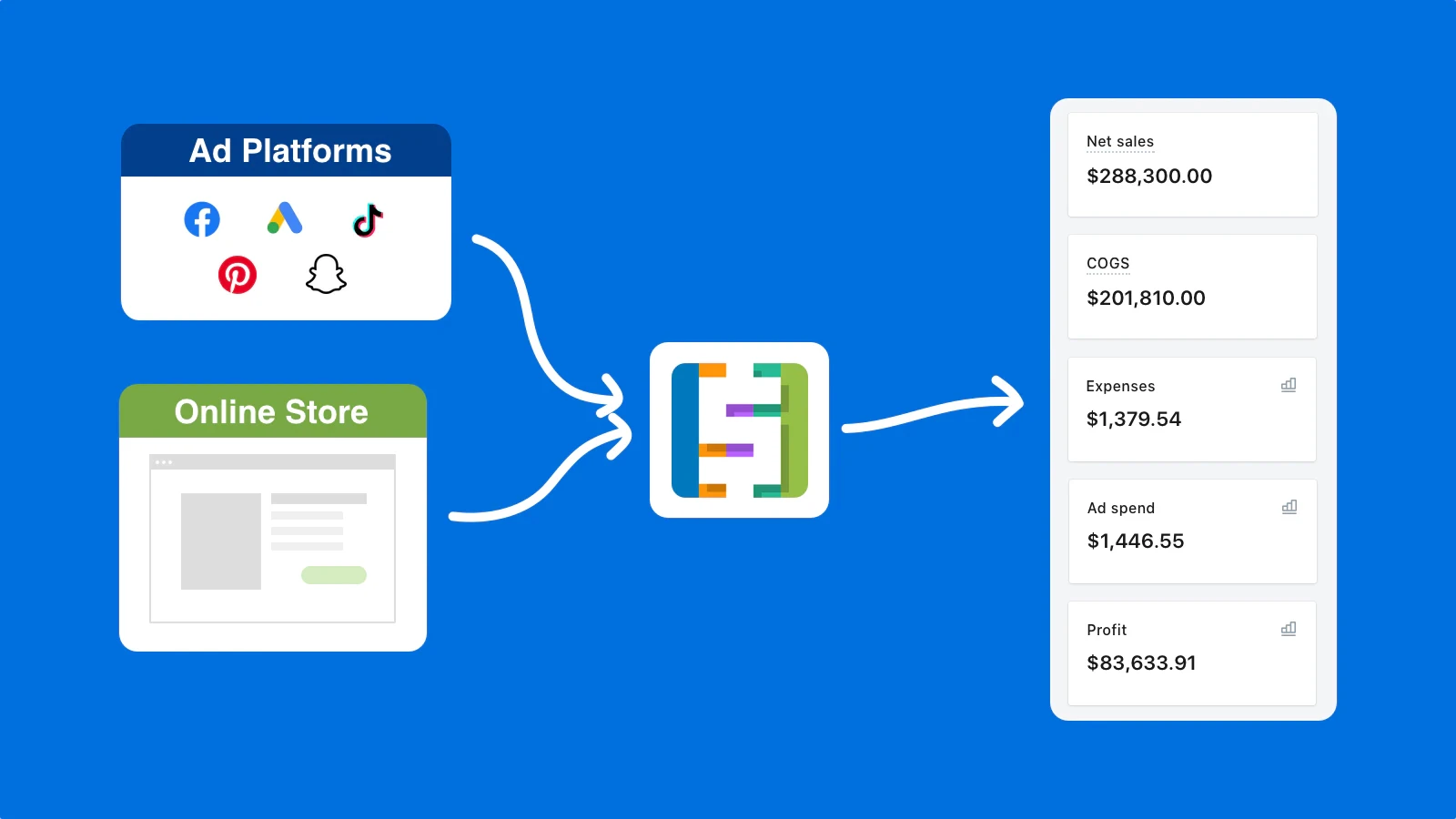
It is not built for attribution, not built for cohort analysis, and not built for product-level decision making. What it does, it does well, which is give a tiny store a clean profit number without spreadsheets.
Best for: Stores doing under $20K/month that just need to know their real margin.
Watch out for: You will outgrow it the moment you start spending on ads at scale.
7. Delirious Profit
Delirious Profit handles one specific job well: spreading monthly expenses evenly across days for accurate daily profit calculations. If you have lumpy monthly costs like rent or software subscriptions, this avoids the spike-and-zero pattern that breaks daily P&L reports.
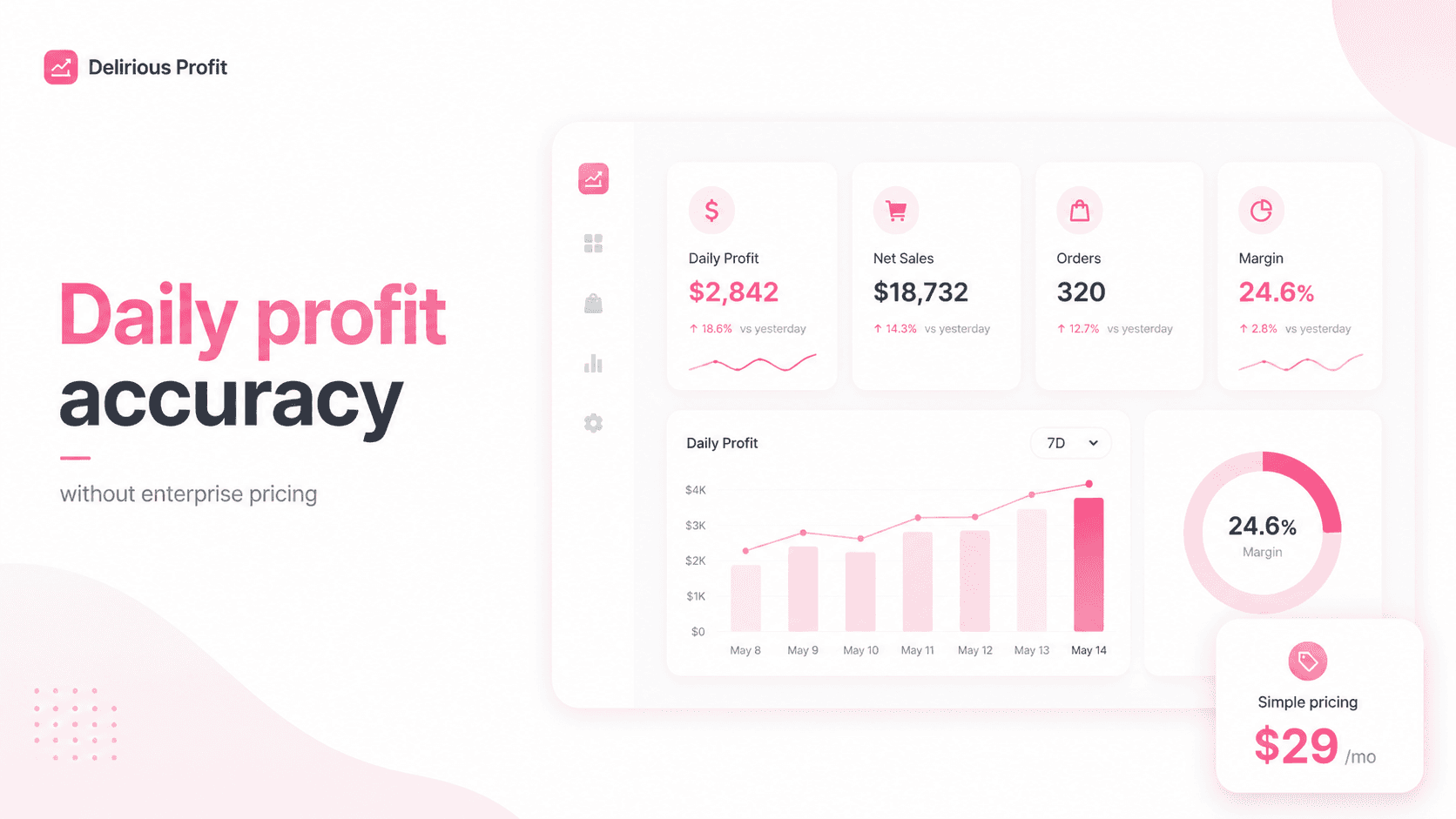
Pricing is $5/month with a 7-day trial. It does batch COGS imports and offers solid reporting for small stores. Support is consistently praised in reviews.
Best for: Small Shopify stores that want daily profit accuracy without enterprise pricing.
Watch out for: No marketing attribution, no campaign-level data, no cohort analysis.
8. Profitario
Profitario imports data from Shopify, AliExpress, Facebook Ads, and PayPal, which makes it useful for dropshippers running a basic stack. The interface is approachable and the free tier (up to 100 orders) is enough to learn the platform.
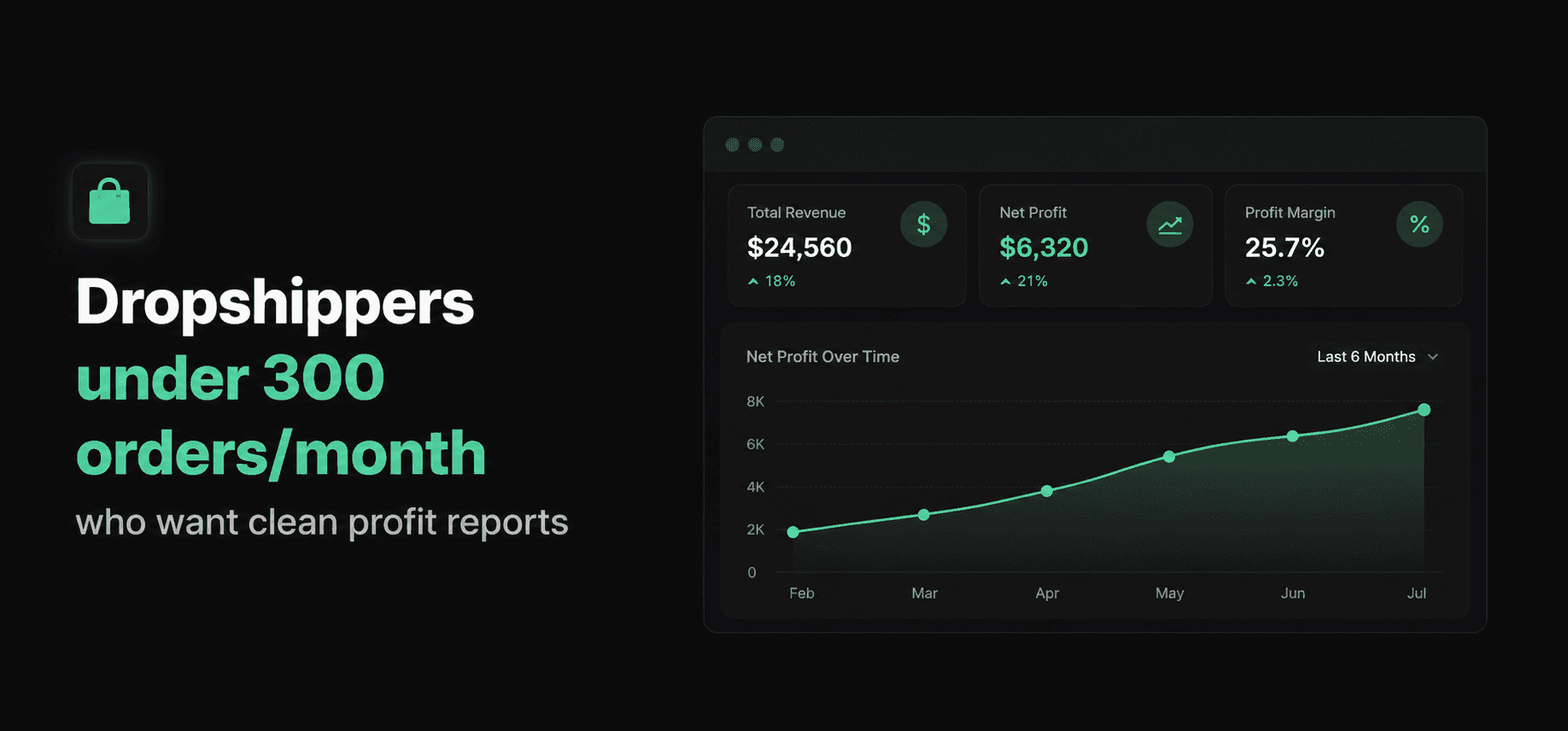
Pricing starts at $20/month and adds $0.20 per order above 300 monthly orders. That keeps it affordable for small stores but turns into a meaningful cost at scale.
Best for: Dropshippers under 300 orders/month who want clean profit reports.
Watch out for: Limited integrations beyond the dropshipping stack.
9. Sellerboard
Sellerboard is an Amazon-first profit analytics tool. The Shopify integration is real and works (tiered pricing from $9 to $79/month on Shopify), but the product was built for FBA sellers and most of the depth lives on the Amazon side.
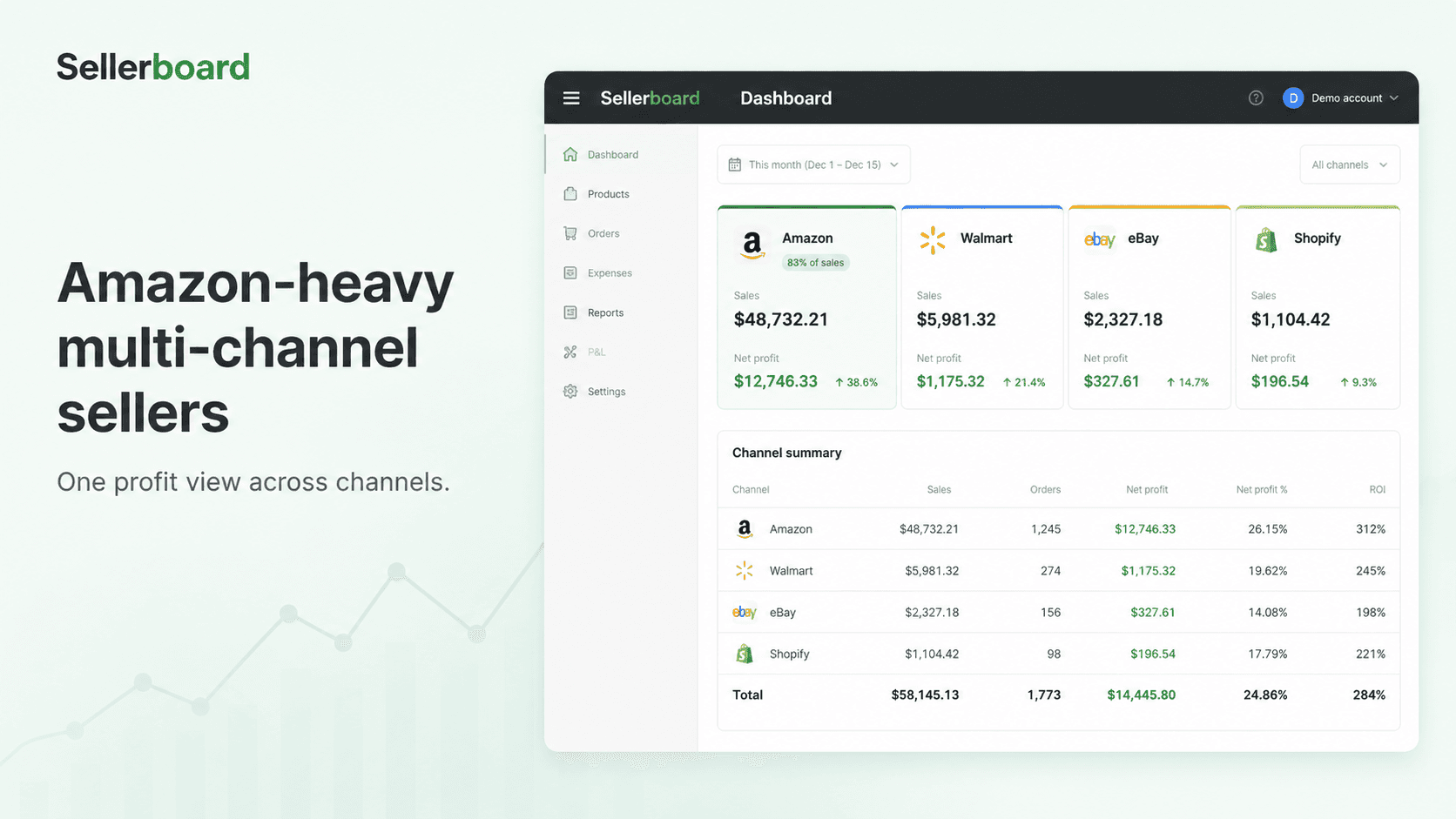
The Shopify dashboard covers COGS, shipping profiles, payment fees, indirect expenses, and LTV. If you run both Amazon and Shopify, Sellerboard gives you a unified view of both businesses. If you only run Shopify, you are paying for muscle you will not use.
Best for: Multi-channel sellers with significant Amazon volume.
Watch out for: Most of the product blog and tooling assumes Amazon, not Shopify.
10. Profiteer
Profiteer is closer to an inventory valuation tool than a profit tracker. It calculates unsold stock value in real time and gives detailed margin reports for any sales period, adapting to changing costs and retail prices.

It does not pull ad spend, does not track attribution, and does not break down profit by campaign or channel. For a brand focused on inventory and bookkeeping accuracy, it is a clean tool. For a brand running paid acquisition, it is missing the half of the equation that actually drives spend decisions.
Pricing starts at $15/month.
Best for: Inventory-heavy stores that need accurate unsold stock valuation.
Watch out for: This is not a profit tracker in the DTC sense. Pair it with something else if you run ads.
Which one should you pick?
Doing under $20K/month and just want a profit number: SimplyCost or Delirious Profit.
Running ads but new to Shopify: Profitario's free tier, then Bloom or TrueProfit as you grow.
Doing $50K+ a month with paid acquisition across two or more channels: Bloom for the combination of profit and attribution at a predictable price, or TrueProfit if you want only profit tracking with a mobile app.
Scaling fast and need cohort depth: Lifetimely.
Spending over $30K/month on ads and need creative and attribution depth: Triple Whale.
Selling on Shopify plus another platform: BeProfit for general use, Sellerboard if Amazon is the bigger channel.
Frequently Asked Questions
What is the best Shopify profit tracking app for small stores?
For stores under $20K/month, SimplyCost ($4.99/month) or Delirious Profit ($5/month) cover the basics: COGS, shipping, transaction fees, and a real-time profit number. Profitario's free tier (up to 100 orders) is the cheapest way to start. Bloom and TrueProfit become worth the cost once you start spending on ads and need per-channel profit data.
Does Shopify track profit on its own?
Shopify shows revenue, orders, and basic cost-of-goods if you fill in the cost per item field for every product. It does not pull ad spend, transaction fees, refunds, shipping costs, or operating expenses into a single net profit view. Most merchants leave money invisible in Shopify's native reports, which is why third-party profit tracking apps exist.
How accurate are profit tracking apps?
Accuracy depends on the data sources connected. Apps that pull real COGS from Shopify or a CSV upload, sync ad spend directly from Meta, Google, and TikTok, and capture actual shipping costs per order are accurate to within a few percent. Apps that estimate margins or use UTM-only attribution drift further from real numbers, especially after iOS privacy changes.
Can I connect ad spend to profit on Shopify?
Yes, but only through a third-party app. Shopify does not pull Meta, Google, or TikTok ad spend natively. Bloom, TrueProfit, Lifetimely, BeProfit, and Triple Whale all sync ad spend automatically. The differences come down to how each app calculates campaign-level profit and which attribution model they use to assign credit.
Is there a free Shopify profit tracking app?
Profitario has a free tier for stores under 100 orders. Triple Whale offers a Free plan with the Triple Pixel and basic attribution. Lifetimely has a free entry point for stores under $5K/month. Most other apps offer 7 to 14 day trials. For ongoing use without a paid plan, Profitario and Triple Whale's free tiers are the most viable options.
Pick the app that fits your stack
The best Shopify profit tracking app is the one that calculates your specific store's numbers correctly without forcing you to pay for features you do not use. For most growing DTC brands running ads, the combination of true profit and attribution in one tool is the right starting point.
Bloom is free to try on Shopify. If you would rather see it with someone first, the consultation call is on us.
Know Your Real Profit And
The Ads That Actually Sell.
No need to spend. Just try it on your store.