Shopify Marketing Attribution: How to Find the Real Source of Your Orders
Learn how Shopify attribution works, why orders show as direct, and how attribution models help connect channels, orders, and profit.
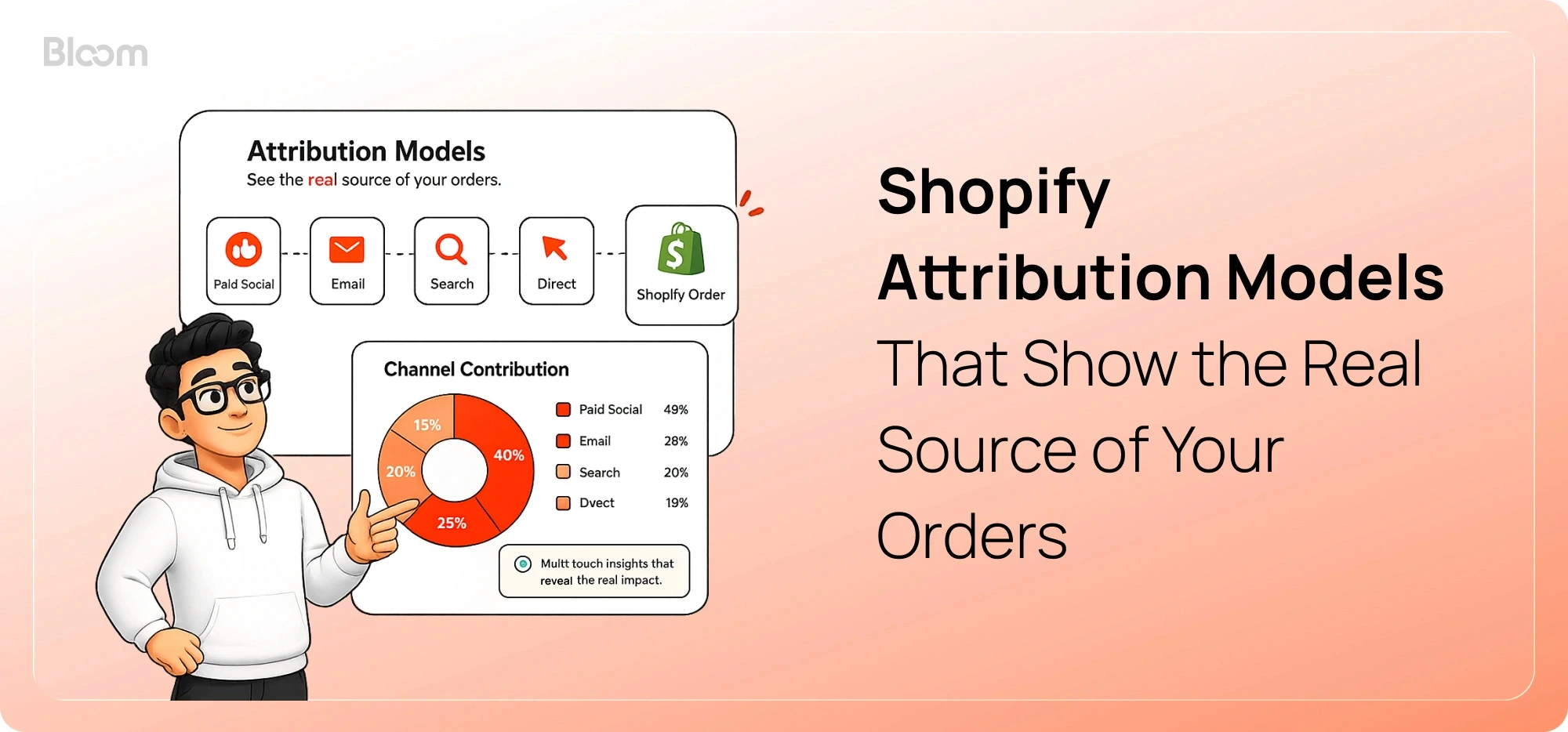
Your ad platform reports 4X ROAS. Shopify shows fewer orders. And somewhere between 10 and 40% of your revenue ends up filed under Direct. That gap is where Shopify marketing attribution either helps you or quietly misleads you.
Shopify marketing attribution is how you connect a completed order back to the marketing touchpoints that influenced the buyer before they paid. If done well, it stitches the buyer's whole path into one view: every touchpoint, in sequence, so you can see how your channels actually worked together. Miss that, and it collapses the path to a single click, dumps most of the credit into Direct, and buries the campaigns doing the real work.
Here's the catch. Attribution isn't one fixed truth. The same order can be read as a Meta win, an email win, or a Direct win depending on the model you view it through. This guide covers what attribution is, why a stitched journey matters more than the size of your Direct bucket, the six models Bloom uses to read that journey, the windows that change the numbers, and how to choose.
Key Takeaways
The real value of Shopify marketing attribution is a stitched customer journey: every touchpoint, across sessions and devices, connected to the order it influenced.
Orders showing as Direct are a symptom of an un-stitched journey, not the core problem. On most Shopify stores, Direct absorbs 10 to 40% of orders because earlier touchpoints get dropped.
Attribution models are just different ways to read that stitched journey. They reassign credit; they don't change what happened.
No single model is "true." Comparing a few of them is the point.
Credit only pays off once it's tied to profit, starting with contribution margin.
Marketing Attribution in Shopify
Shopify marketing attribution is the process of connecting a completed order to the marketing touchpoints that influenced the customer before purchase. It answers one question: where did this order really come from? It's incomplete by nature, because no system captures every session across every device and channel a buyer touches.
Most customers don't buy in one step. A realistic path looks like this:
Clicks a Meta ad on Monday
Comes back through Google search on Wednesday
Opens an email campaign on Friday
Buys by typing the store URL directly on Saturday
Four touchpoints. One order. When your tracking only sees part of that path, the order gets handed to whatever it did catch, which is often that final direct visit. The marketing that created the demand disappears from the report.
Why Do Shopify Orders Show as Direct?
Orders land under Direct when the purchase can't be traced to a tracked source, usually because the buyer returned on their own and the earlier touchpoints fell outside Shopify's attribution window. In our store data, Direct typically absorbs 10 to 40% of orders, and most of those buyers were first introduced by a paid or email touch days earlier.
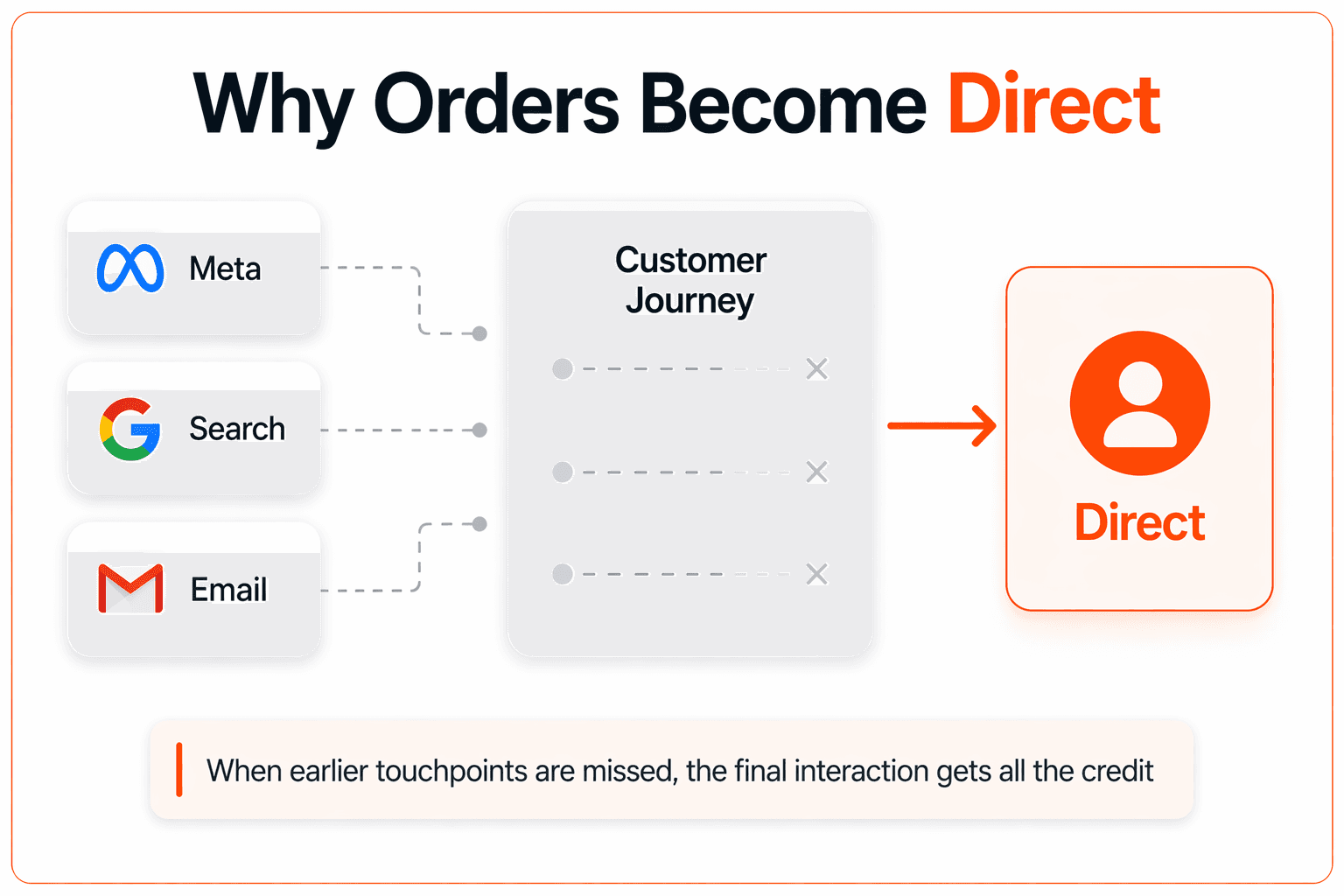
Returning buyers are the main culprit. Someone discovers you through an ad, thinks it over, then comes back days later by typing your URL, clicking a saved tab, or using a bookmark. That return visit carries no referrer, so Shopify files it under Direct and the ad that started everything gets nothing. A store with heavy repeat behavior can look like it runs on Direct when paid and email are quietly doing the recruiting. So a swollen Direct bucket isn't really the problem. It's the symptom of a journey that was never stitched back together.
How Does Shopify Attribution Actually Work, and Where Does It Break?
Shopify's native attribution reads two things off a completed order: the referral data of the visit that was converted and any UTM parameters on that link. A pixel records the sale when checkout finishes, and Shopify assigns credit on a click-based, last-click-family model. Its channel reporting uses the last non-direct click on a fixed 30-day lookback, and it has no view-through attribution, so the whole picture rests on the last tagged click it can see. When that click is missing or stale, the order defaults to Direct.
Two inputs feed the tracking. UTM parameters (utm_source, utm_medium, utm_campaign, utm_term, utm_content) tag your marketing links so Shopify can name the channel. Without them, traffic gets bucketed from the referrer into organic, referral, or direct. The Shopify pixel, part of Customer Events, runs JavaScript that captures behavioral events such as page_viewed, checkout_started, and checkout_completed, and the sale is logged when checkout_completed fires on the thank-you page. Custom pixels run in a sandbox that limits cookies and page access, which is better for privacy but tighter for tracking.
Why Shopify Under-Attributes and Defaults to Direct
Under-attribution happens whenever the converting click can't be tied back to its real origin. If the same shopper uses two devices, Shopify treats each as a separate journey. If UTMs aren't carried across sessions, or a link was never tagged, the source is lost and the order falls into Direct or organic. Private browsing, cookie expiry, and the pixel's own consent and sandbox limits all cut the same way. There's even a blunt edge case: checkout_completed only fires once the thank-you page loads, so a buyer who closes the tab a second too early can slip past the event entirely. And by design, a last-click model hands nothing to the touches that built the demand in the first place.
Why Platform Numbers Over-Attribute and Never Add Up
Over-attribution is the opposite failure, and it's usually your ad platforms, not Shopify. Each platform counts conversions in its own window, often on view-through, so it claims orders Shopify credits elsewhere. Meta uses a 7-day click and 1-day view window and counts view-through by default. Google Ads runs data-driven attribution on a 90-day lookback. TikTok uses 7-day click and 1-day view. Shopify sees none of the view-through and caps at 30 days. Add every platform's reported conversions together and you'll count more sales than the store actually made, because the same order gets claimed twice or three times over.
Why Does Stitching the Full Customer Journey Matter?
The point of attribution isn't to fix the Direct number. It's to reconstruct the whole path a customer took, every touchpoint across sessions, devices, and days, and connect it to the order it produced. Stitch that journey back together and the Direct problem mostly dissolves, because the earlier touches stop being invisible.
That complete view is what makes everything else possible. You can see which channels open journeys and which close them, spot the email that quietly rescued a stalled cart, and watch how paid and organic hand off to each other. A single-click report shows none of that. This is the part merchants tend to underestimate: the prize isn't a tidier Direct line, it's finally seeing the sequence and the assists that a last-click view throws away. That is what turns attribution from a scorecard into something you can actually act on.
Full-journey Attribution Pays Off When It's Tied to Profit
A stitched journey tells you which channels touched an order. Profit tells you whether the order was worth having. A channel can win a pile of attributed orders and still lose money, because order count and revenue say nothing about product cost, shipping, discounts, refunds, or ad spend. That's the real question behind attribution: not "which channel got credit," but "was the credited order actually worth fulfilling?"
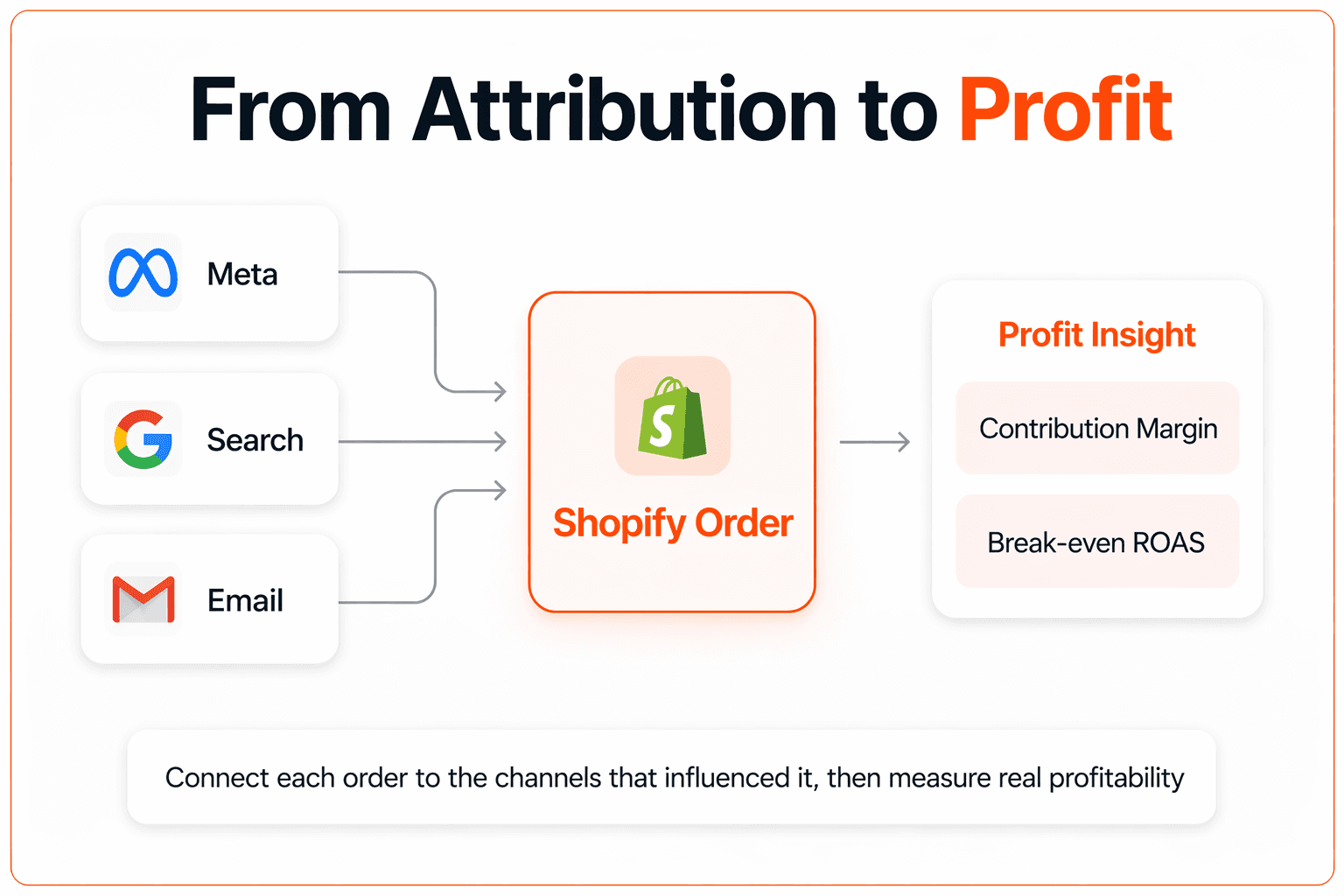
This is where Bloom's approach differs from a standard traffic report. Instead of stopping at order credit, Bloom ties each attributed order to contribution margin, the profit left after the variable costs of fulfilling it. So the question shifts from "which channel drove the most orders" to "which channel drove profitable ones, and which products look like winners while quietly bleeding margin." From what we've seen, reframe changes spend decisions more than swapping one attribution model for another ever does.
What are The Six Shopify Attribution Models?
Bloom offers six order-based attribution models, split between one-touch and multi-touch. Think of them as six lenses on the same stitched journey. Each one reads the identical set of touchpoints but assigns the credit differently, which is why a single order can tell six different stories. Here's how they compare at a glance:
Model | Who gets the order credit | Best question it answers | Watch out for |
First Click | 100% to the first channel in the journey | Which channels discover new customers? | Ignores everything that closed the sale |
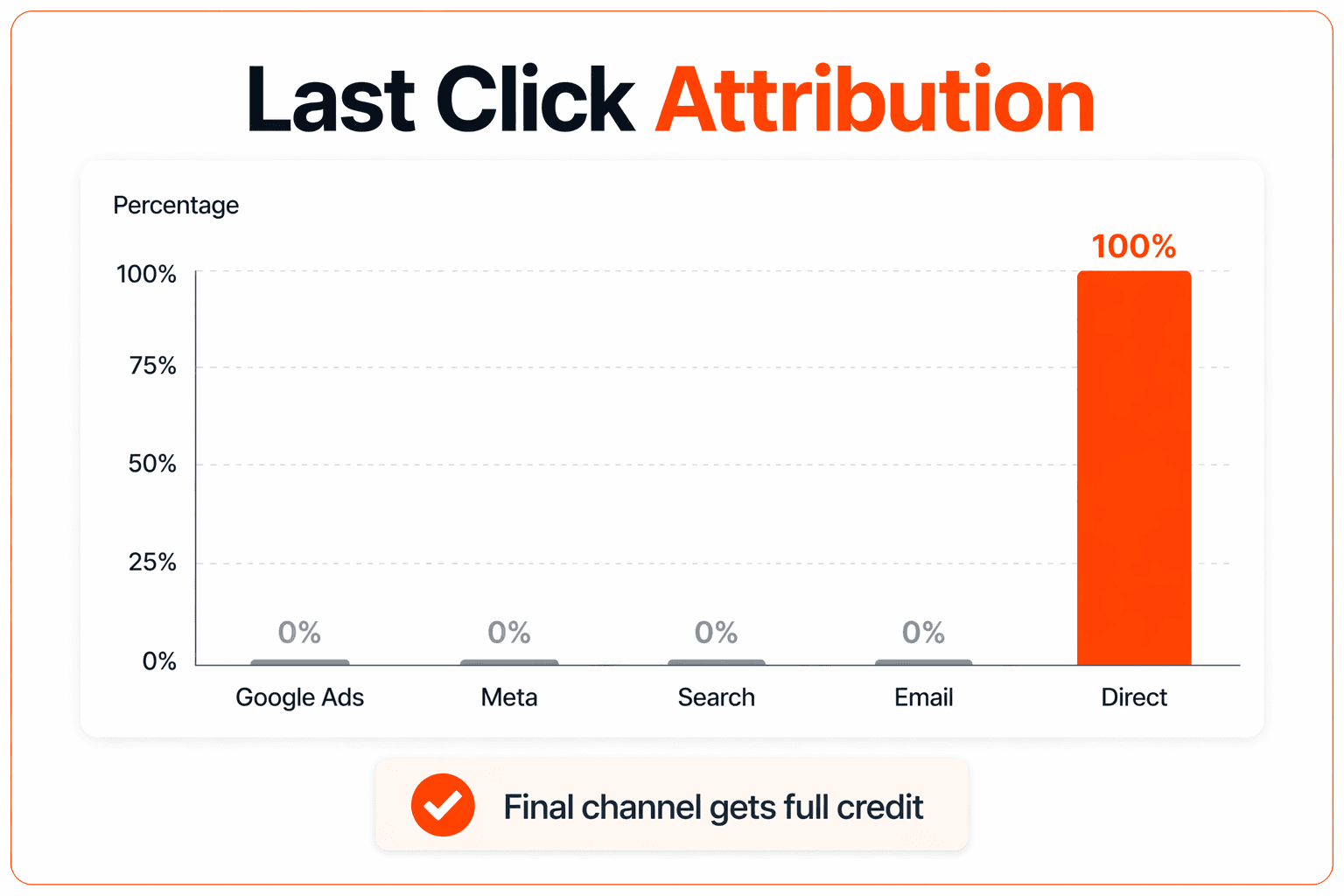
Last Click | 100% to the final channel before purchase | What pushed the buyer to convert? | Over-credits Direct and undervalues demand creation |
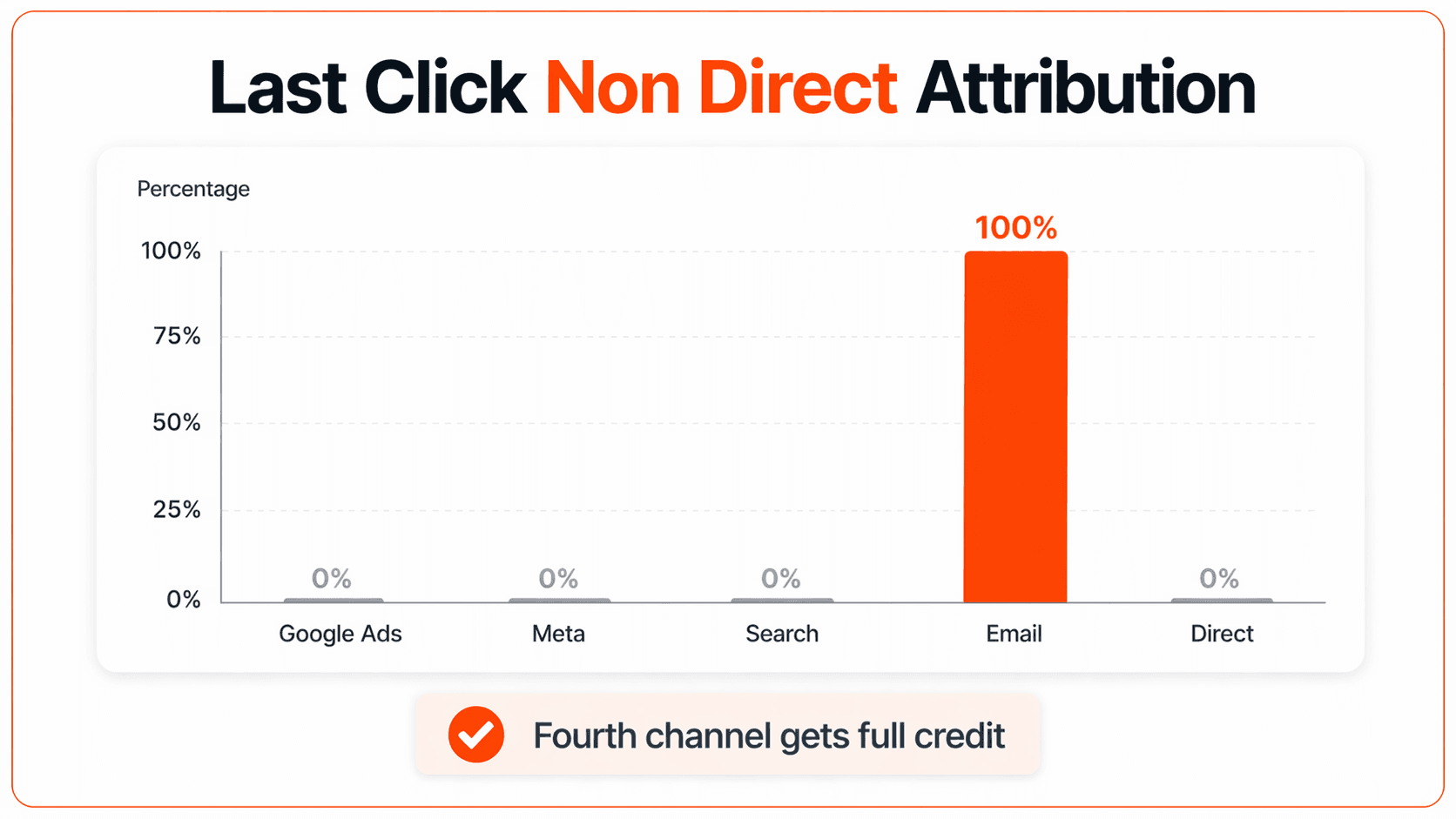
Last Click Non-Direct | 100% to the last channel, skipping Direct | What marketing actually closed it? | Still ignores earlier assist channels |
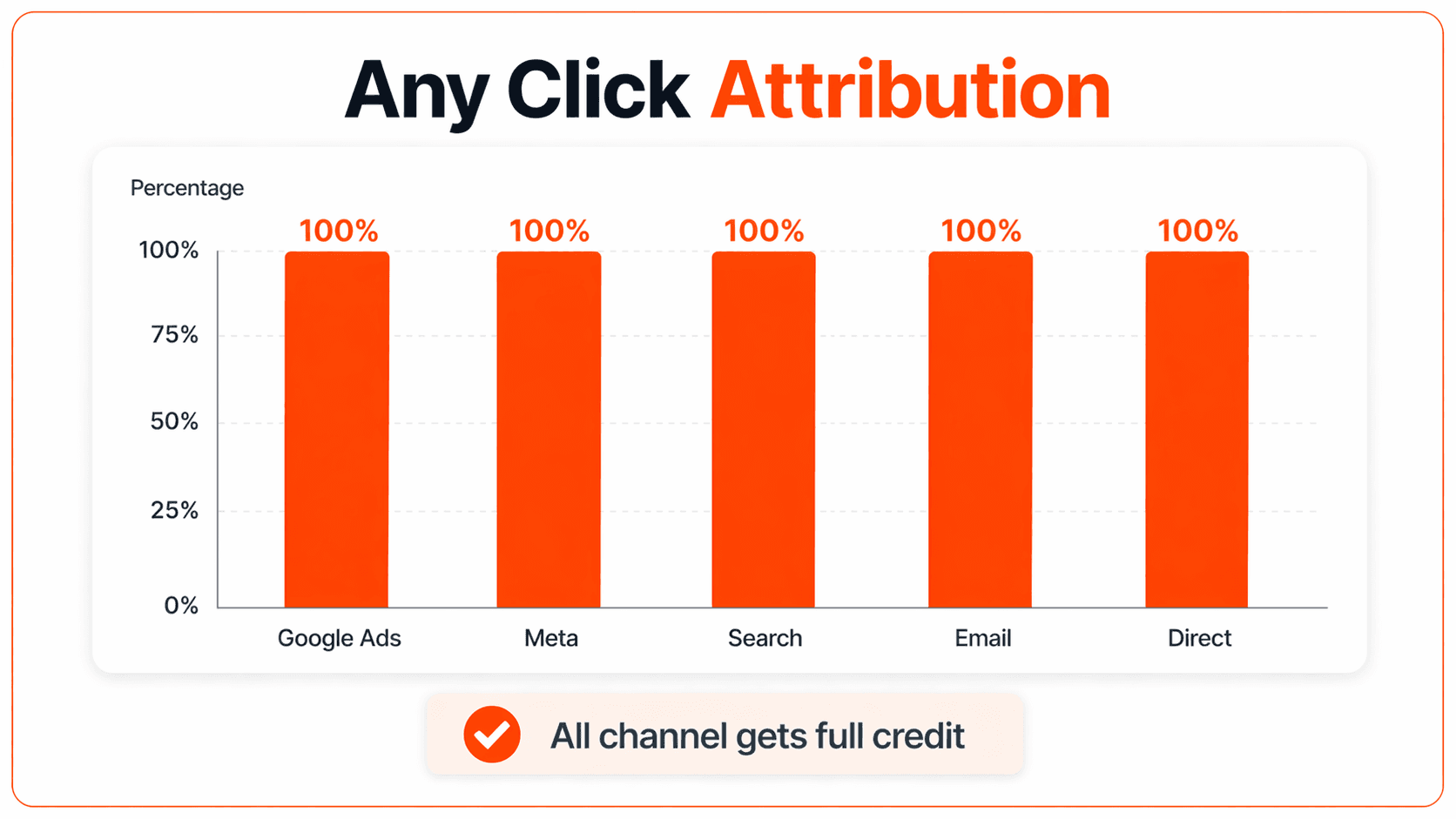
Any Click | Full credit to every qualifying click | Which channels show up in winning journeys? | Inflates totals, so it's directional, not exact |
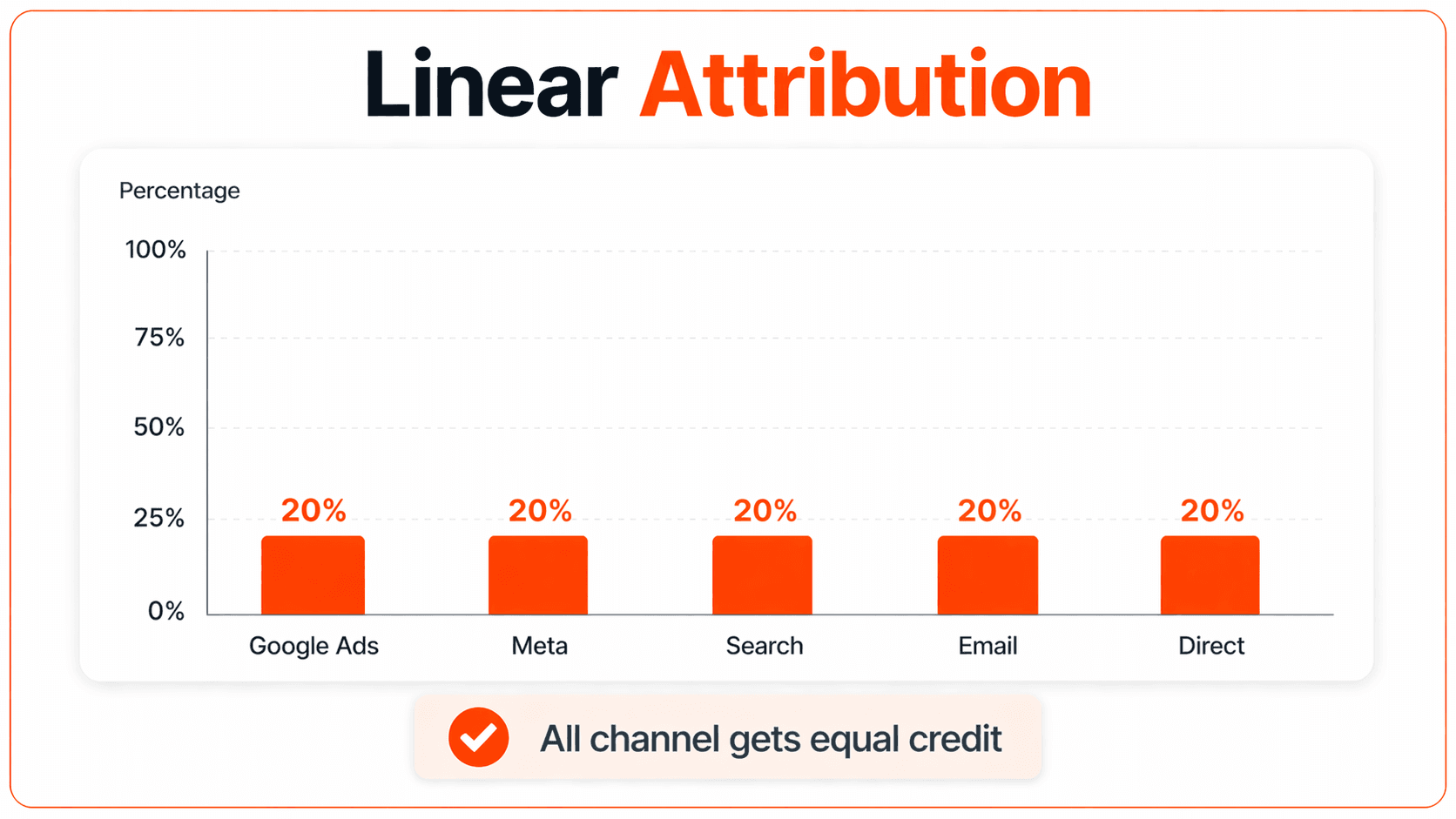
Linear | Split evenly across all qualifying clicks | What's the balanced full-path view? | Treats a minor touch the same as a decisive one |
Linear Paid Only | Split evenly across paid clicks only | How efficient is paid media on its own? | Hides organic and email influence |
One-Touch Attribution Models
One-touch models give the full order credit to a single interaction, which makes them simple to read and easy to argue about.
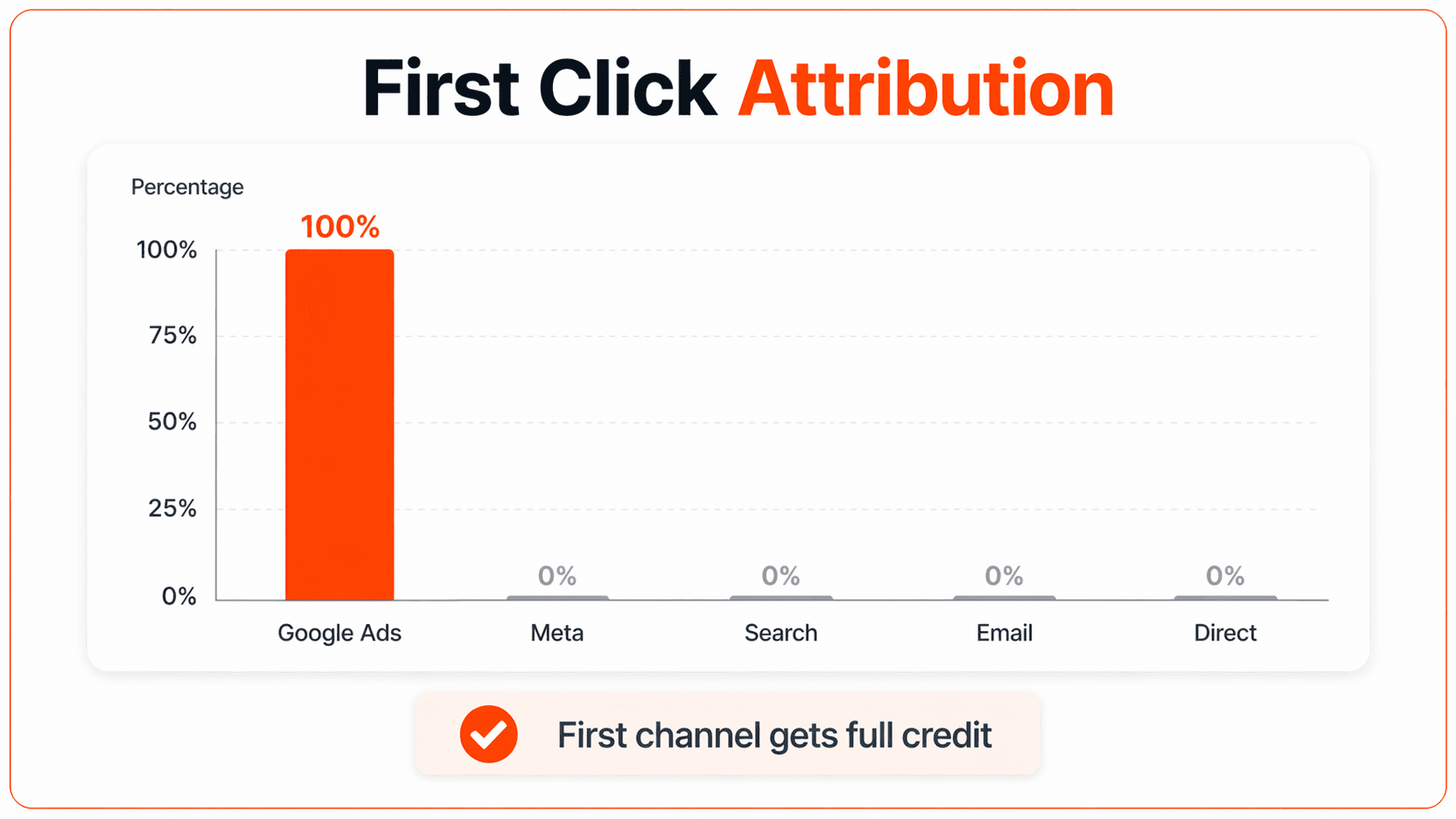
First Click credits the channel that first brought the customer in, so it's your discovery lens: if Meta introduced the buyer, Meta keeps the credit even if email closed the deal.
Last Click does the opposite, crediting the final touch before purchase, which is intuitive but tends to over-reward Direct and the bottom of the funnel.
Last Click Non-Direct fixes part of that by skipping direct visits and crediting the last real marketing touch instead, which is usually the cleanest one-touch view of what closed the sale.
Multi-Touch Attribution Models
Multi-touch models spread credit across several interactions, so you see how channels work together rather than picking one hero. This is where assist channels finally get their due. A channel that builds visibility early, or does the convincing in the middle, is worth just as much as the one that happens to catch the final click. Those assists need to keep running, paid or organic, because starve them and the conversions downstream dry up too. One-touch models hide that contribution. Multi-touch models put it on the record.
Any Click gives full credit to every qualifying click, so use it to study influence, not to count orders, because the same order gets credited to multiple channels and totals inflate fast.
Linear splits credit evenly across every click in the path, which is the balanced view when you don't want to over-weight the first or last step.
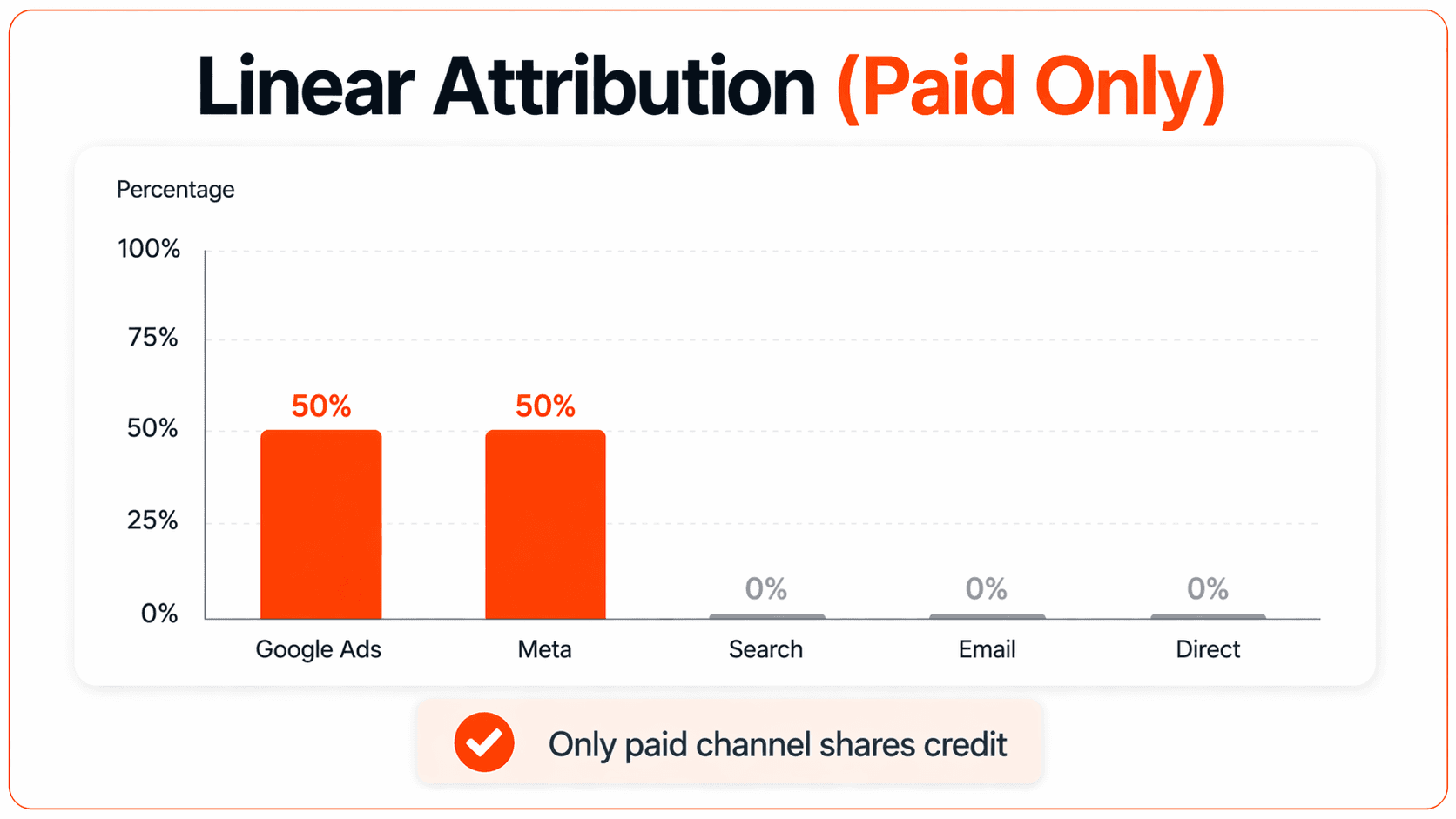
Linear Paid Only runs the same even split but includes paid touches only, which media teams like for judging paid efficiency without organic and email muddying the picture.
The Same Order, Six Different Stories
Nothing about an order changes when you switch models. Only the credit does. Take the Monday-to-Saturday journey from earlier, Meta then Google then email then a direct purchase, and watch where the credit lands:
Model | Credit goes to |
First Click | Meta |
Last Click | Direct |
Last Click Non-Direct | |
Linear | Split across Meta, Google, Email, and possibly Direct |
Linear Paid Only | Split across the paid touches only |
Any Click | Every qualifying touch, all at once |
Same order. Six answers. This is why attribution debates spiral so quickly: people compare numbers from different models as if they're competing facts, when they're really different answers to different questions.
Why do Attribution Windows Matter in Shopify Marketing Attribution?
An attribution window sets how far back a click can still earn credit for a sale, and getting it wrong distorts every model you run. Too short and you miss the ad that started a week-long consideration cycle. Too long and you keep crediting stale touches that had no real pull. Bloom supports 1, 7, 14, 30, and 90-day windows so you can match the window to the buying cycle.
The right window depends on your products. A low-cost impulse buy often converts the same day, so a 1 or 7-day window tells the truth. A considered, higher-ticket purchase can take weeks, so a 30 or 90-day window is the only way to see the touch that actually kicked things off. Stores selling both should compare windows rather than commit to one, because a single window will flatter one product type and starve the other.
Which Shopify Attribution Model Should You Use?
The best model is the one that matches the question you're asking, not a universal winner. Use this as a starting map:
If you want to understand... | Use this model |
Discovery and top-of-funnel reach | First Click |
What closed the sale | Last Click |
Real closing marketing, minus Direct noise | Last Click Non-Direct |
The balanced full-journey view | Linear |
Paid media efficiency in isolation | Linear Paid Only |
Which channels influence winning journeys | Any Click |
In practice, don't marry one model. A channel that looks weak under Last Click can be the quiet workhorse of your assisted conversions, and you'd only see it by comparing First Click and Linear against it. Comparing two or three models on the same orders is what turns attribution from a debate into a decision.
The Real Goal is Clarity, Not a Perfect Attribution Model
If too many of your orders read as Direct, or your platform conversions never match your Shopify orders, your marketing probably isn't failing. Your view of the journey is just broken. The fix isn't chasing one perfectly "accurate" model. It's stitching the whole journey back together first, then choosing the model that fits your question, and finally tying the credited orders back to profit so you know which channels are worth scaling.
Bloom gives Shopify merchants a stitched customer journey across every touchpoint, six attribution models to read it through, five attribution windows, and a profit layer that connects channel credit to contribution margin. Want to see which channels drive real orders and real profit, not just conversions?
Frequently Asked Questions
What is Shopify marketing attribution in simple terms?
It's the process of connecting a completed Shopify order to the marketing touchpoints that influenced the buyer before they purchased. It tells you where demand came from and which channels should get credit for the sale, so you can decide where to spend instead of guessing.
Why do so many Shopify orders show as Direct?
Because buyers often return on their own, by typing your URL, using a bookmark, or reopening a saved tab, and that visit has no referrer. On most stores, 10 to 40% of orders land under Direct, and many of those buyers were first introduced by a paid or email touch days earlier.
Can Shopify attribution show the full customer journey for an order?
That's the whole point of it. Instead of crediting one click, full-journey attribution stitches together every touchpoint a buyer hit across sessions and devices, then links that sequence to the order. It's how you see which channel opened the journey, which assisted, and which closed, rather than defaulting everything to Direct.
How is Shopify attribution different from the conversions my ad platform reports?
Ad platforms report conversions they can observe or model, using their own windows and often view-through credit. Shopify records completed purchases in the store. The two systems measure different events, so their numbers rarely match, and a platform can claim conversions that never show up as matching Shopify orders.
How does Shopify decide which channel gets credit for a sale?
Shopify reads the UTM parameters and referrer on the visit that converts, records the sale through its pixel when checkout completes, then assigns credit on a last-click-family model with a 30-day lookback and no view-through. If the converting click has no source, the order defaults to Direct.
Which Shopify attribution model is most accurate?
There's no single most accurate model, because each answers a different question. First Click shows discovery, Last Click shows what closed the sale, and Linear shows the balanced full path. Accuracy comes from matching the model to your question and comparing two or three rather than trusting one.
What attribution window should I use on Shopify?
It depends on your buying cycle. Impulse or low-cost products often convert within a 1 to 7-day window, while considered or higher-ticket purchases need 30 or 90 days to capture the touch that started the journey. If you sell both, compare windows instead of committing to one default.
Why does profit matter in attribution, not just order credit?
Because a channel can win plenty of attributed orders and still lose money after product cost, shipping, discounts, refunds, and ad spend. Tying credited orders to contribution margin shows which channels are profitable to scale, which is a more useful answer than raw order or revenue counts.
Know Your Real Profit And
The Ads That Actually Sell.
No need to spend. Just try it on your store.