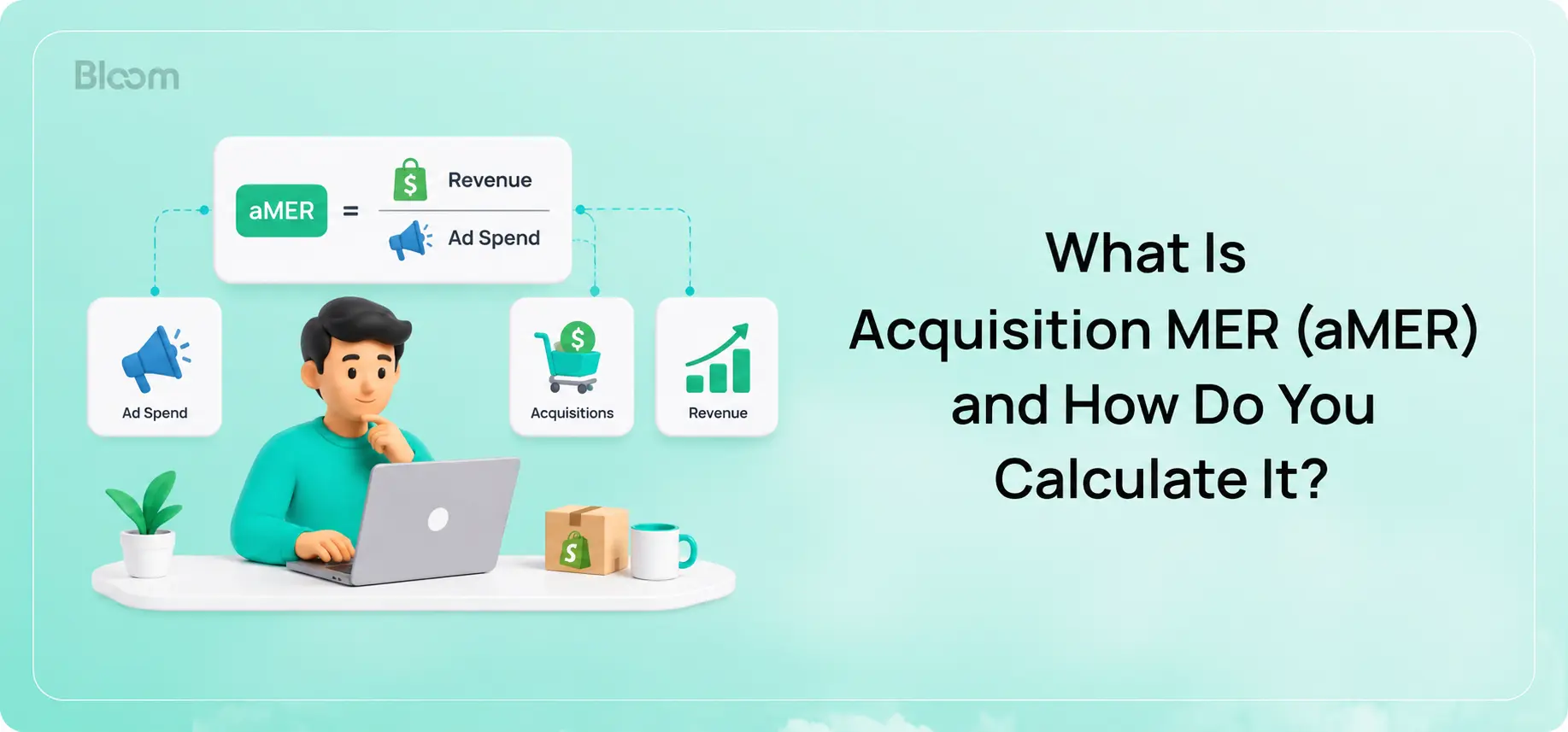


Acquisition MER (aMER), or acquisition marketing efficiency ratio, is your marketing efficiency measured against new-customer revenue only. Where blended MER (marketing efficiency ratio) divides all revenue by ad spend, aMER divides only the revenue from newly acquired customers by that same spend, so you can see how efficiently your marketing is actually winning new customers, not just how well your existing base is buying again.
The distinction matters because a healthy-looking MER can hide a stalling acquisition engine. If returning customers are propping up your blended number, growth can look fine while new-customer acquisition quietly gets more expensive. aMER separates the two.
How to Calculate Acquisition MER
The formula is a single division:
aMER = New Customer Revenue / Total Ad Spend
New customer revenue is the revenue from customers whose first-ever order falls inside the period you're measuring. On Shopify this is straightforward to isolate: flag each order as a first order or a repeat, then sum the revenue from the first orders in the window. Total ad spend is the same spend figure you already use for blended MER. Keep the denominator identical so the two ratios are directly comparable.
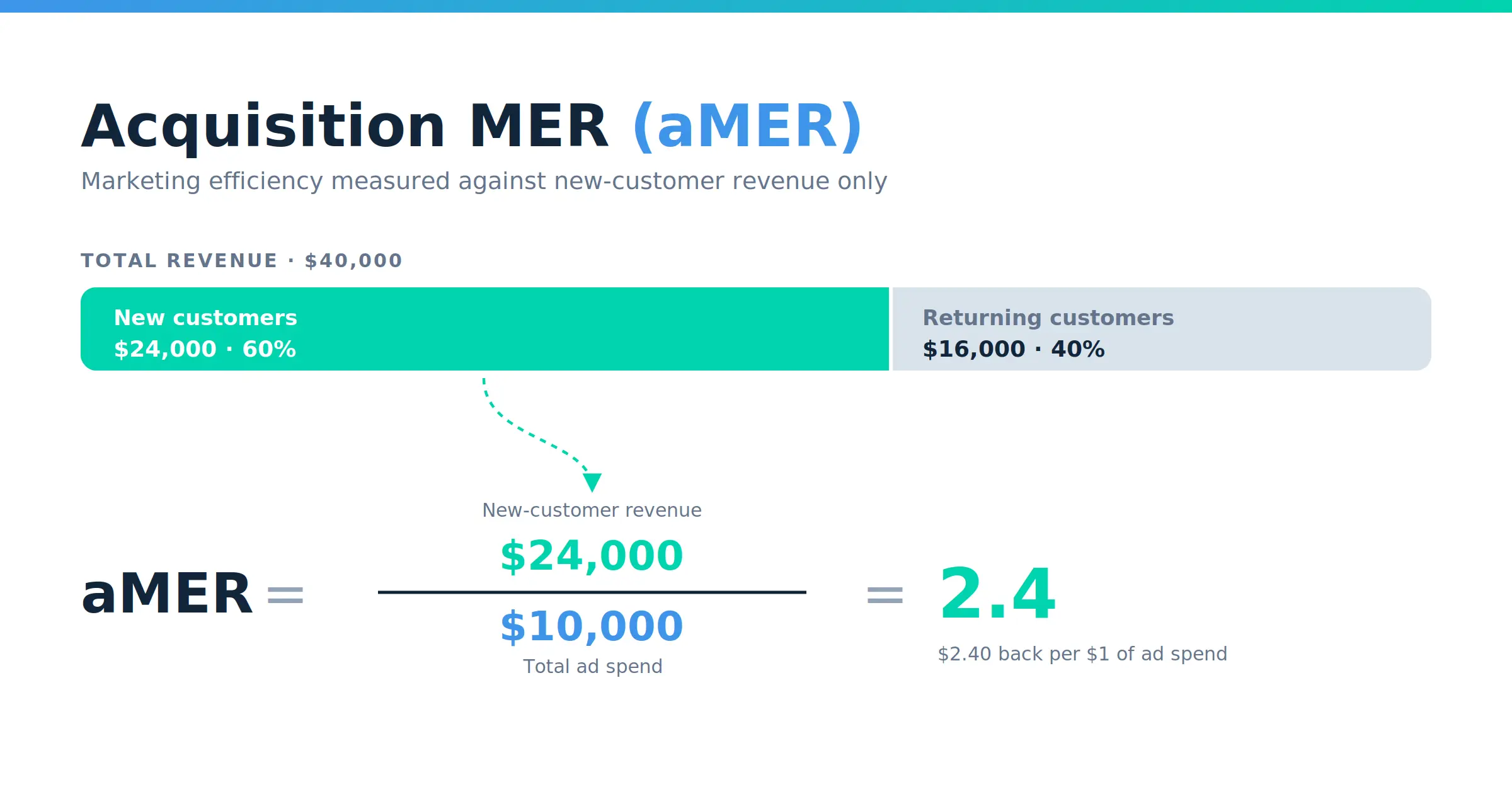
A quick example. Say you spend $10,000 on ads in a month and generate $40,000 in total revenue. Your blended MER is 4.0. But if only $24,000 of that came from brand-new customers, your aMER is 2.4. Every dollar of ad spend returned $4.00 across the whole business, but $2.40 from new acquisition specifically.
How to Use aMER for Analysis
MER answers one question: how much revenue does the whole business return for every dollar of marketing spend? That's useful, but it blends new and returning customers into a single number, and returning customers are cheap to sell to. A strong MER built mostly on repeat purchases tells you your existing base is loyal. It doesn't tell you whether you're still growing.
aMER closes that gap. By isolating new-customer revenue, it tells you whether you're expanding the customer base or leaning on the customers you already have. Read the two together:
MER strong, aMER strong: acquisition and retention are both pulling their weight. Healthy growth.
MER strong, aMER weak: your existing base is carrying the business. Acquisition is getting expensive, and the blended number is hiding it.
MER weak, aMER strong: you're acquiring efficiently but not monetizing repeat purchases. That's a retention and LTV problem, not an acquisition one.
For a single number that captures the split, divide aMER by MER. In the example above, 2.4 / 4.0 = 0.6, which means 60% of your blended efficiency comes from newly acquired customers and 40% from returning ones. Watch that ratio over time. If it drifts down, growth is tilting toward your existing base. If it holds or climbs, new acquisition is still doing the heavy lifting.
Tracking aMER over time is where it earns its place. A blended MER that holds steady while aMER slides is an early warning that acquisition costs are climbing before it shows up anywhere else.
The step past this is marginal aMER, the return on your next dollar of acquisition spend rather than your average across the period. Average aMER tells you how efficient acquisition has been. Marginal aMER tells you whether scaling spend further is still worth it. We cover that in a separate piece on marginal aMER.
Frequently Asked Questions
What's the difference between MER and aMER?
MER divides total revenue (new and returning customers) by ad spend, giving you a blended efficiency number for the whole business. aMER divides only new-customer revenue by that same ad spend, isolating how efficiently your marketing acquires new customers. Use MER for overall health and aMER to check whether acquisition specifically is working.
What is a good acquisition MER?
There's no universal benchmark. It depends on your margins, price point, and how much repeat revenue your model relies on. The more useful signal is the trend: a stable or rising aMER means acquisition efficiency is holding, while a falling aMER means new customers are getting more expensive to win. Compare it against your own MER and your own history rather than an external number.
Discover More