Best Shipping Method For Shopify: 5 Options Compared (and How to Pick One)
Compare the 5 Shopify shipping methods: flat rate, free, price based, weight based, and carrier calculated. Learn which one fits your store and protects margin.

Shipping costs hit your Shopify P&L harder than most merchants realize. For a typical DTC store, fulfillment can eat 8 to 15% of revenue before anyone notices, and the shipping method you picked at setup is often the biggest reason. Flat rate stores undercharge on heavy orders and overcharge on light ones. Free shipping stores absorb carrier costs they never budgeted for. Carrier calculated stores get the math right at checkout but still can't see the real margin per order.
Most merchants set up a shipping method once and never come back to it. That's expensive. The right method depends on what you sell, what your customers expect, and how much shipping cost variance your margins can handle. Picking wrong means losing money on every order, even when revenue looks fine.
This guide covers the five shipping methods Shopify supports natively, the tradeoffs of each, how to pick the one that fits your store, and the gap every rate method leaves behind: knowing what you actually paid the carrier on each order.
TL;DR
Shopify supports five native shipping methods: flat rate, free shipping, price based, weight based, and carrier calculated rates.
The right method depends on your product mix, average order value (AOV), and how much shipping cost variance your margins can absorb.
Flat rate is the easiest. Weight based usually produces the most consistent margin. Carrier calculated is the most accurate but requires a specific Shopify plan.
Free shipping lifts conversion and AOV but only protects margin if your product margins are high enough to absorb the actual carrier cost.
What Are The Five Shipping Methods In Shopify?
Shopify offers five native shipping rate types: flat rate, free shipping, price based rates, weight based rates, and carrier calculated rates. Each one decides what your customer pays at checkout, but none of them tells you what the order actually cost you to fulfill. The right method depends on your product type, average order value(AOV), and shipping geography.
Flat Rate Shipping
Flat rate shipping charges every customer the same fee at checkout regardless of weight, quantity, or destination. It is the easiest method to set up and the most common one for early stage Shopify stores. The tradeoff is variance: a flat rate that works for small orders will underprice large ones, and vice versa.
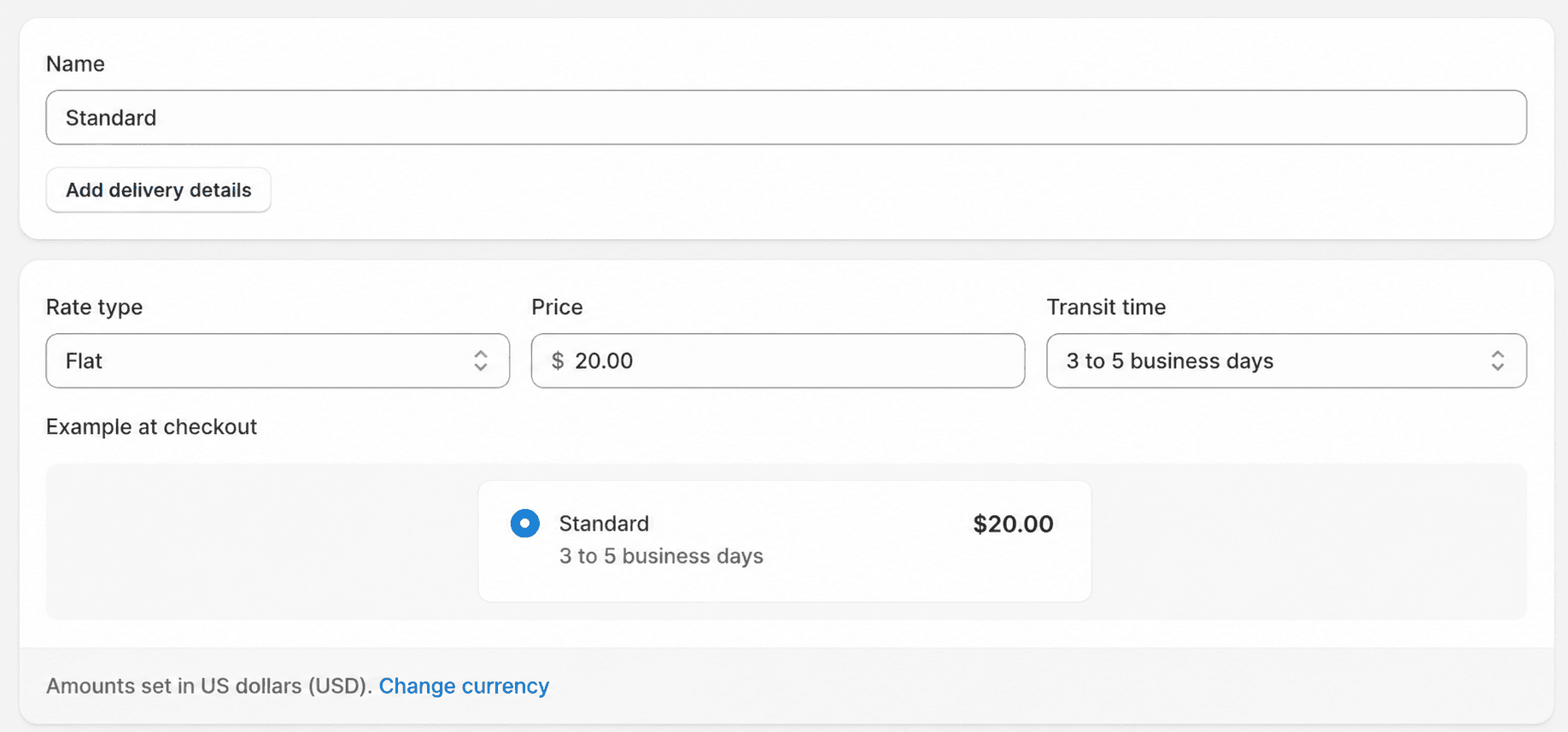
Example: a store charges a flat $20 shipping fee on every order.
Order size | Actual carrier cost | Customer pays | Margin impact |
1 unit | $10 | $20 | +$10 |
10 units | $30 | $20 | -$10 |
The small cart customer overpays for shipping. The large cart customer underpays. The store absorbs the difference on every heavy order.
Flat rate works best when product weights and sizes are similar across SKUs, when shipping zones are narrow, and when ease of setup matters more than precision.
Free Shipping
Free shipping displays $0 at checkout. The customer pays nothing for delivery, but the merchant still pays the carrier. Free shipping increases conversion and average order value, but it only protects margin if product margins are healthy enough to absorb the actual cost, or if the cost is already baked into product prices.
Example: a brand offers free shipping on every order. Average carrier cost is $9 per order. AOV is $58. Gross product margin is 35%.
Each order generates $20.30 in gross profit ($58 × 35%). The $9 shipping cost takes that to $11.30 before any ad spend or fees. If the store also spends 25% of revenue on ads, the order is at break even or below.
Free shipping with a threshold (free over $75, paid below) usually works better than universal free shipping because it nudges AOV up and protects smaller orders from absorbing full carrier cost.
Price Based Shipping
Price based shipping charges different rates based on the total cart value at checkout. Lower value carts pay more. Higher value carts get reduced or free shipping. This is the most common way to nudge AOV up without giving away free shipping on every order.
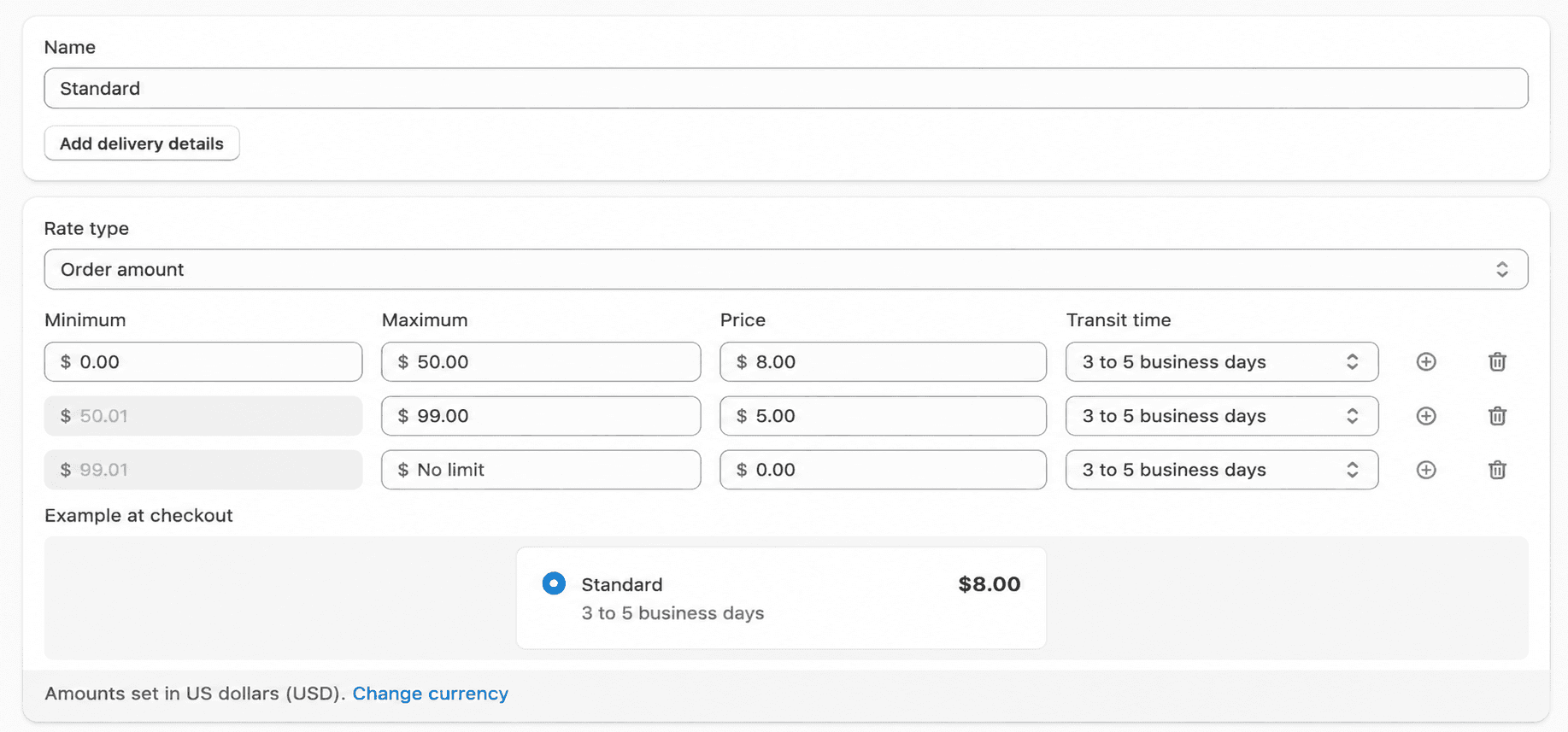
Example:
Order value | Customer pays | Typical carrier cost | Net to merchant |
Under $50 | $8 | $7 | +$1 |
$50 to $99 | $5 | $10 | -$5 |
$100+ | Free | $12 | -$12 |
The structure assumes higher value orders carry enough product margin to absorb shipping. That holds at high gross margins. It doesn't at low ones.
Price based shipping works well for stores with strong product margins, predictable AOV bands, and customer behavior that responds to free shipping thresholds.
Weight Based Shipping
Weight based shipping charges customers based on the total weight of their order. You set weight tiers in Shopify and assign a rate to each. This method generally produces the most consistent shipping margin across orders because what you charge scales with the actual carrier cost, which is itself weight driven.
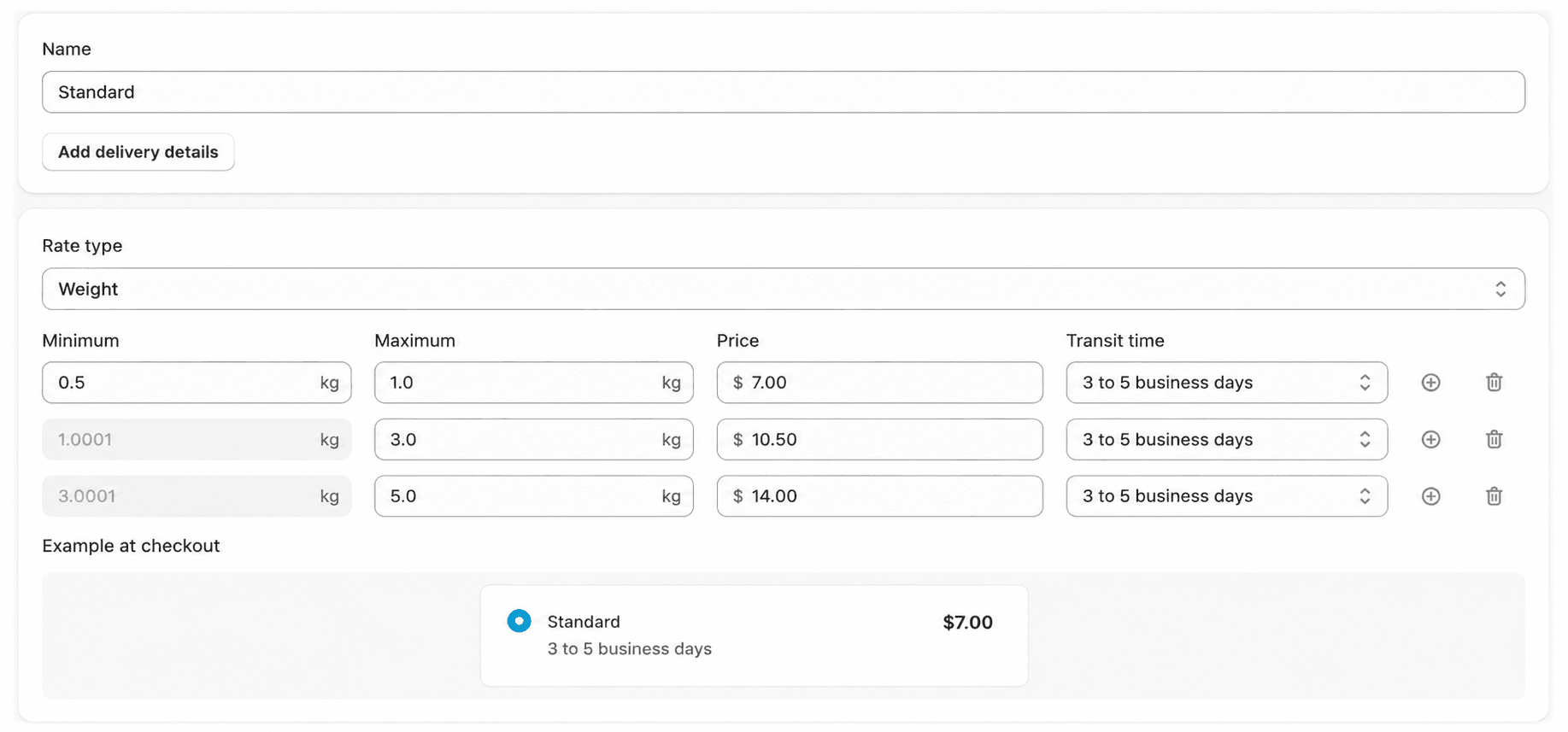
Example:
Weight tier | Actual carrier cost | Customer pays | Margin |
500g to 1kg | $6.10 | $7.00 | +$0.90 |
1kg to 3kg | $9.40 | $10.50 | +$1.10 |
3kg to 5kg | $13.50 | $14.00 | +$0.50 |
Shopify also lets you set product specific weight overrides, so fragile or premium items can carry their own rate even when they share a weight tier with standard products.
Weight based works best for stores with wide weight variance across SKUs, stores that ship physical products with predictable carrier costs, and operators who want consistent shipping margins instead of chasing AOV.
Carrier Calculated Shipping
Carrier calculated shipping pulls live rates from carriers like USPS, UPS, FedEx, or DHL during checkout based on package weight, dimensions, and destination. The customer pays the actual carrier rate. This is the most accurate method, but it is only available on the Advanced Shopify plan, on any annual Shopify plan, or through the Shopify Shipping add on.
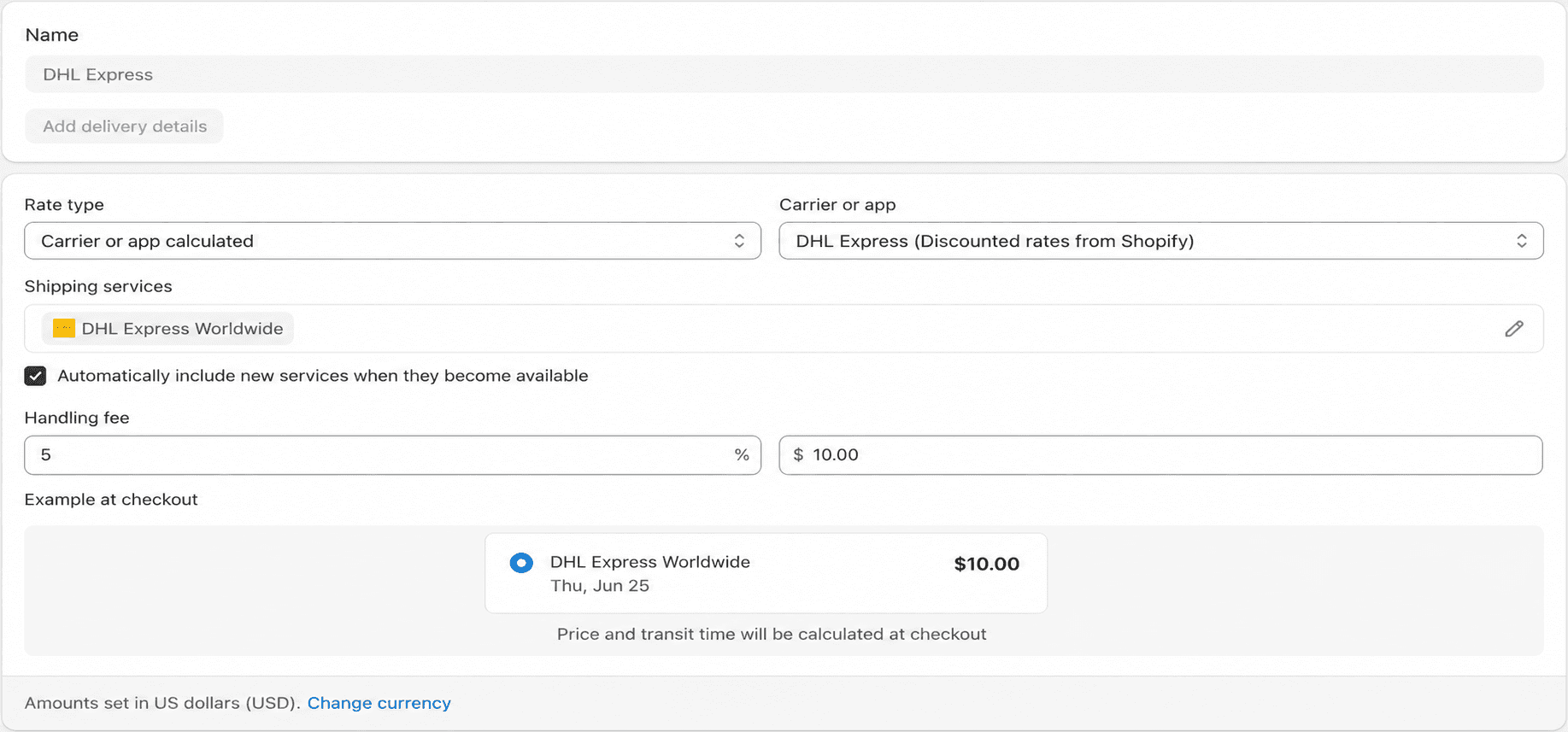
Example: the carrier rate for a 5 unit order to a particular zip code is $10. The customer sees and pays $10. The merchant pays the carrier $10. Margin on shipping is zero, by design.
Carrier calculated shipping works best for stores with high weight variance, broad shipping geography (including international), and complex SKUs where flat or tiered rates can't track cost cleanly.
The cost is plan eligibility plus checkout speed, since live rate calls add latency at checkout that can hurt conversion on slower connections.
How to Choose the Right Shipping Method for Your Shopify Store
The right shipping method depends on three things: how much variance there is in your order weights, what your average order value looks like, and how price sensitive your customers are. Stores with consistent product weights do well with flat rate. Stores with wide weight variance need weight based or carrier calculated. High AOV stores can offer free shipping. Low AOV stores usually can't.
Use this matrix as a starting point.
If your store... | Best shipping method |
Sells products of similar weight and size | Flat rate |
Has wide weight variance across SKUs | Weight based |
Wants to lift AOV | Price based with free shipping threshold |
Ships internationally with variable destinations | Carrier calculated |
Has product margins above 50% | Free shipping |
Has product margins below 25% | Flat rate or weight based with full pass through |
Sells one fragile or premium item alongside standard SKUs | Weight based with product overrides |
Most growth stage Shopify stores end up combining methods inside different zones. Free shipping over a threshold for domestic orders, flat rate for orders below, and carrier calculated for international. That mix protects margin where it matters and pushes AOV where it can.
The Gap Every Shipping Rate Method Leaves Behind
Every shipping method in Shopify decides what the customer pays at checkout. None of them tells you what you actually paid the carrier. That gap matters because the real shipping cost per order is what determines your true profit, and it can swing 15 to 40% from order to order even when the customer paid a flat rate.
Three reasons the customer pays number doesn't match what you paid the carrier:
Free shipping orders cost the merchant the full carrier rate. The $0 the customer sees is a $9 (or $14, or $22) cost line you absorb.
Flat rate and price based orders over or under collect by design. The variance is the whole point of the model.
Carrier surcharges (fuel, peak season, residential delivery, oversize) can change the rate after the order ships. The customer paid amount is locked. Your cost isn't.
To run a real Shopify P&L, you need both numbers per order: what the customer paid for shipping, and what you actually paid the carrier. The difference is a profit line. Without it, your margin reporting is wrong by a few percentage points across every order.

How Bloom Tracks Actual Shipping Cost Per Order
Bloom, a profit intelligence layer on top of Shopify, pulls actual carrier cost per order from your connected shipping platform and allocates it to the correct order in your profit reporting. It integrates with ShipStation, Ship Hero, CJ Dropshipping, and other shipping apps on request. Once connected, every order's true shipping cost flows into CM2 (your profit after fulfillment and ad spend), so the real margin is visible at the order level.
For merchants who don't have a shipping app connected, Bloom also supports rule-based shipping cost allocation by weight, price, quantity, date range, or per product cost. The allocation rules sit inside Bloom's profit calculation. They don't change what the customer pays at Shopify checkout.
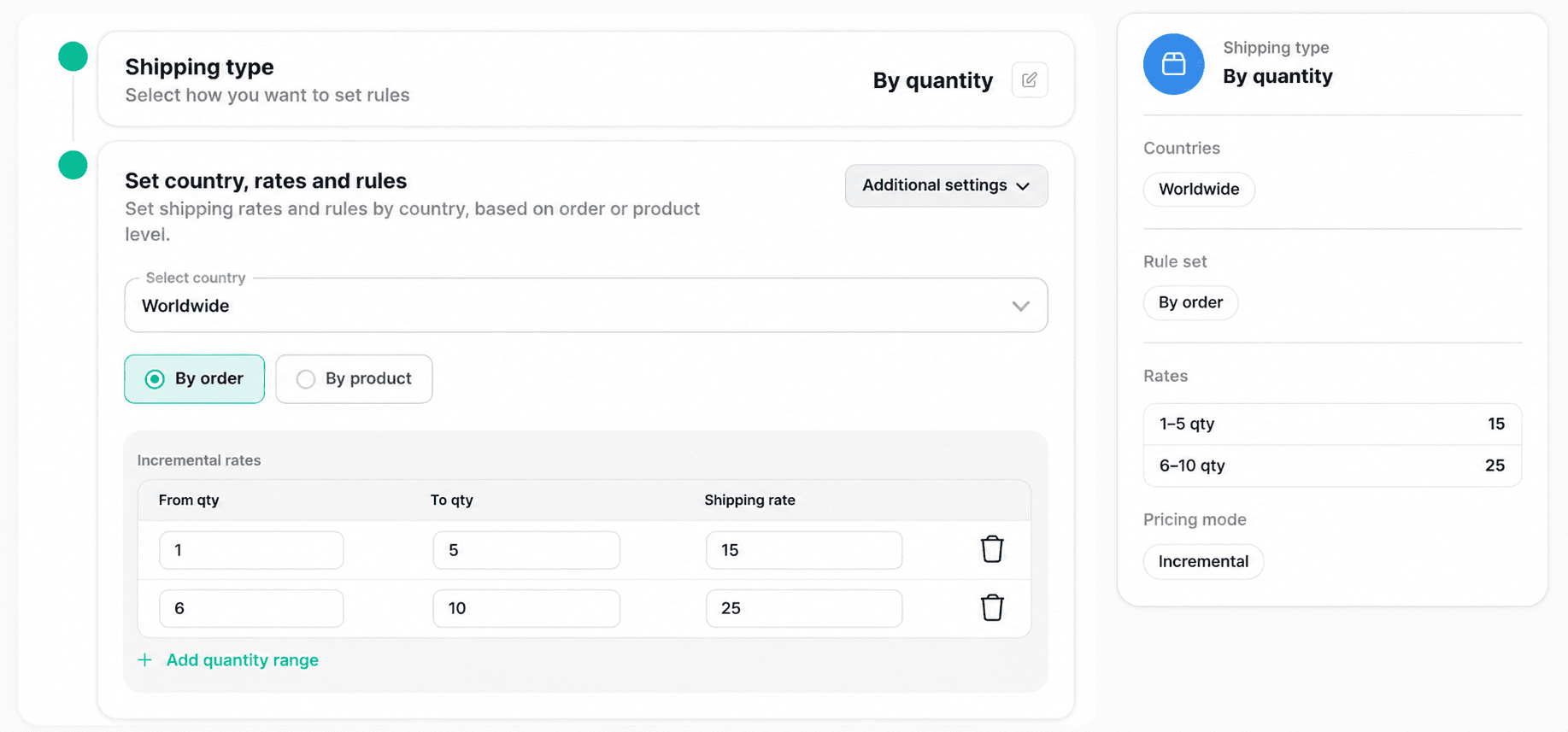
The result is one profit view that combines:
Customer paid shipping (from Shopify)
Actual carrier cost (from ShipStation, Ship Hero, CJ Dropshipping, and other connected apps)
The gap, applied per order, flowing into true profit
This is the view that tells you whether your free shipping threshold is actually profitable, whether one specific product is silently losing money on fulfillment, and whether your flat rate needs to move. It also surfaces shipping cost as a line item in the daily P&L, alongside COGS, ad spend, and refunds, so the full margin picture sits in one place.
Frequently Asked Questions
What is the cheapest shipping method on Shopify?
Flat rate is the cheapest to set up and run because Shopify charges no platform fee for it and customers see one predictable charge. The cheapest method for the customer is free shipping, but that cost moves to the merchant. The cheapest method that still protects margin is usually weight based, since what you charge tracks the actual carrier cost.
Can I use multiple shipping methods on the same Shopify store?
Yes. Shopify lets you set up multiple shipping zones, each with its own rates. Most merchants combine methods: free shipping above a price threshold, flat rate below it, and carrier calculated for international zones. You can also mix weight based and price based rates inside the same zone, which is useful when product weights vary widely but you also want to incentivize larger carts.
Do I need a Shopify plan upgrade to use carrier calculated rates?
Yes, Carrier calculated shipping is available on the Advanced Shopify plan, on any annual Shopify plan, or as a paid add on through Shopify Shipping. If you are on a lower tier monthly plan, you'll need to upgrade, switch to annual billing, or use a third party shipping app that calculates rates outside Shopify's native settings.
What's the difference between shipping methods in Shopify and shipping cost tracking?
Shipping methods in Shopify decide what the customer pays at checkout. Shipping cost tracking measures what you actually paid the carrier after the order ships. The two numbers are different on almost every order, and the gap between them is what determines your real margin. Shopify handles the first. A profit tool handles the second.
Should I charge shipping by weight or by order value?
Weight based is more accurate. Price based is better for AOV. If your products vary widely in weight, charge by weight to protect margin. If your products are similar in weight but you want to push customers to bigger carts, charge by order value with a free shipping threshold. Stores with both wide weight variance and high AOV ambition often combine the two across different zones.
Know Your Real Profit And
The Ads That Actually Sell.
No need to spend. Just try it on your store.