


In ecommerce, revenue is easy to track. Actual profit is much harder. As Shopify stores scale across paid ads, fulfillment partners, and growing SKU catalogs, spreadsheets and native reports often stop giving a reliable picture of profitability.
That is why many brands now rely on a Shopify profit tracking app to combine product costs, shipping, transaction fees, refunds, and ad spend into a clearer profit view. But with so many tools offering similar dashboards and attribution claims, choosing the right platform is difficult.
To help answer that, we researched and compared 10 of the best Shopify profit tracking app platforms based on the features that matter most: net profit visibility, attribution accuracy, cost flexibility, reporting depth, integrations, and ease of use for growing ecommerce brands.
Here are ten apps worth knowing, with what each one does well and where it falls short.
1. Bloom
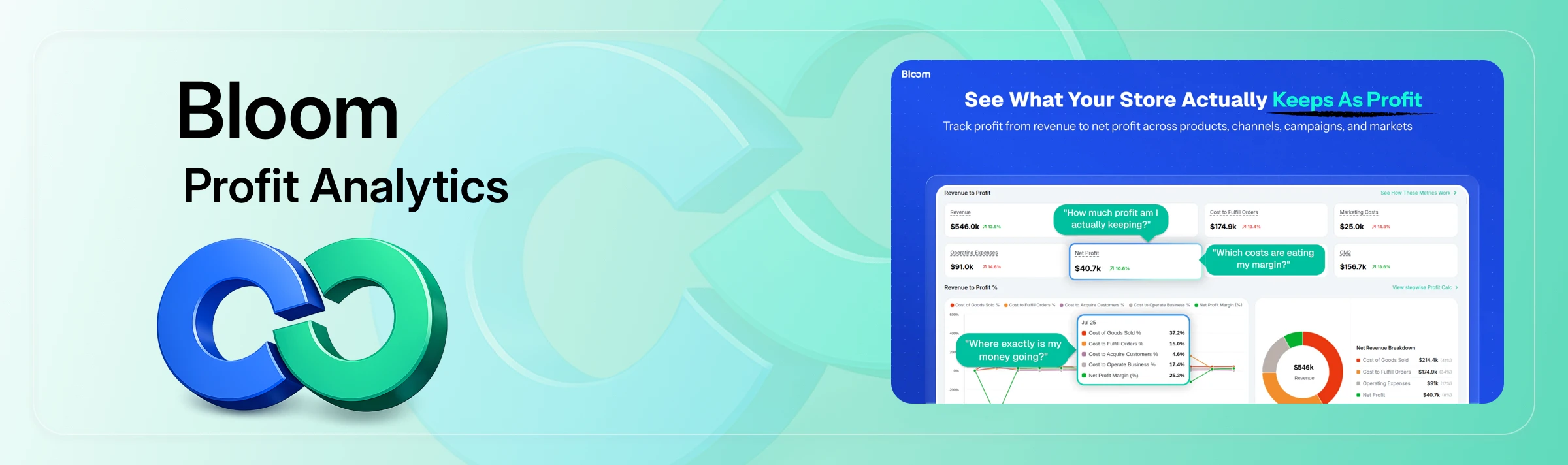
Core strength:
A profit and marketing attribution app for Shopify DTC merchants that connects revenue, product costs, marketing, fulfillment, and operations into a single profitability view through a layered P&L waterfall model (CM1, CM2, CM3) to provide true net profit visibility. It combines detailed cost structuring, first-party attribution, and product & marketing intelligence in a clean, easy-to-understand interface.
Who is it for:
Shopify brands with complex cost structures, multi-store operations, and growing paid media spend that need granular shipping and cost logic, detailed profit tracking across orders, products, campaigns, markets, customer cohorts, and Klaviyo flows, plus plain-English insights and MCP integrations that explain what each metric means and what actions to take to improve profitability.
It is especially compelling for founders who want deeper operational visibility without needing a dedicated analyst, all on predictable pricing that does not scale with order volume.
Where it falls short:
As a newer platform, Bloom has less market visibility than longer-established tools, but it is evolving quickly with ongoing improvements shaped by customer feedback and real-world merchant needs.
Pricing snapshot:
Starts at around $20/month and scales to roughly $80/month, with unlimited orders, multi-store support for up to 3 free shops, and a 14-day free trial included across all plans.
2. TrueProfit
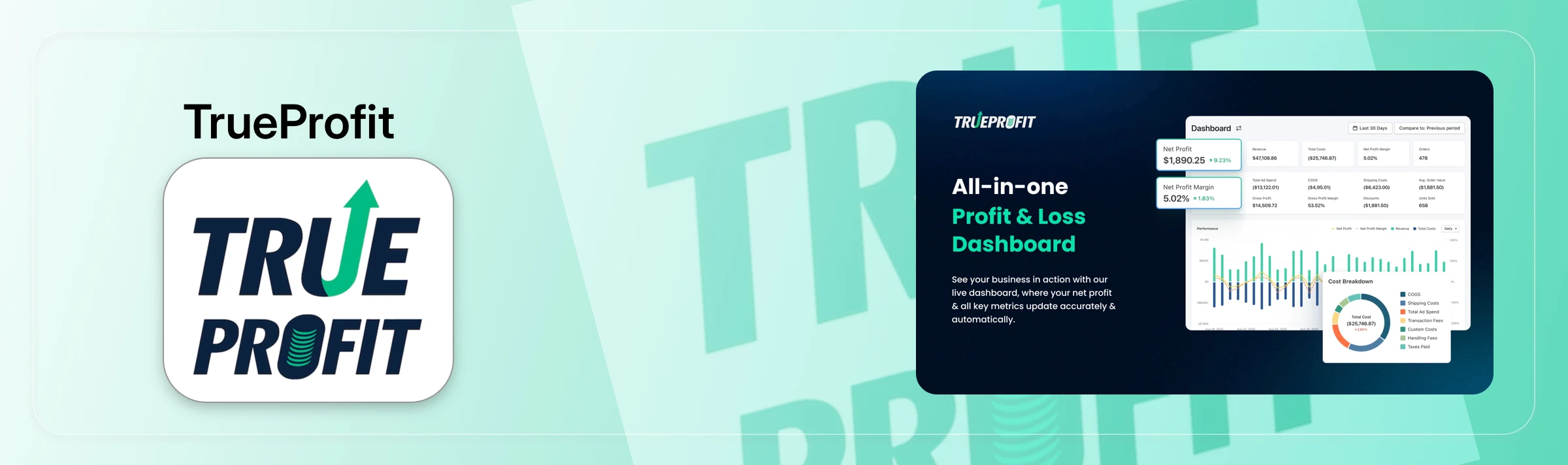
Core strength:
A straightforward Shopify profit analytics platform focused on turning Shopify orders, ad spend, COGS, shipping, transaction fees, and operating expenses into a clean end-to-end net profit view, with simplified reporting, basic attribution, and high-level LTV tracking for growing DTC brands.
Who is it for:
Shopify and dropshipping merchants who want simplified profit visibility without configuring complex operational rules. It works well for merchants with focused catalogs who need clear P&L visibility, product profitability tracking, basic attribution, LTV and CAC in a simpler interface.
Where it falls short:
Advanced attribution is limited to its $200/month Enterprise plan, and pricing scales with order volume through tier caps and overage fees. It is also less flexible for brands needing layered margins, detailed order-level cost allocation, or complex shipping and supplier cost logic.
Pricing snapshot:
Starts around $35/month and scales to roughly $200/month, with order limits attached to every tier.
3. BeProfit
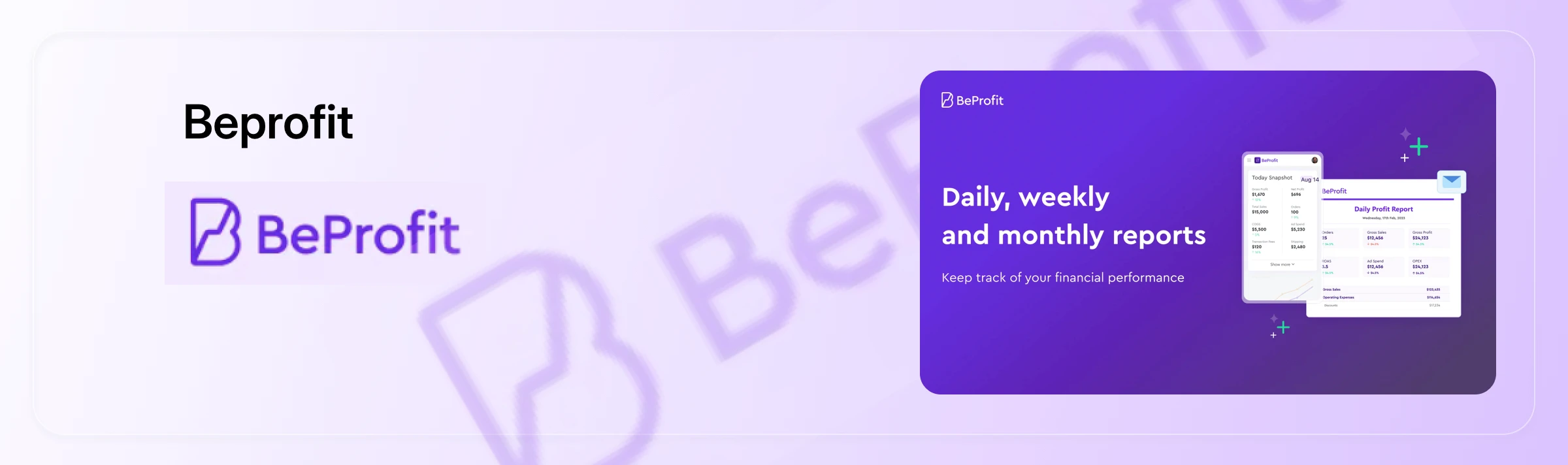
Core strength:
A Shopify profit analytics app focused on customizable reporting, multi-store visibility, and flexible cost tracking across COGS, shipping, ad spend, contribution margins, and operational expenses, with one of the stronger custom report builders in the category.
Who is it for:
Shopify merchants who want broad operational visibility and flexible reporting without needing deeply technical attribution workflows. It fits brands selling across multiple platforms like Shopify, Wix, WooCommerce, or Amazon, as well as teams that rely heavily on scheduled reports and custom profitability breakdowns.
Where it falls short:
Marketing attribution relies mainly on UTM tracking, which can lose accuracy because of iOS privacy restrictions and ad blockers. Pricing also scales with order volume, and marketing profitability analysis is less granular compared to platforms using first-party attribution methods.
Pricing snapshot:
Starts around $49/month and scales to roughly $249/month, with unlimited orders and multi-store support on higher tiers.
4. Lifetimely
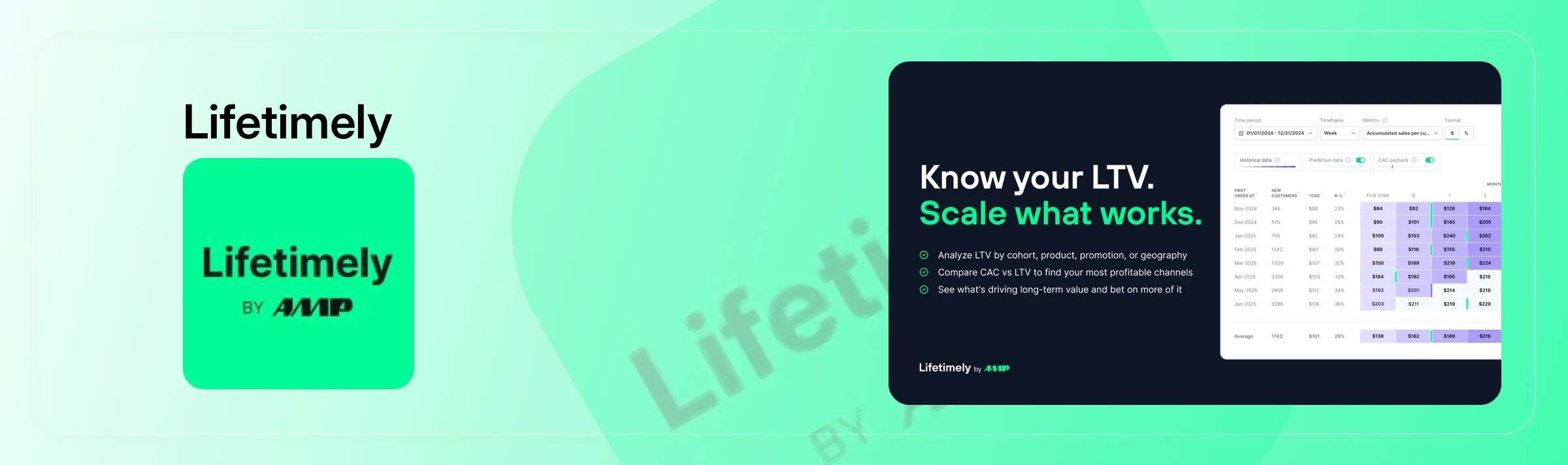
Core strength:
A Shopify analytics platform focused on customer lifetime value, cohort analysis, CAC recovery, and acquisition forecasting, helping brands understand which customers and channels drive long-term revenue growth.
Who is it for:
Shopify brands prioritizing customer acquisition efficiency, retention analysis, and LTV forecasting over deep operational profit analysis. If retention and customer value are your priority, this is one of the strongest options here.
Where it falls short:
Profit tracking remains relatively high-level, with less flexibility around layered cost structures, operational expense modeling, and detailed margin analysis. Attribution depth and lookback windows are also more limited compared to platforms built around profit-first marketing analysis.
Pricing snapshot:
Starts free for smaller stores and scales to roughly $999/month for unlimited orders, with pricing increasing based on monthly order volume.
5. Sellerboard Profit Analytics
Core strength:
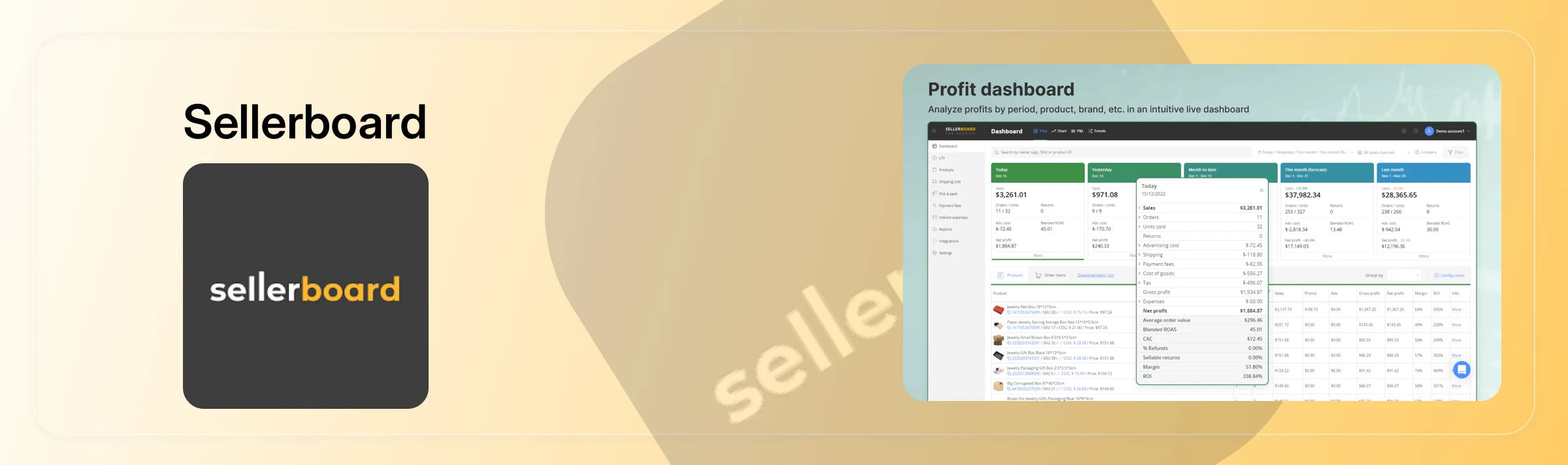
A real-time profit analytics platform focused on granular cost tracking and live P&L visibility across Shopify, Amazon, and eBay, with flexible COGS management, detailed shipping and pick-and-pack cost tracking, payment fee monitoring, and profitability reporting across products, orders, ads, and operations.
Who is it for:
Data-driven operators, especially merchants selling across Amazon and Shopify, who want a detailed profitability view across any period of time, products, orders, ad spend, and inventory operations at a relatively low cost.
Where it falls short:
Attribution relies primarily on UTMs, Shopify first-party cookies, and product-level tracking, so it does not go as deep on cross-channel, multi-touch analysis as Shopify-first DTC tools. Some merchants also report occasional sync and data reliability issues that require manual monitoring.
Pricing snapshot:
Starts around $9/month and scales to roughly $79/month, with pricing tied mainly to order volume. All plans include the same core features plus a 60-day free trial.
6. Profitario
Core strength:
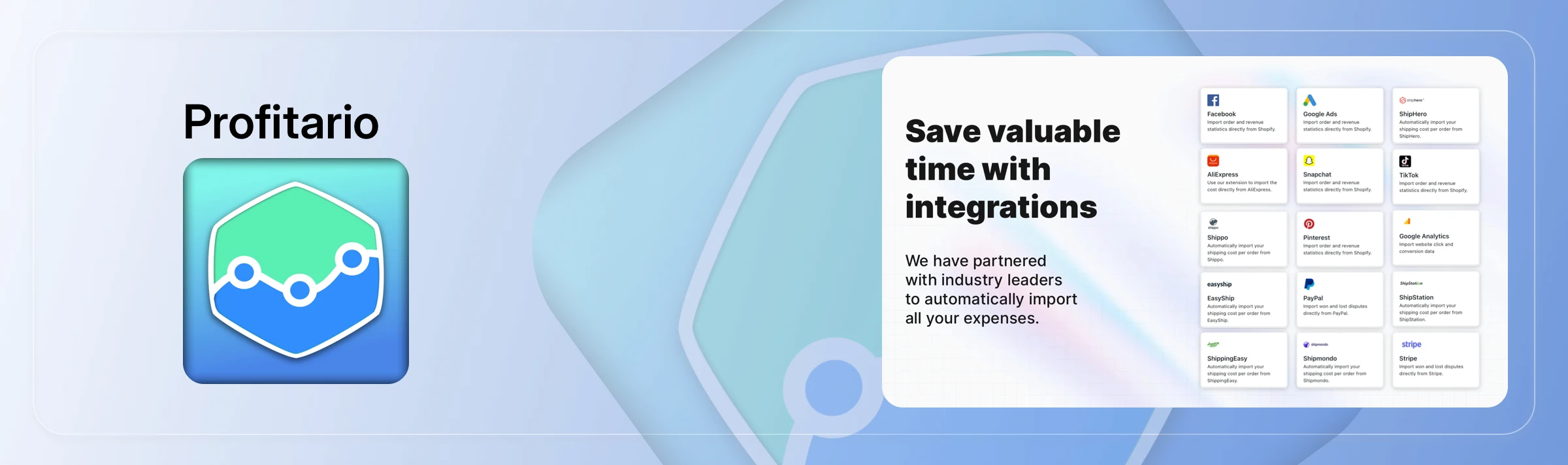
A Shopify profit analytics platform focused on automated profit reporting, real-time P&L visibility, per-order profitability, and easy financial tracking. It automatically pulls data from Shopify, AliExpress, PayPal, Facebook Ads, and Google Ads to help merchants understand how orders, ad spend, shipping, gateway fees, refunds, and customer value impact actual profitability.
Who is it for:
Smaller Shopify and dropshipping-focused stores that want a lightweight, easy-to-use profit tracking tool without building complex dashboards or reports. It fits merchants looking for automated integrations, pre-built analytics, and quick visibility into margins, customer value, and channel performance without needing deep analytics expertise.
Where it falls short:
Customization and attribution depth are more limited compared to advanced analytics platforms. Reporting is designed around simplicity and automation rather than highly flexible dashboards, custom report building, or deeper cross-channel attribution analysis.
Pricing snapshot:
Starts free for up to 50 orders/month, with paid plans ranging from roughly $29/month to $299/month, scaling based on order volume, store count, and advanced analytics access.
7. GoProfit
Core strength:
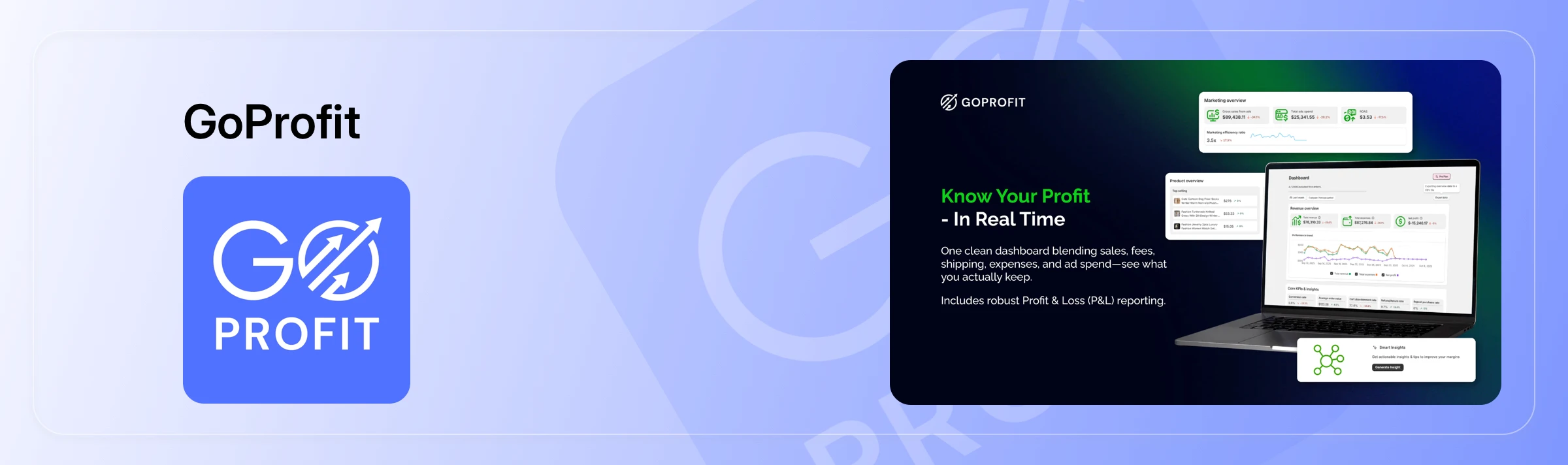
GoProfit is a ‘Built for Shopify’ certified profit analytics app built around real-time profit tracking, automated cost monitoring, and easy-to-read profitability dashboards. It combines live P&L reporting, product-level profitability, ad spend tracking, and expense management to help merchants understand how COGS, shipping, refunds, and marketing affect actual profit in real time.
Who is it for:
Solo operators and growing Shopify brands that want a clean, beginner-friendly profit dashboard with minimal setup. It fits merchants looking for automated COGS tracking, multi-platform ad tracking (Google, Meta, TikTok), daily profit summaries, smart alerts for real-time profit drops, and tools like Promo Planner to forecast campaign profitability before launch
Where it falls short:
Historical lookback is capped on lower plans, making long-term analysis harder as stores scale. Reporting customization is limited to mostly pre-built dashboards, and the platform is Shopify-focused, making it less suited for merchants managing multiple ecommerce platforms. Ad spend syncing mainly covers Meta, Google, and TikTok, so niche channels may require manual tracking.
Pricing snapshot:
Starts free for up to 50 orders/month, with paid plans starting around $29.99/month and scaling to custom enterprise pricing based on order volume and advanced analytics access.
8. Profit Peak
Core strength:
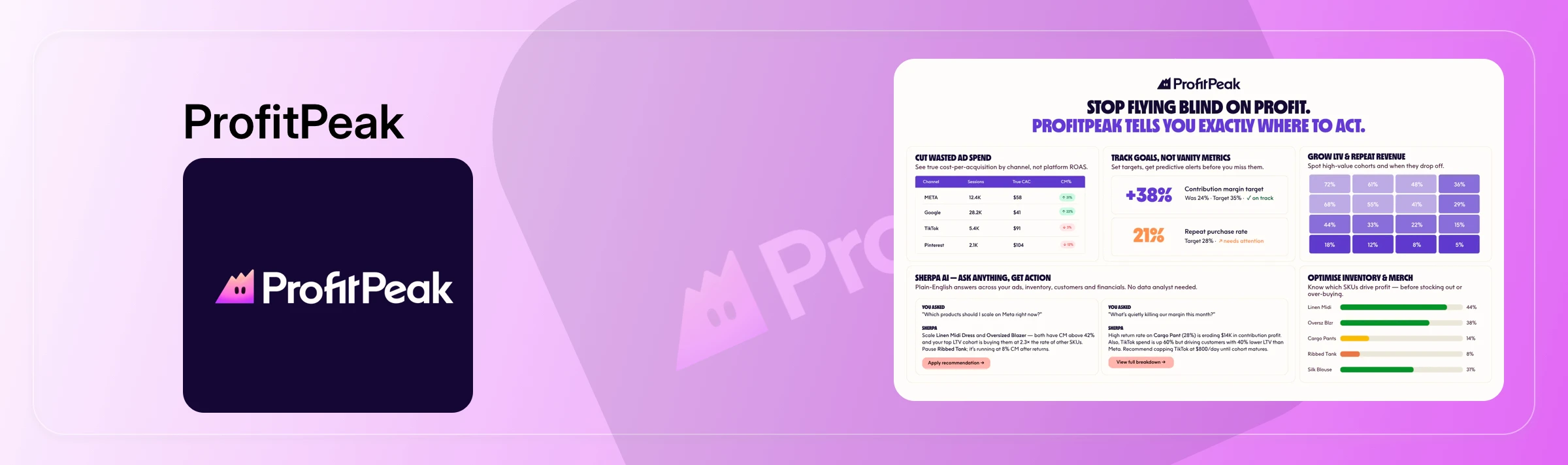
A profit intelligence platform that unifies ad spend, attribution, inventory, customer data, and operating expenses into one system for profit-led growth. It supports full P&L visibility with first-party tracking for customer journey and ad performance analysis, alongside inventory intelligence like demand forecasting and profit-based product segmentation. Sherpa AI adds faster insights and automated recommendations across ads, inventory, and profitability.
Who is it for:
Best suited for teams that want AI-driven guidance across ads, inventory, customer, and financial data instead of manually interpreting reports themselves, and are comfortable with a higher-touch setup.
Where it falls short:
More complex and higher-touch than plug-and-play tools, making it less suitable for simple profit reporting needs. Its premium pricing is also significantly higher than many Shopify profit analytics apps with overlapping core features.
Pricing snapshot:
Premium pricing built for larger ecommerce brands, starting at $649/month and scaling to $1,249/month based on forecasting, attribution, and intelligence capabilities included in each tier.
9. Kleio Analytics
Core strength
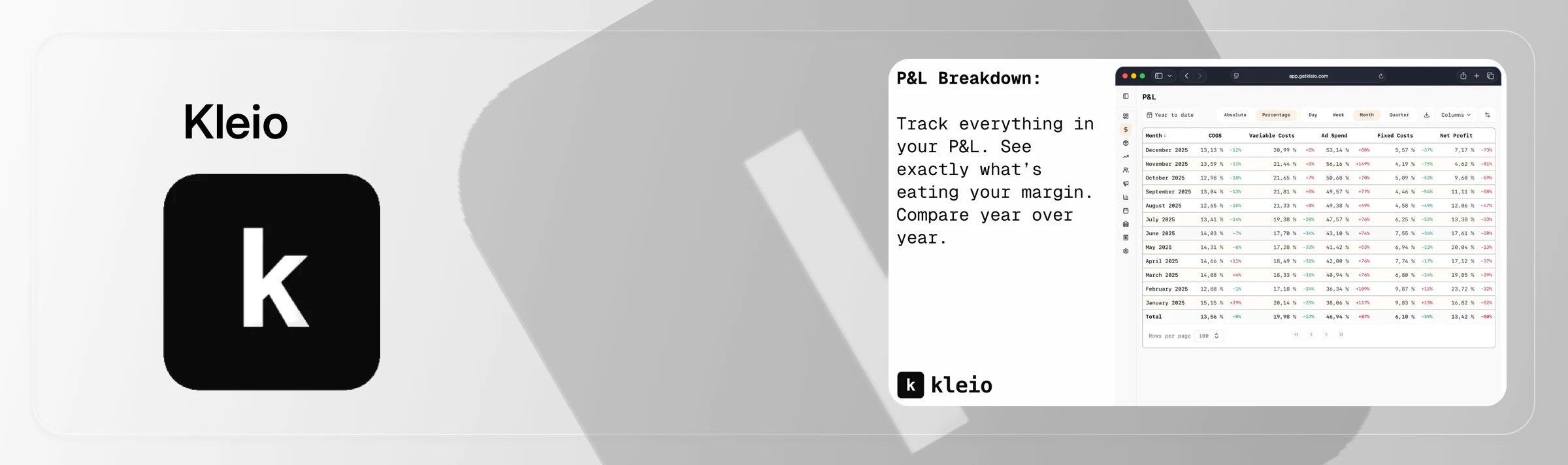
A profit analytics system that follows a P&L waterfall model to net profit, breaking revenue into CM1, CM2, and CM3 to help merchants isolate which costs impact profitability most. It supports flexible cost modeling (variable costs, COGS, shipping), real-time inventory intelligence, product prioritization and cohort tracking for LTV, retention and LTV:CAC. It also connects directly to AI tools like Claude or Cursor via MCP for plain-English analysis of store data.
Who is it for:
Profit-first founders and operators who want granular cost accuracy, basic cohort and inventory visibility, and AI-assisted analysis at a low, predictable price.
Where it falls short: No standalone or multi-touch attribution, by design. Smaller and earlier than the established names, with fewer integrations and no native mobile app.
Pricing snapshot: Flat $29/month, no order or feature limits.
10. Juicy Attribution and Profit
Core strength:
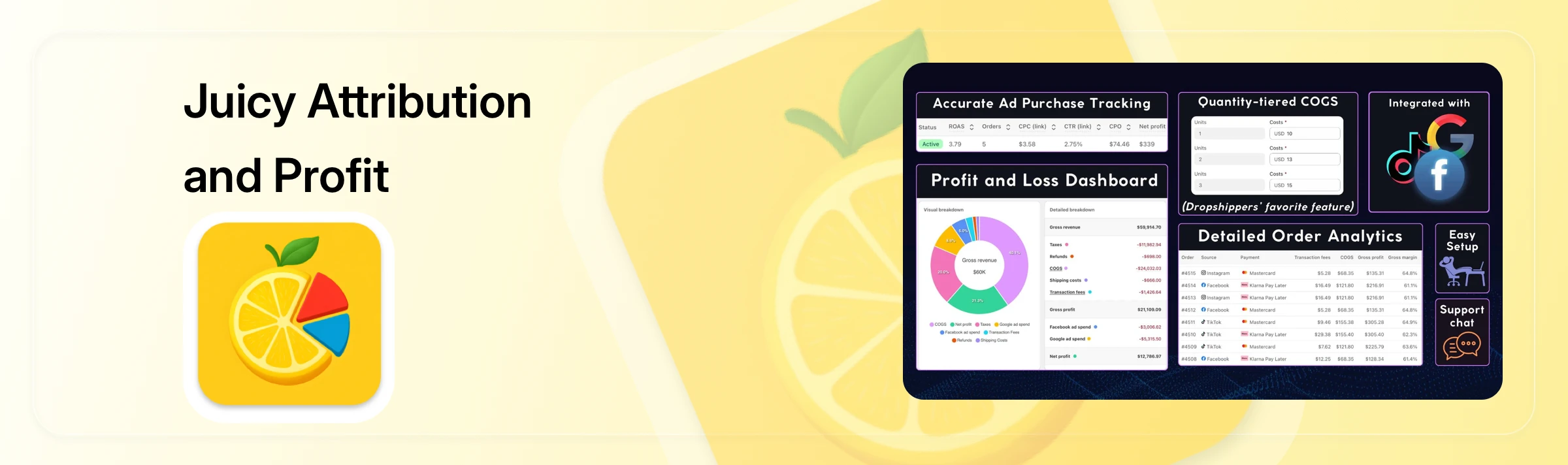
A profit tracking and attribution platform focused on showing true profit per order and the ads linked to it. It combines ad attribution, COGS, shipping costs, transaction fees, and business expenses into one dashboard so operators can understand profitability across campaigns, and orders. It supports flexible cost tracking with quantity-based COGS, historical cost updates, and custom shipping logic for more accurate margin visibility over time. The platform also supports multi-store profit tracking, giving brands a unified view across multiple Shopify stores.
Who is it for:
Shopify brands running paid ads that want clearer visibility into order-level profitability and campaign performance without needing a complex analytics stack.
Where it falls short:
While cost tracking is flexible, businesses with rapidly changing fulfillment or pricing structures may still need manual cost updates to maintain accuracy. As brands scale, some merchants may also outgrow its simpler reporting and customization capabilities.
Pricing snapshot:
Free plan available for up to 50 orders/month. Paid plans start at $29/month (up to 500 orders/month), with an Advanced plan at $49/month for higher-volume stores.
Features to Prioritize When Choosing a Profit Tracking App
Choosing a platform with the longest feature list is how stores end up paying premium prices for capabilities they never use. Focus on the features that match where your store actually loses visibility.
If you are scaling paid acquisition, prioritize attribution depth and profit-based ad measurement over everything else, because that is where the biggest dollars are being misjudged. If retention is your engine, prioritize cohort and LTV reporting. If your margins are thin and your costs are messy, prioritize custom cost flexibility and layered contribution margin so you can see exactly where the money leaks.
Four things matter regardless of store type:
1. Check that your actual stack is covered before you commit: your ad platforms, your email tool, your shipping platform for real fulfillment cost, and any marketplace you sell on.
2. The app has to handle your real cost structure, not a simplified version of it, or the profit number is fiction.
3. It has to tell you what to do, not just what happened. A dashboard you cannot act on is a more expensive spreadsheet.
4. And watch the pricing structure as closely as the features. An app that is cheap at 200 orders a month can become your most expensive subscription at 5,000 orders if the pricing is order-based. Model the cost at the scale you expect to reach, not the scale you are at today.
Which Shopify Profit Tracking App Is Right for Your Store?
There just isn't a shopify profit tracking app that is the absolute best for every store. The right one for you will depend on how your business runs, where it is struggling to get the data it needs, and how deep you need the analysis to go.
Here’s a quick breakdown of all 10 Shopify profit tracking apps across the features that matter most:
Feature | TrueProfit | BeProfit | Lifetimely | Sellerboard | Profitario | GoProfit | Profit Peak | Kleio | Juicy | |
Key strength | Layered margin plus first-party attribution in one view | Clean, established end-to-end net profit | Customizable reporting and multi-store | LTV, cohort, and acquisition depth | Granular cost tracking across Shopify, Amazon, eBay | Automated profit reporting at low cost | Built for Shopify, real-time dashboard and alerts | Unified ads, attribution, inventory, plus Sherpa AI | Most flexible cost modeling plus AI via MCP | True profit per order tied to the ads behind it |
Limitation | Newer, less market visibility | Advanced attribution gated to $200 plan, cost climbs with orders | UTM-based attribution, scales with orders | Profit tracking stays high-level | UTM/cookie attribution, occasional sync issues | Limited customization and attribution depth | Capped lookback on lower plans, Shopify only | Premium and higher-touch | No multi-touch attribution by design, small and early | Simpler reporting, manual cost updates at scale |
Profit tracking depth | High (CM1/CM2/CM3) | High | High | Moderate | High | Moderate | Moderate | High | High (CM1/CM2/CM3) | Moderate to high (order-level) |
Attribution depth | High (first-party, 6 models) | Basic (advanced on Enterprise) | Moderate (UTM) | Moderate | Light (UTM/cookie) | Light | Light (channel ROAS, no multi-touch) | High (first-party journey) | None (by design) | Moderate (ad attribution focus) |
Custom cost flexibility | High | Moderate | High | Limited | High | Moderate | Moderate | High (pro forma P&L) | Very high | High (quantity-based COGS, custom shipping) |
Cohort/LTV reporting | Yes | Basic | Yes | Strong | Basic | Basic | Basic | Yes | Yes | Basic |
Multi-store support | Yes (up to 3) | Yes | Yes (Shopify, Wix, Woo, Amazon) | Yes | Yes (Amazon, eBay, Shopify) | Yes (paid tiers) | No (Shopify only) | Yes (Shopify, Magento) | Limited | Yes |
Pricing model | Usage-based, unlimited orders | Order-based, mid | Order-based, mid | Free to premium | Order-tied, budget | Freemium, scales up | Freemium then tiered | Premium | Flat, budget | Freemium, budget |
Ease of setup | Easy | Easy | Easy | Easy | Easy | Easy | Easy | Higher touch | Easy | Easy |
Best for | Complex-cost DTC wanting margin plus attribution | Focused catalogs wanting a trusted profit number | Established multi-platform brands | Retention-led brands | Amazon plus Shopify sellers | Small dropship or FB/Google stores | Solo and small Shopify brands on Meta/Google/TikTok | Large ads-heavy brands wanting AI guidance | Profit-first founders on a budget | Ad-running stores wanting order-level profit |
Whatever you choose, the underlying point holds: the brands that build profit visibility early are usually the ones that scale more sustainably over time.
Once you can clearly track product costs, shipping, ad spend, fees, and profitability in one place, decision-making becomes far more reliable. You stop guessing which products, orders or campaigns are performing and start operating with clearer financial insight.
Most profit tracking apps offer free trials, so test them with your real store data and see which platform gives you the most confidence in your store’s actual profit numbers.
Frequently Asked Questions
What is the Difference Between Revenue and Profit Tracking on Shopify?
Revenue tracking shows total sales before costs, which is what Shopify's native reports display. Profit tracking subtracts COGS, shipping, fees, ad spend, refunds, and operating costs to show what you keep. A store can grow revenue while losing money, so profit is the more reliable signal of health.
Does Shopify Have a Built-In Profit Tracker?
No. Shopify reports orders, revenue, and average order value, but not true net profit. It does not pull in ad spend from Meta, Google, or TikTok, or account for app subscriptions, shipping, and transaction fees. A dedicated app fills that gap.
How Much Does a Shopify Profit Tracking App Cost in 2026?
Pricing ranges widely. Some apps are free, budget tools start around $20/month, mid-market options run $25 to $150/month, and premium platforms cost several hundred or more. Watch the model: order-based plans get pricier as you scale, while usage-based or flat plans stay predictable.
Which Profit Tracking App is Best For Stores Running Paid Ads?
Prioritize attribution depth and profit-based ad measurement. Apps that compare platform-reported ROAS against real, cost-adjusted profit help you spot campaigns that look successful but lose money after COGS. Tools with multiple attribution models and campaign-level margin are a better fit than profit calculators that treat attribution as a secondary feature.
How Accurate are Profit Tracking Apps?
Accuracy depends almost entirely on the quality of the data you feed in. If your product costs, shipping rates, and operating expenses are entered correctly and your ad accounts are connected, the better apps produce reliable real-time numbers. Test any app with your own real costs during the free trial before trusting it for decisions.
Discover More