What Is a Good Profit Margin for a Shopify Store?



There's no single good profit margin for a Shopify store. A healthy one usually runs 8 to 15 percent net profit, but the right number depends on what you sell and how you sell it.
The earlier you ask this question, the better. Most founders check it too late, after they've scaled a model that was never going to pay them.
Here's how it usually goes. You have a solid product, so you build the store, run ads, fulfill orders, and cover salaries, software, and a hundred smaller costs along the way. Have you factored all of it in?
Working out what you actually keep, and what counts as a good margin for your business, is what this article covers.
TL;DR
There's no single good profit margin for Shopify. It depends on your business model, so benchmark against your model, not a generic number.
Measure profit in three layers: gross (after product cost), contribution (after shipping and ads), and net (after everything). Your dashboard usually shows only the first and least honest one.
Rough healthy ranges for a physical-product store: 60–80% gross, 20–30% contribution, 8–15% net. Digital runs higher, dropshipping and print-on-demand run lower.
The size of the drop between each layer tells you what to fix. Work unit economics first, cut costs as the fallback.
The math is simple. The hard part is that the inputs live in five separate places, which is why most founders check gross margin and stop.
Good Profit Margins By Shopify Business Model
There's no universal good profit margin, because cost structures differ widely by model. A dropshipper and a digital-product seller can both be thriving while posting margins that look nothing alike. So before you compare yourself to anything, find your group below.
These are rough ranges by business model. If the columns don't mean much yet, the next section breaks down each margin layer in plain English.
Business model group | Gross profit | Contribution margin | Net profit | The squeeze point |
Group 1: Inventory-heavy physical (retail, manufacturing, wholesale, DTC, reselling) | 35–60% | 15–35% | 5–15% | Heavy operating expense (rent, staff) eats the gap from contribution to net |
Group 2: Asset-light physical (dropshipping, print-on-demand) | 15–40% | 5–20% | 3–10% | Ad spend devours the gap from gross to contribution |
Group 3: Zero-inventory digital (digital products, subscriptions, licensing) | 70–95% | 40–75% | 15–40% | Customer acquisition cost and churn at the contribution line; low operating cost otherwise |
A few things to read out of that table.
Group 1 carries the highest financial risk and working-capital need, because you tie up cash in stock and often own fulfillment. The danger isn't the gross-to-contribution drop, it's the operating expense that eats everything after.
Group 2 is easy to start and brutal to keep profitable. Low barriers mean fierce competition for ad clicks, and acquisition cost is what collapses the margin.
Group 3 scales beautifully once the product is built, near-zero cost per sale. The whole game is acquisition and churn, not unit economics.
Read these as orientation, not law. Real books move them around depending on COGS, Shipping, adspend etc. But the point holds: if you're a dropshipper measuring yourself against a digital business's 15 percent net margin, you'll think you're failing when you're normal for your model. Match the benchmark to your structure first.
How Profit Margin Works (the three layers)
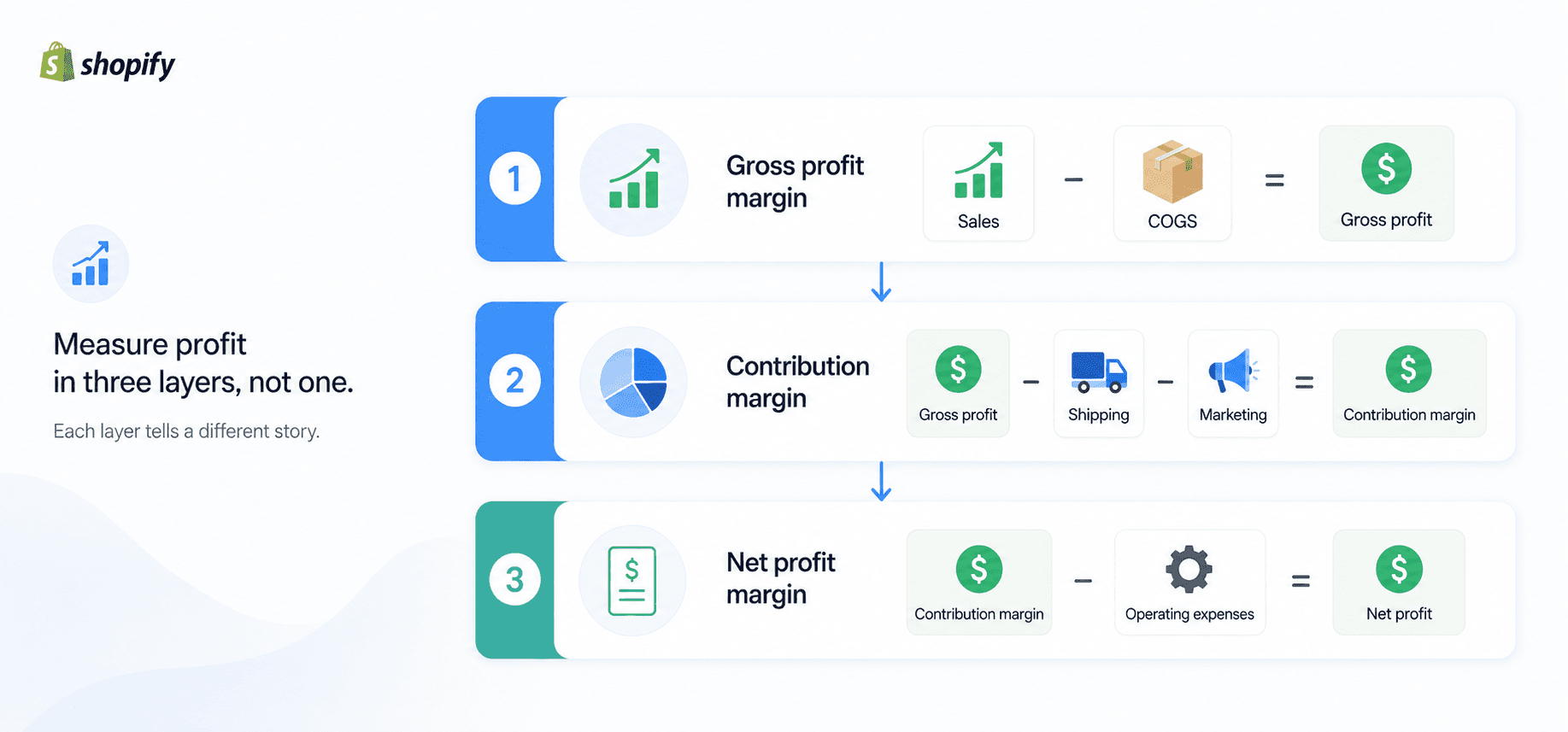
Measure profit in three layers, not one. Each tells a different story about the same store, and the one on your dashboard is usually the least honest.
Gross margin is what's left after the product cost. Contribution margin is what's left after shipping and ads. Net margin is what stays after everything, including fixed costs. A store can post a strong gross margin and still lose money at the net line, when shipping and ads eat the gap to contribution and operating costs eat the rest.
Shopify Gross Profit Margin
What's left after the product cost. Use net revenue (after discounts and refunds) and full landed cost (product, inbound shipping, duties, packaging).
Gross Margin = (Net Revenue − COGS) / Net Revenue × 100
A store at $100K revenue and $35K product cost runs a 65 percent gross margin. But this number hasn't paid for one ad or one shipping label. It's the ceiling, not the floor.
Contribution Margin
What's left after shipping, fulfillment, and ad spend. This is where most stores quietly win or lose, because it shows whether each sale makes money before fixed costs.
Contribution Margin = Gross Profit − Shipping & Fulfillment − (Ad Spend + Marketing)
Use real carrier cost per order, not a flat estimate, because shipping swings with weight, zone, and carrier. Count agency fees and tools, not just platform spend.
Shopify Net Profit Margin
What actually stays after everything, including rent, payroll, and software.
Net Margin = (Contribution Margin − Operating Expenses) / Net Revenue × 100
One worked example ties it together. A store doing $300K/month at 65 percent gross has $195K gross profit. Subtract $36K fulfillment and $90K ad spend: contribution is $69K, or 23 percent. Subtract $40K operating costs: net is $29K, about 10 percent.
Same store, three numbers: 65 percent gross, 23 percent contribution, 10 percent net. All true. Only the last one pays you. Run it monthly, and start early.

What to do Once You Know Your Numbers
Your three margins don't just tell you where you stand. The size of the drop between each layer tells you exactly what to fix. Find the biggest fall, and that's your problem.
Big drop from revenue to gross margin? Your unit economics are off at the source. The product costs too much to make or buy relative to what you charge. Fix it by renegotiating supplier cost, raising price, or improving landed cost through bulk freight or better duties handling. If none of those move, the product itself may not be viable at your price point.
Big drop from gross to contribution margin? Shipping and ad spend are eating the sale. This is the most common squeeze for scaling stores. Fix the economics before you fix the spend: raise average order value so each order absorbs its shipping cost, tighten acquisition so you're not overpaying for customers, and check whether specific products lose money after ad spend even when they look like winners on revenue.
Big drop from contribution to net margin? Your operating costs are too heavy for your contribution to carry. This is the one case where cutting expenses is the right first move, not the fallback. Software you don't use, an agency retainer that isn't earning out, headcount ahead of revenue.
The order matters. Fixing unit economics raises your ceiling; cutting costs only raises your floor. You can cut expenses to zero and still have a business that doesn't make money on each sale. So work on economics first. Cut costs when the economics genuinely can't move, or when operating expenses are clearly the layer bleeding you.
Frequently Asked Questions
What is a good net profit margin for a Shopify store?
For a physical-product store, 8 to 15 percent is healthy. Digital and subscription businesses run higher (15 to 40 percent) because per-unit cost is near zero. Dropshipping and print-on-demand run lower (3 to 10 percent) because ad spend takes more. Your target depends on your model.
Is gross profit margin the same as contribution margin?
No. Gross margin is what's left after the product cost only. Contribution margin goes further and subtracts shipping, fulfillment, and ad spend. A store can show a strong gross margin and a thin contribution margin when shipping and acquisition costs are high.
How often should I calculate my profit margins?
Monthly at minimum, contribution margin ideally weekly. Monthly catches structural problems, like a product that loses money after ad spend, before they compound. Weekly visibility helps scaling stores spot a campaign quietly draining cash while overall revenue still looks fine.
What profit margin do I need to break even on Shopify?
Break-even is where your contribution margin covers your fixed costs. There's no universal percentage. Total your monthly fixed costs, then find the revenue at your contribution margin that covers them. Above that line is profit, below it is a loss, no matter how strong your gross margin looks.
Try it on your own numbers
Once you calculate your margins, you'll see exactly where your good profit margin is slipping away and why you're running above or below the benchmark for your model.
The hard part isn't the math. The inputs live in five different places: Shopify for revenue and COGS, your carrier for shipping, Meta and Google for ad spend, Klaviyo for email, and a spreadsheet for operating costs. Pulling them together by hand every month is the reason most founders check gross margin and stop.
That's the gap Bloom closes. It pulls real COGS, shipping cost, ad spend, and operating expenses into a single profit view, so you see gross, contribution, and net margin for your store, by model, without rebuilding the spreadsheet every month.
Bloom is free to try on Shopify for 14 days, so you can watch your margins trend from day one. Also set your own profit benchmarks. If you'd rather see it with someone first, you can book a free consultation call.
Discover More