Marketing Efficiency Ratio (MER) is the total revenue your business earns in a period divided by everything you spent on marketing in that same period. It answers one blunt question: for every dollar you put into marketing, how many dollars came back?
Unlike ROAS, which measures the return on a single channel or campaign, MER is a blended, top-down metric. It looks at your whole marketing engine at once, which makes it harder to game and closer to what actually lands in your bank account.
How to Calculate MER
The formula is simple:
MER = Total Revenue ÷ Total Marketing Spend
The part most brands get wrong is the denominator. Many calculate MER using ad spend alone, but "marketing spend" is more than what you hand to Meta and Google. Salaries, design, agency retainers, tool subscriptions, and your organic efforts are all real marketing costs. Leaving them out inflates the number and hides how efficient you actually are.
Here is the same month calculated both ways for an example store:
Line item | Amount |
Total revenue | $80,000 |
Ad spend | $20,000 |
Design + marketing salaries | $15,000 |
Tool subscriptions | $600 |
Total marketing spend | $35,600 |
MER on total marketing spend: $80,000 ÷ $35,600 = 2.25
MER on ad spend only: $80,000 ÷ $20,000 = 4.0
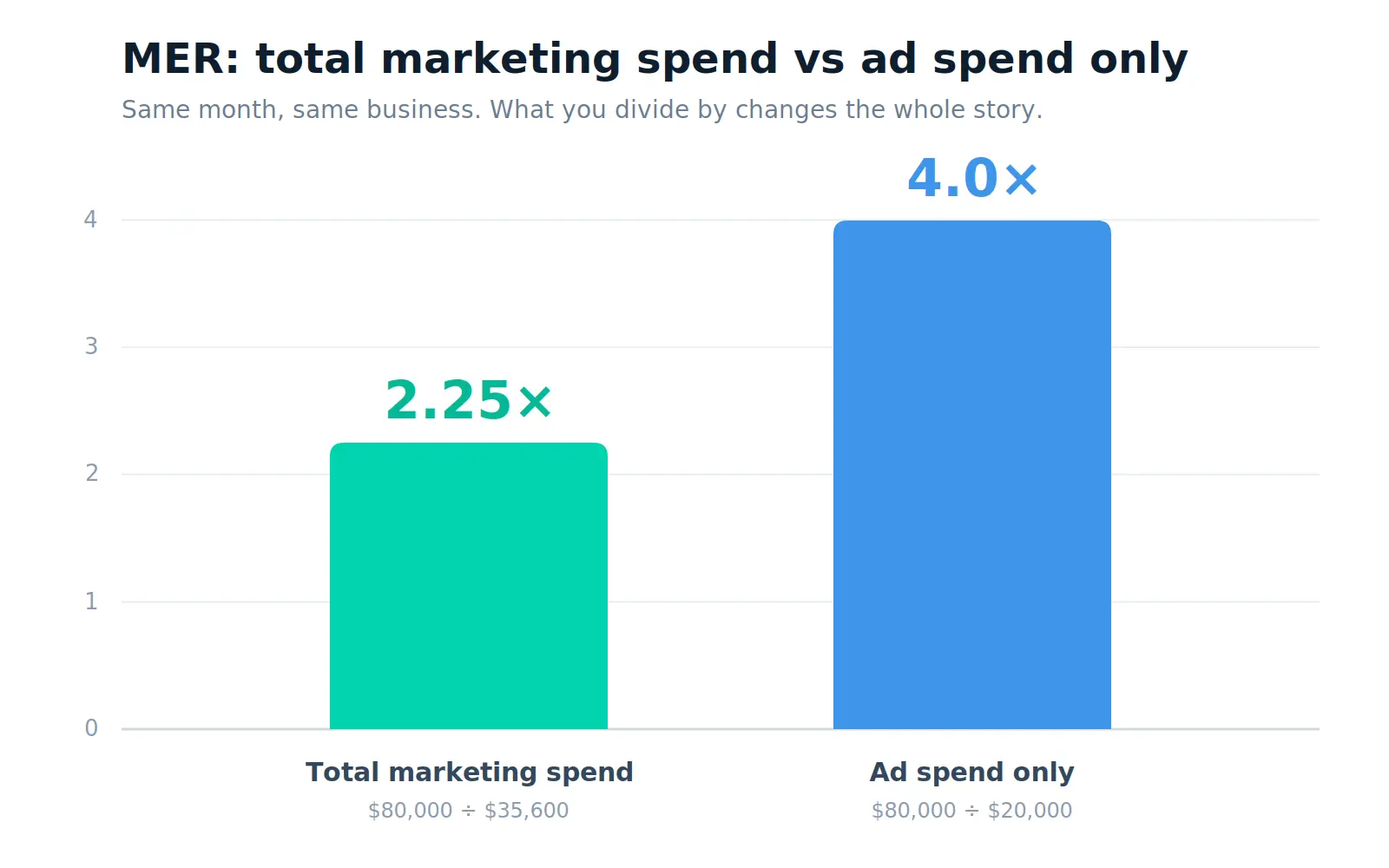
Same business, same month, and the number nearly doubles depending on what you count. The ad-spend version tells you you are earning 4x. The honest version tells you 2.25x. Decisions made on the first number are decisions made on a flattering illusion.
What Counts as a Good MER?
There is no universal "good" number, and anyone who quotes one without asking about your margins is guessing. A store selling high-margin digital products can thrive at a MER a low-margin retailer would go bankrupt on.
The real benchmark is your break-even MER, which you can calculate directly:
Break-even MER = 1 ÷ contribution margin %
If your contribution margin is 40%, your break-even MER is 1 ÷ 0.40 = 2.5. At the 2.25 MER above, that store is actually losing money on marketing, even though 2.25x "feels" profitable. Push contribution margin to 50% and break-even drops to 2.0, which flips the same month into profit.
So the question is not "is my MER above 3?" It is "is my MER comfortably above my break-even MER?" Anything below it means you are buying revenue at a loss. Anything well above it means you likely have room to spend more and grow.
The Bottom Line
MER is only useful when you feed it honest inputs: all your revenue over all your marketing spend, judged against your own margins. Calculated that way, it stops being a vanity metric and starts telling you whether your next marketing dollar is worth spending.
Frequently Asked Questions
Is MER the same as ROAS?
No. ROAS measures the return on a specific campaign or channel using attributed revenue, while MER measures total revenue against total marketing spend across everything. ROAS zooms in; MER zooms out. Most brands need both.
Should MER use ad spend or total marketing spend?
Total marketing spend. Ad spend alone ignores salaries, tools, agencies, and organic costs, which makes the ratio look better than reality and leads to over-optimistic budget decisions.
Discover More