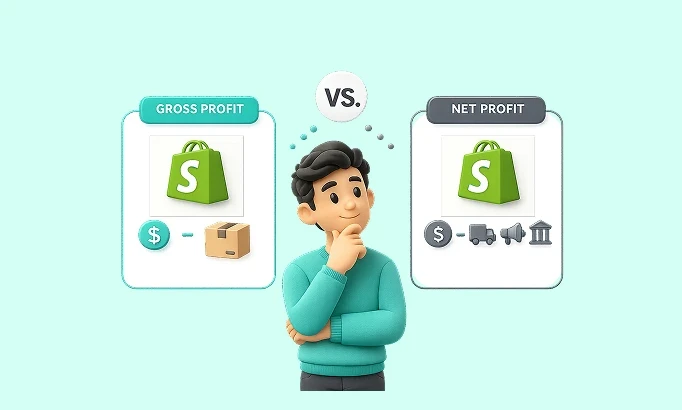


Running a Shopify store is not just about hitting sales targets. The real question is how much money you keep after every cost is paid. That is the gap between Shopify gross profit and Shopify net profit, and it is where a lot of stores get a nasty surprise.
A product can sell well and still leave almost nothing behind once you account for ads, shipping, transaction fees, and overhead. Revenue tells you how busy your store is. It does not tell you whether the store is healthy.
Gross profit and net profit answer two different questions. Gross profit tells you whether your products are priced right. Net profit tells you whether your business is actually making money. You need both, and most founders only watch one of them.
In short
Shopify gross profit is what's left after you subtract the cost of goods sold (COGS) from net sales. It measures product profitability.
Shopify net profit is what's left after you subtract every expense from revenue. It measures the health of the whole business.
Gross profit margin and net profit margin are the percentage versions of those two numbers.
Shopify's built-in reports show you a rough gross picture but miss most of the costs that decide your real net profit.
Gross Profit vs. Net Profit: A Quick Comparison
Here is the difference at a glance before we work through each one.
Gross profit | Net profit | |
What it measures | Profit after product cost | Profit after every cost |
Formula | Net sales − COGS | Total revenue − all expenses |
Costs included | Product cost, inbound freight, direct production/labor | COGS plus shipping, packaging, ad spend, marketing, transaction fees, refunds, taxes, operating expenses |
The question it answers | Are my products priced right? | Is my business actually making money? |
Margin version | Gross profit ÷ net sales × 100 | Net profit ÷ total revenue × 100 |
Gross profit looks at one decision: pricing versus product cost. Net profit looks at the whole machine. A store can have a strong gross profit and a terrible net profit at the same time, and that combination is what kills brands that look successful from the outside.
What is Shopify Gross Profit?
Shopify gross profit is the money left after you subtract the cost of goods sold (COGS) from your net sales. It covers what it costs to make or buy the product itself, including raw materials, direct labor, and the freight to get inventory into your warehouse. It does not include the costs of selling and running the business, like ads, fulfillment shipping, or rent.
The formula is simple:
Gross profit = Net sales − COGS
Let's use one product and carry it all the way through this post. Say you sell a jacket for $100.
Line | Amount |
Selling price (net revenue) | $100 |
Product cost + inbound freight (COGS) | $40 |
Gross profit | $60 |
Your gross profit on that jacket is $60. That tells you the product is priced well above what it costs to source. It says nothing yet about whether the sale made you money overall, because you haven't paid to acquire the customer or ship the order.
One thing to get right: COGS includes the freight to bring inventory in, but not the shipping to send the order out to the buyer. Outbound shipping is a selling cost, so it lands below gross profit, in net profit. Mixing those two up is one of the most common reasons a store's gross numbers look better than reality.
Gross Profit vs. Gross Profit Margin
These get used interchangeably, but they are two different things.
Gross profit is a dollar amount. For our jacket, that's $60.
Gross profit margin is the percentage of net sales you keep after COGS.
Gross profit margin = Gross profit ÷ net sales × 100
For the jacket: $60 ÷ $100 × 100 = 60%.
In contribution-margin terms, the dollar figure ($60) is your CM1 (contribution margin after product cost). The 60% is the percentage view of that same number. CM1 is the dollars; the margin is the percent. They describe the same layer, just in different units.
What's a Good Gross Profit Margin on Shopify?
It depends on your category, but the benchmarks give you a reference point. The average ecommerce gross margin sits around 45%, and a healthy target for most product brands lands in the 60 to 70% range. Apparel and accessories typically run 50 to 65%, while beauty and skincare can clear 80%.
A useful rule of thumb:
60% or higher: strong product-level pricing for most categories
Below 30%: a warning sign that pricing or sourcing needs a hard look
A healthy gross margin means your products carry enough cushion to absorb the selling and operating costs that come next. If gross margin is thin, every cost below it eats into a tiny base, and net profit collapses fast.
What is Shopify Net Profit?
Shopify net profit is the money you actually keep after subtracting every business expense from total revenue. Unlike gross profit, it accounts for the cost of selling and running the store: ad spend, fulfillment shipping, packaging, transaction fees, refunds, taxes, and operating overhead. This is the number that tells you whether the business is sustainable.
The formula:
Net profit = Total revenue − all expenses
Now let's take the same $100 jacket, with its $60 gross profit, and follow it all the way down.
Line | Amount | Running total |
Gross profit (from above) | $60 | $60 |
− Ad spend to acquire the order | $20 | $40 |
− Outbound shipping | $6 | $34 |
− Packaging | $2 | $32 |
− Transaction fee (~3%) | $3 | $29 |
− Refund/returns allowance | $4 | $25 |
− Operating overhead (software, labor, rent) | $15 | $10 |
Net profit | $10 |
That same jacket, which looked like a $60 winner at the gross level, leaves $10 once every cost is in. The product is healthy. The order is barely profitable. That is the gap nobody sees on the gross line.
This is also why two stores with identical revenue and identical gross margins can have wildly different net profits. The one with cheaper acquisition, lighter shipping, and tighter overhead keeps far more of every dollar.
Net profit vs. Net Profit Margin
Same distinction as before:
Net profit is the dollar amount kept: $10 on this order.
Net profit margin is that amount as a percentage of revenue.
Net profit margin = Net profit ÷ total revenue × 100
For the jacket: $10 ÷ $100 × 100 = 10%.
What's a Good Net Profit Margin on Shopify?
Lower than most founders expect, and that's the important part. The average ecommerce net profit margin sits near 10%, with one widely cited benchmark putting the average brand at 8.8%. The median DTC brand nets somewhere between 3 and 10% depending on scale, category, and channel mix. Top-performing brands reach 20 to 30%.
So the honest reference range looks like this:
20%+: top-tier, usually strong brand or pricing power
10 to 20%: healthy and sustainable
3 to 10%: common and workable, especially for ad-heavy or early-stage stores
Negative or stuck below break-even: the real danger zone
A single-digit net margin is not automatically a problem. Plenty of profitable, growing brands live there. The actual warning sign is a margin that is negative, or one that won't move no matter how much revenue you add, because that usually means a cost structure or acquisition problem rather than a sales problem.
Why Shopify's Own Profit Numbers Don't Tell the Whole Story
Here is the part that trips up most merchants. Shopify's reports give you a reasonable view of revenue and a rough gross picture, but they do not calculate your true net profit. Several real costs are either missing or not tracked accurately, so the number you see tends to look healthier than your bank balance.
The costs that usually slip through:
Ad spend. Meta, Google, and TikTok costs don't live in Shopify, so your spend isn't subtracted from your sales by default.
Real shipping and fulfillment. Actual carrier costs, fulfillment fees, and packaging often aren't loaded per order.
Payment processing. Card fees, currency conversion, and gateway charges quietly shave points off every sale.
Returns and refunds. Returned inventory, reverse shipping, and processing costs are easy to underestimate, and returns can consume 8 to 15 percentage points of margin in categories like apparel.
Operating overhead. Software, labor, and rent rarely make it into a per-order view at all.
Because these are missing, a store can look profitable on the surface while the real net margin is razor-thin or negative. The gap between reported and real margin is often 5 to 8 percentage points once returns, fees, and overhead are properly loaded.
This is exactly the view that Bloom, which pulls real COGS and ad spend into a single profit view, builds automatically from your Shopify data. Instead of stitching costs together in a spreadsheet, you see gross profit, net profit, and the layers in between for every order, product, and campaign. The point isn't more dashboards. It's seeing the $10 instead of the $60.
Why You Need both Numbers, Not One
Gross profit and net profit aren't competitors. They diagnose different problems, and watching only one leaves you blind to the other.
Gross profit tells you:
whether your pricing covers product cost
whether a SKU is worth keeping in the catalog
how efficient your sourcing and production are
Net profit tells you:
whether the business is actually making money
whether you can afford to scale ad spend
how sustainable the store is over the long run
Watch only gross profit and you'll happily scale a product that loses money after ads. Watch only net profit and you'll miss that a pricing or sourcing fix could rescue the whole line. The brands that survive track both, every week, on the same screen.

Frequently Asked Questions
How Do I Calculate Gross Profit On Shopify?
Subtract your cost of goods sold from your net sales. COGS covers the product cost itself plus inbound freight and any direct production or labor cost to get the item ready to sell. The formula is gross profit = net sales − COGS. It shows product-level profitability before any selling or operating costs are counted.
Does Shopify Show My Net Profit Automatically?
Not fully. Shopify reports revenue and a basic profit view, but they don't reliably pull in ad spend, real shipping costs, payment fees, refunds, or operating overhead. Because those costs are missing, the profit figure usually looks higher than your actual take-home. You need to load every cost to see a true net number.
Why is My Gross Profit High but My Net Profit Low?
Because the costs that separate the two, ad spend, fulfillment shipping, transaction fees, returns, and overhead, all land below the gross line. A product can carry a 60% gross margin and still net under 10% once you pay to acquire and ship the order. A high gross profit with a low net profit almost always points to acquisition cost or overhead, not pricing.
Is Gross Profit Margin the Same as Contribution Margin?
They overlap but aren't identical. Gross profit margin (CM1) is what's left after product cost. Contribution margin usually goes further, subtracting variable selling costs like shipping and ad spend (often called CM2) to show profit on each order before fixed overhead. Gross margin is the first layer; contribution margin keeps peeling back the costs.
What's a Realistic Net Profit Margin for a Shopify Store?
Around 10% is average for ecommerce, and many healthy DTC brands run between 3 and 10%, especially when ads drive most of their sales. Anything above 20% is strong. A single-digit margin isn't a crisis on its own. A negative margin, or one that won't improve as revenue grows, is the real signal something's wrong.
Discover More