Shopify Profit and Loss Analysis to Fix Margin Leaks
A step-by-step Shopify profit and loss analysis to collect your cost line items, read margins at each tier, and pinpoint exactly where your store is leaking profit.
A profit and loss (P&L) analysis for Shopify businesses must track every dollar from total sales down to net profit, layering in costs and expenses at each stage so you can see exactly where your margins erode. Without one, most store owners know they are making revenue but cannot pinpoint why so little of it survives as actual profit.
The process is straightforward: collect five categories of line items, stack them in order, and read the margin that remains after each layer. Here is how to build yours and use it to find the leaks.
Collect Your Line Items
Before you can analyze anything, you need accurate numbers in five buckets.
Total Sales is your net order revenue, gross sales minus returns and refunds. This is the starting line, not the finish.
Discounts and Refunds sit right below total sales. Every slashed price, coupon code, and refunded order chips away at what looked like healthy revenue. If you are running aggressive promotions, this layer alone can knock 10–20% off your top line before a single cost is deducted.
Cost of Goods Sold (COGS) covers everything involved in getting a finished product onto your store. For a manufacturer that means raw materials, production, and labor. For a dropshipper it might be supplier invoices and freight. For a reseller, wholesale cost plus inbound shipping. Including inventory storage and handling these are easy to overlook and they compound fast.
Shipping, Fulfillment, and Transaction Fees go beyond outbound delivery. Return shipping costs are one of the most common blind spots in ecommerce P&L statements. Layer in tariff costs if you import, and payment processing fees from Shopify Payments or your gateway.
Marketing Spend means all of it, not just Meta, Google, and TikTok ad spend but also agency retainers, freelancer fees, influencer deals, and any tools you pay for to run campaigns.
Operational Expenses are the final layer: rent, salaries, software subscriptions, interest, taxes collected, and every other recurring or one-time cost of running the business. This bucket tends to have the most line items and the most surprises.
Read the Margins to Find the Leaks
With your line items stacked, the P&L becomes a diagnostic tool. Each subtotal tells you something specific.
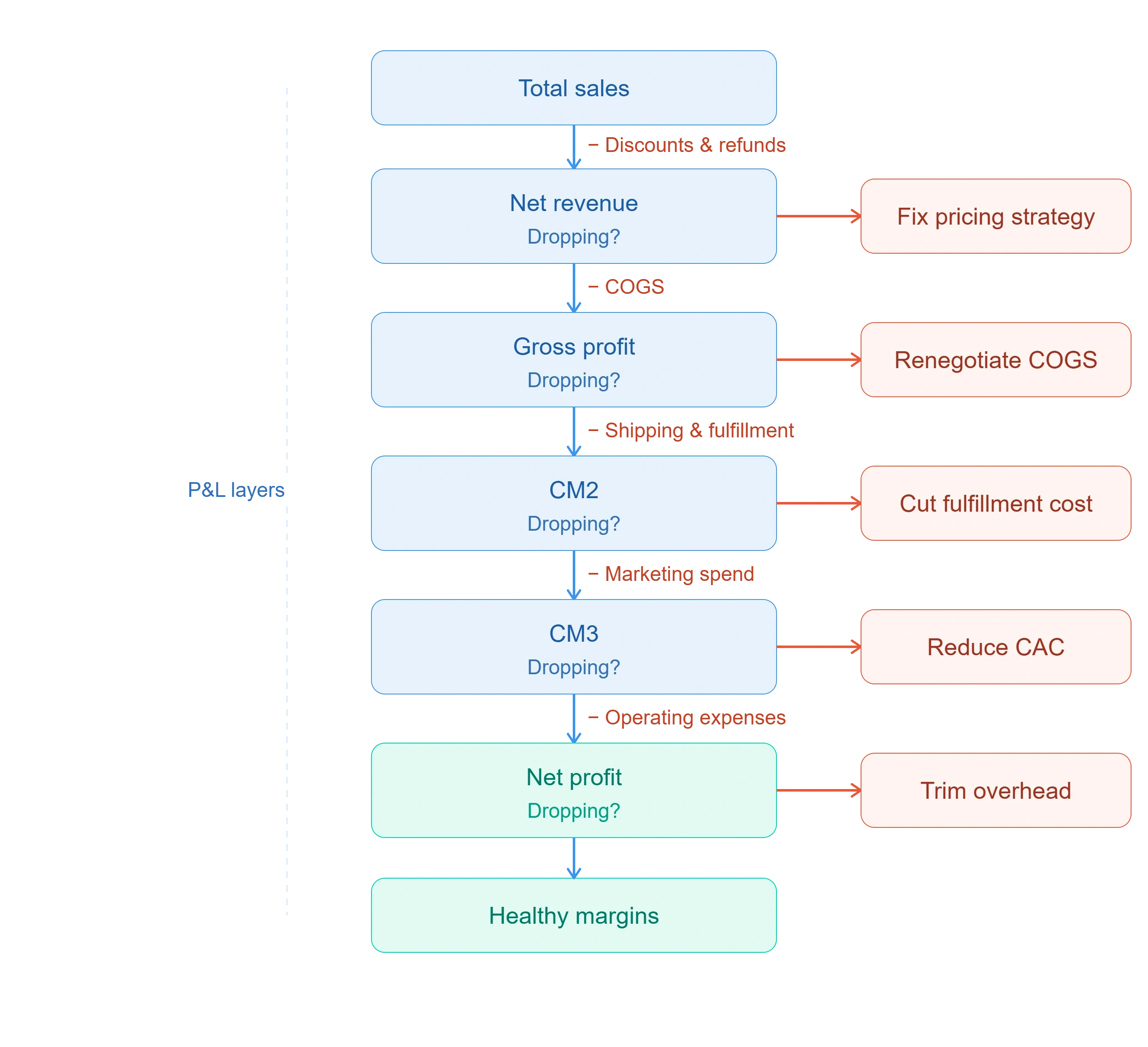
Net Revenue (total sales minus discounts and refunds) reveals whether your pricing and promotion strategy is sustainable. A declining net revenue trend means discounts or refunds are outpacing sales growth.
Gross Profit (net revenue minus COGS) isolates product-level economics. If gross profit is healthy, your sourcing and pricing are sound, the problem lives further down.
Contribution Margin 2 (CM2) subtracts shipping and fulfillment costs from gross profit. A sharp drop here means fulfillment is eating your margins, and you need to renegotiate carrier rates, reduce return shipping exposure, or revisit your free-shipping threshold.
Contribution Margin 3 (CM3) removes marketing spend. If CM2 is solid but CM3 craters, your customer acquisition cost is the leak, you are spending more to acquire customers than the margin they generate.
Net Profit is what remains after operational expenses. If CM3 is reasonable but net profit is thin, the overhead of running your business is the problem, not your unit economics.
The margin distribution across these layers varies by product, category, and business model. The point of a Shopify profit and loss analysis is not to hit a universal benchmark, it is to see your own distribution clearly enough to know which layer to fix first.
FAQ
What is the difference between gross profit and contribution margin on Shopify?
Gross profit subtracts only COGS from net revenue, showing product-level profitability. Contribution Margin layers in additional variable costs fulfillment at CM2, marketing at CM3 giving you a more complete picture of what each sale actually earns after the costs required to make and deliver it.
How often should I run a profit and loss analysis for my Shopify store?
At minimum, monthly. Costs shift and ad CPMs fluctuate, carrier rates change, suppliers adjust pricing. A monthly cadence catches margin leaks before they compound into a quarterly surprise. Stores running heavy promotions or scaling ad spend benefit from weekly check-ins on the lines that move fastest.
Know Your Real Profit And
The Ads That Actually Sell.
No need to spend. Just try it on your store.