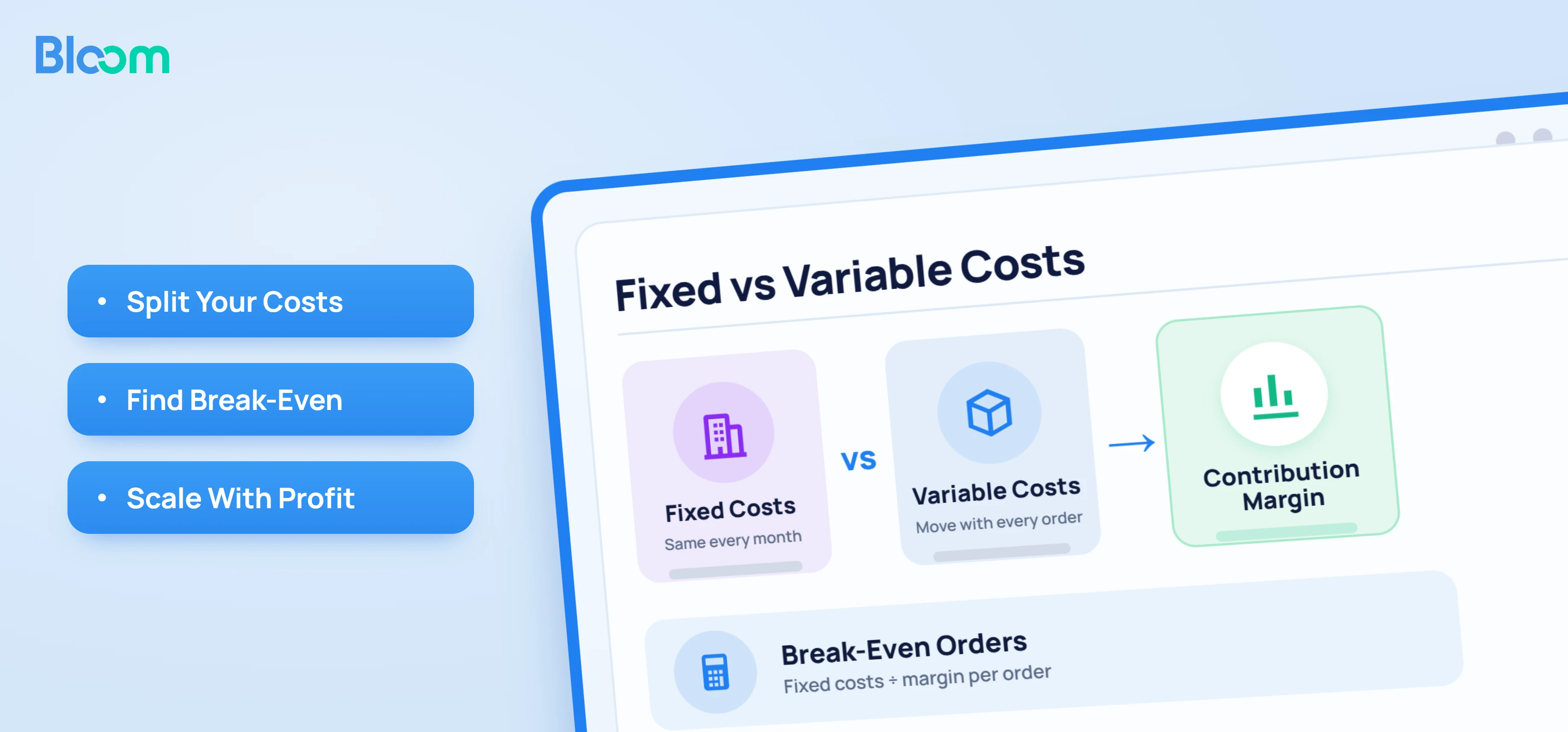



Fixed and variable costs in ecommerce are the two kinds of spend every store carries. Fixed costs stay roughly the same each month whether you ship 10 orders or 10,000: your Shopify plan, salaries, flat-fee apps. Variable costs move with every order: product cost, shipping, payment fees and, for most brands, ad spend.
The split matters because each type answers a different question. Variable costs tell you how much profit one order actually leaves you. Fixed costs tell you how many of those orders you need before the month turns a profit. Get the split wrong and you can double revenue while your profit shrinks.
This guide covers what goes in each bucket, where the grey-area costs land, and how to use the split to make scaling decisions.
Fixed vs variable costs at a glance
Fixed costs | Variable costs | |
How they behave | Stay flat as order volume changes | Rise and fall with every order or unit |
Ecommerce examples | Shopify plan, salaries, rent, flat-fee apps | Product cost, shipping, payment fees, ad spend |
What they decide | How many orders you need to break even | How much profit each order leaves you |
Where they hit | Below Contribution Margin, on the way to net profit | Product Gross Profit, Gross Profit and Contribution Margin |
How to cut them | Renegotiate or remove overheads | Raise price, lower unit cost, improve ad efficiency |
What are fixed costs in ecommerce?
Fixed costs are the overheads you pay even in a month with zero sales. If your store shipped nothing in March, these bills would still arrive.
Common fixed costs for a Shopify store:
Platform and software: your Shopify plan subscription, apps billed at a flat monthly rate, your theme licence, domain, and email or helpdesk tools on fixed tiers.
People: salaries, contractor retainers and agency fees paid monthly regardless of output.
Premises: rent for an office, studio or warehouse you lease yourself, plus utilities and insurance.
Professional services: accounting, bookkeeping and legal retainers.
"Fixed" means fixed within a range, not forever. A store that grows from 1,000 to 10,000 orders a month will eventually hire more people and move to a bigger plan. These are called step costs: flat for a while, then a jump. Treat them as fixed for monthly planning and revisit them when you set growth targets.
What are variable costs in ecommerce?
Variable costs are the costs attached to each order or unit you sell. Sell twice as many and these roughly double. They are the reason a $60 order is never $60 of profit.
The main variable costs for a Shopify store:
Product cost (COGS): what you pay to make or buy each unit, including inbound freight and import duties spread across units.
Fulfillment: pick and pack fees, packaging, outbound shipping labels and per-order 3PL charges.
Payment and transaction fees: gateway processing fees, Shopify's additional transaction fee if you use a third-party gateway, and buy now, pay later fees.
Marketing and ad spend: Meta, Google and TikTok spend, plus affiliate and influencer commissions paid per sale.
Order-level losses: discounts, returns, refunds and chargebacks.
Usage-based apps: any app that bills per order or by revenue tier.
In the worked example later in this guide, variable costs take 75% of every $60 order before a single fixed cost is paid. That is why variable costs, not overheads, usually decide whether a store is profitable.
Where do shipping, payment fees and ad spend fall?
Shipping, payment fees and ad spend are all variable costs, but each one hits a different profit layer, and a few have fixed parts hiding inside them.
Cost | Fixed or variable | Profit layer it reduces | Watch out for |
Inbound freight and duties | Variable | Product Gross Profit (part of landed COGS) | Leaving it out makes product margins look better than they are |
Outbound shipping to customers | Variable | Gross Profit | Shipping you charge customers is revenue; free shipping puts the full label cost on you |
3PL fees | Mixed | Gross Profit (per-order part) | Monthly minimums and storage fees are fixed; pick, pack and postage are variable |
Payment processing fees | Variable | Gross Profit | The flat per-transaction part is still variable, because you pay it once per order |
Shopify's extra transaction fee | Variable | Gross Profit | Only applies with a third-party gateway; the rate depends on your plan |
Refunds and chargebacks | Variable | Gross Profit | Processing fees are often not returned on refunds |
Ad spend | Variable | Contribution Margin | It is discretionary, but it scales with growth, so treat it as variable |
Flat-fee apps and gateway subscriptions | Fixed | Net profit | Per-order or revenue-tier apps are variable instead |
The common thread: if a cost would disappear in a month with zero orders, it is variable. If you would still pay it, it is fixed.
How fixed and variable costs map to the profit layers
Variable costs are removed first, layer by layer, to reach Contribution Margin. Fixed costs come off last, turning Contribution Margin into net profit.
Revenue: what customers paid, including any shipping they were charged.
Product Gross Profit: revenue minus product costs (COGS).
Gross Profit: Product Gross Profit minus fulfillment, shipping and payment fees.
Contribution Margin: Gross Profit minus marketing and ad spend. This is what each order contributes toward your overheads.
Net profit: Contribution Margin minus fixed costs.
Contribution Margin is the line that connects the two cost types. It is everything left after variable costs, and it is the pool that has to cover your fixed costs before you keep anything.
Why the fixed and variable cost split matters
Separating the two lets you answer the three questions every scaling decision depends on.
How many orders do you need to break even?
Divide your monthly fixed costs by your Contribution Margin per order. A store with $10,000 in fixed costs and $15 of Contribution Margin per order needs about 667 orders a month to break even. Every order after that adds $15 to net profit.
Break-even orders = Monthly fixed costs ÷ Contribution Margin per order
Will more revenue actually mean more profit?
Only if Contribution Margin per order stays positive as you grow. Scaling spreads fixed costs over more orders, which helps. But if ad costs per order rise faster than that benefit, each extra order earns less, and growth can push you into a loss.
Which lever should you pull?
Thin Contribution Margin is a variable cost problem: fix price, product cost, shipping or ad efficiency. Healthy Contribution Margin with a net loss is a volume or overhead problem: grow orders or trim fixed costs. Treating one as the other wastes months.
Worked example: fixed and variable costs for one Shopify store
Here is an illustrative month for a store selling 1,000 orders at a $60 average order value, with free shipping and $10,000 in fixed costs.
Line | Per order | Month (1,000 orders) |
Revenue | $60.00 | $60,000 |
Product cost (COGS) | -$18.00 | -$18,000 |
Product Gross Profit | $42.00 (70%) | $42,000 |
Pick, pack and packaging | -$3.00 | -$3,000 |
Outbound shipping | -$7.00 | -$7,000 |
Payment fees (2.9% + $0.30) | -$2.04 | -$2,040 |
Gross Profit | $29.96 (49.9%) | $29,960 |
Ad spend ($15 cost per order) | -$15.00 | -$15,000 |
Contribution Margin | $14.96 (24.9%) | $14,960 |
Fixed costs (plan and apps $600, salaries $8,000, other $1,400) | -$10,000 | |
Net profit | $4,960 (8.3%) |
Variable costs take $45.04 of every $60 order. Break-even sits at 669 orders, so only the last 331 orders of the month produce net profit.
What happens when this store doubles revenue?
Say the store pushes to 2,000 orders and $120,000 in revenue, with fixed costs unchanged.
If ad cost per order holds at $15: Contribution Margin doubles to $29,920 and net profit rises to $19,920. Fixed costs spread over twice the orders, so profit grows four times.
If ad cost per order climbs to $25 to buy that extra volume: Contribution Margin per order drops to $4.96. The month brings in $9,920 of Contribution Margin against $10,000 of fixed costs, an $80 loss on double the revenue.
Same revenue, opposite outcomes. The difference sits entirely in one variable cost line, which is why tracking costs per order matters more than tracking revenue.
Why Shopify's gross profit report misses most variable costs
Shopify's native gross profit report subtracts only the cost per item you enter on each product. It leaves out outbound shipping, packaging, payment fees, ad spend and refunds, and it has no place for fixed costs.
In the worked example above, that report would show $42,000 of profit, the Product Gross Profit line. The store actually kept $4,960. The gap is every variable and fixed cost the report never sees.
Bloom Analytics breaks each order into Product Gross Profit, Gross Profit and Contribution Margin, then lets you add your fixed costs to see true net profit by product, order, country and campaign. Install Bloom free on the Shopify App Store to see what your store actually kept last month.
Frequently asked questions
Is shipping a fixed or variable cost in ecommerce?
Shipping is a variable cost because you pay it on every order. Outbound shipping to customers reduces Gross Profit, while inbound freight from suppliers belongs in product cost. Any shipping fee you charge customers counts as revenue and offsets part of the cost.
Is ad spend a fixed or variable cost?
Ad spend is usually treated as a variable cost because it scales with the orders you are trying to win. It is subtracted after Gross Profit to reach Contribution Margin. A fixed agency retainer for running ads, by contrast, is a fixed cost.
Are Shopify fees fixed or variable?
Both. Your monthly Shopify plan is a fixed cost. Payment processing fees and Shopify's additional transaction fee are variable, because they are charged on each order.
What is the difference between Contribution Margin and gross profit?
Gross Profit is revenue minus product costs, fulfillment, shipping and payment fees. Contribution Margin goes one step further and also subtracts marketing and ad spend. Contribution Margin shows what each order contributes toward fixed costs and net profit.
How do I calculate my break-even point using fixed and variable costs?
Divide your monthly fixed costs by your Contribution Margin per order. With $10,000 in fixed costs and $14.96 of Contribution Margin per order, you need 669 orders a month to break even.
Discover More